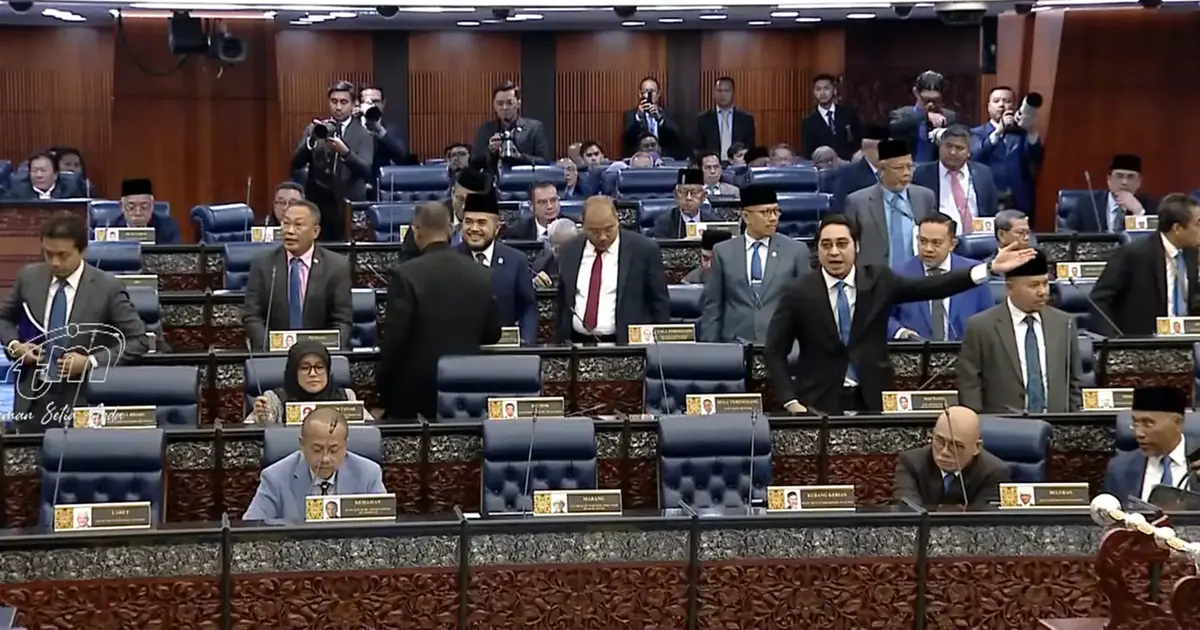
Communications Minister Fahmi Fadzil has publicly commended Bersatu Members of Parliament for their active participation in the ongoing Tabung Haji Royal Commission of Inquiry sittings, marking a notable moment of intra-coalition friction within the opposition alliance. The minister's remarks underscore deepening ideological and strategic divisions within Perikatan Nasional, the opposition bloc that has sought to present itself as a unified political force but increasingly demonstrates internal fractures when confronting governance accountability mechanisms.
Fahmi's acknowledgment of Bersatu's attendance carries significant political weight, particularly given the simultaneous absence of other Perikatan Nasional parliamentarians who opted to boycott the proceedings. This divergence in approach reflects broader tensions within the opposition coalition regarding how best to respond to inquiries into the management and performance of Tabung Haji, the Islamic pilgrimage savings institution that handles hajj savings for millions of Malaysians. The Royal Commission of Inquiry itself represents a formal governmental mechanism to examine governance issues, financial management, and operational challenges that have attracted public scrutiny and concern among pilgrims and depositors.
The Tabung Haji scandal has become increasingly prominent in Malaysian political discourse, with questions about institutional transparency, fund management practices, and accountability resonating beyond party lines. For ordinary Malaysians, particularly the substantial portion of the population who entrust their hajj savings to the institution, the integrity and oversight of Tabung Haji operations represent matters of genuine personal consequence. The Royal Commission's work therefore touches directly on issues of public trust and financial security for a significant demographic constituency.
Bersatu's decision to engage constructively with the RCI process rather than retreat into oppositional posturing demonstrates a pragmatic approach to parliamentary accountability. While the Perikatan Nasional coalition has frequently presented itself as an alternative to the ruling coalition, selective engagement with investigative mechanisms risks appearing evasive or dismissive of public concerns about governmental institutions. Bersatu's participation suggests that within the opposition alliance, differing perspectives exist regarding the appropriate balance between party solidarity and genuine engagement with accountability frameworks.
The walkout by other Perikatan Nasional members raises fundamental questions about the coalition's internal discipline and strategic coherence. Opposition coalitions are inherently more fragile than ruling coalitions, as they lack the binding force of ministerial appointments and patronage networks. When component parties pursue divergent strategies on high-profile issues, it exposes the coalition's underlying structural weaknesses and raises questions about whether such alliances can effectively govern should they return to power. The Tabung Haji RCI thus becomes a litmus test for how opposition formations respond to institutional accountability rather than mere partisan advantage.
From a governance perspective, the Royal Commission of Inquiry into Tabung Haji represents exactly the type of institutional mechanism that should function independently of party political calculations. When opposition members strategically boycott such proceedings, they effectively prioritise short-term political positioning over legitimate public interest in understanding institutional failures or mismanagement. The Bersatu MPs who chose to participate arguably recognised that their constituents, regardless of party affiliation, have legitimate interests in how hajj savings are managed and protected.
The contrast between Bersatu and other Perikatan Nasional members also reflects different calculations about political sustainability and voter expectations. In the contemporary Malaysian political environment, where institutional credibility and governmental effectiveness increasingly matter to voters, parties that appear to obstruct transparency mechanisms risk reputational damage. Bersatu's willingness to engage with the RCI may reflect awareness that younger, more educated voters and urban constituencies increasingly penalise parties perceived as evasive on matters of public accountability.
Fahmi's public commendation of Bersatu serves another strategic purpose for the government coalition, as it highlights fractures within opposition ranks while simultaneously validating the RCI process itself. By praising one opposition component while noting the absence of others, the minister reinforces the legitimacy of the inquiry without appearing overtly partisan. This rhetorical positioning allows the government to present itself as committed to accountability while suggesting that opposition obstruction reflects narrow partisan interests rather than principled governance concerns.
The Tabung Haji issue carries particular resonance in Malaysian society because it directly affects ordinary citizens' ability to fulfill Islamic obligations. Unlike more abstract policy debates, questions about hajj savings management engage deeply held religious and cultural values. When politicians weaponise such institutional matters for partisan advantage, they risk alienating voters who view the issue primarily through the lens of personal financial security and religious devotion rather than factional politics.
Looking forward, the divergent responses to the RCI among opposition parties will likely become increasingly salient in Malaysian political calculations. Voters and civil society observers are increasingly sophisticated in distinguishing between genuine accountability mechanisms and partisan theatre. Parties that engage constructively with investigations into institutional performance may ultimately benefit from enhanced credibility, while those perceived as obstructionist risk being associated with evasiveness and lack of transparency.
The situation also illustrates broader challenges facing all Malaysian political coalitions, whether in government or opposition. As institutional accountability and good governance increasingly dominate public discourse, pressure mounts on all political formations to demonstrate genuine commitment to transparency rather than using accountability mechanisms as convenient targets for oppositional criticism. Bersatu's approach to the Tabung Haji RCI suggests that some opposition elements recognise this shifting political terrain and are adjusting their strategies accordingly.

