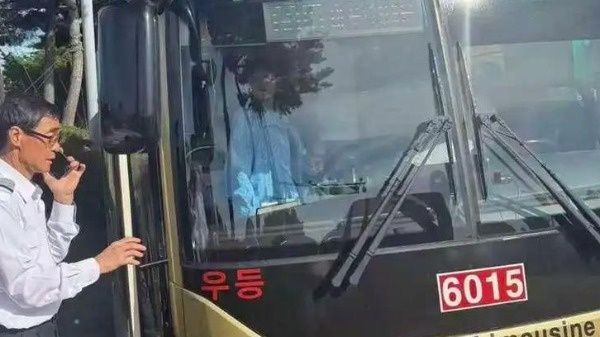
A group of Chinese visitors became unlikely heroes on a Seoul highway last Saturday when they responded swiftly to a life-threatening emergency aboard an airport shuttle bus. The incident, which unfolded in minutes on the No 6015 service heading toward Incheon International Airport, showcased the kind of collective action that can mean the difference between tragedy and salvation in a crisis. The women's calm and decisive intervention has since drawn widespread admiration across both Chinese and South Korean social media, reminding observers that courage and quick thinking can emerge from ordinary people in extraordinary circumstances.
The emergency began in the afternoon when the bus driver, operating a vehicle carrying more than a dozen passengers predominantly comprising Chinese tourists, suddenly lost consciousness. The immediate consequence was a vehicle veering dangerously across lanes, scraping against roadside barriers as it struggled without guidance. Sun Qian, a health sector professional from Nanjing visiting Seoul to study local medical programmes, was seated directly behind the driver. She recognised the severity of the moment instantly and did not hesitate to act, lunging forward to grab the steering wheel and attempt to stabilise the massive vehicle as it threatened to become a projectile on a busy thoroughfare.
Sun's intervention alone might have sufficed to prevent an immediate crash, but the true effectiveness of the rescue lay in the coordinated response of multiple passengers working simultaneously toward a single objective. While Sun battled to control the unwieldy steering mechanism of the coach, another passenger rushed to locate and engage the braking systems. The combination of steering control and emergency braking brought the vehicle under control within seconds—a narrow window of opportunity that could easily have closed with fatal consequences. Sun, who works in healthcare in China, later reflected on her own nervousness while gripping an unfamiliar steering wheel far larger than those she had experience with, yet her professional background may have instilled the composure necessary to execute such actions.
Sun's friend Du He, also from Nanjing and aged 33, positioned herself at another critical juncture in the emergency response. Observing the driver's condition more closely, Du applied traditional first-aid techniques, attempting to stimulate consciousness through pressure on the philtrum. However, she quickly recognised that the situation had moved beyond such interventions. The driver's colouration was changing to purple, and his breathing had ceased—clear indicators of cardiac arrest. Du's rapid assessment shifted her focus from revival to resuscitation, and she rallied other passengers to begin performing cardiopulmonary resuscitation in a desperate effort to maintain the driver's circulation and oxygenation.
The coordinated medical response that followed demonstrated how crisis situations can strip away hesitation and transform ordinary people into emergency responders. Sun, whose fluency in Korean added another crucial dimension to their collective efforts, used the driver's own mobile telephone to contact emergency services in the local language, ensuring that professional help would arrive with minimal delay caused by communication barriers. Meanwhile, other passengers took turns applying chest compressions, attempting to keep blood flowing to the driver's vital organs. These efforts, sustained over critical minutes, represented the last chance to prevent the irreversible cellular damage that cardiac arrest inflicts on the brain and heart.
Despite the passengers' best efforts and the subsequent arrival of professional emergency medical personnel, the outcome could not be altered. The bus driver was transported to hospital in cardiac arrest but could not be revived despite approximately two hours of intensive treatment by medical staff. South Korean police subsequently launched an investigation to determine the precise medical cause of the collapse, though initial assessments suggested the possibility of a heart attack. The tragedy underscores a sobering reality: even perfectly executed emergency response cannot always overcome the biological limits of what medicine can achieve.
Yet the near-catastrophe could have produced a far worse outcome had the passengers remained passive. Du reflected on the fortunate timing and circumstances that prevented secondary accidents. The highway carried relatively light traffic at that particular moment, meaning the out-of-control bus did not collide with other vehicles that could have multiplied casualties exponentially. Had the incident occurred during peak travel hours or in congested urban areas, the consequences would almost certainly have been devastating. The passengers, having accomplished what they could in an impossible situation, calmly signalled another bus to transport them onward to their airport destination, demonstrating a psychological resilience that emerged only after the acute crisis had passed.
The delayed emotional impact of the experience became apparent to both women only after the immediate danger had dissipated. Du described the sense of terror that descended upon her after reaching the airport, the adrenaline wearing off and the full weight of what might have occurred crushing down upon her consciousness. She reflected that in the moment of crisis, survival instinct had overridden fear, but retrospective contemplation brought the shock of how narrowly disaster had been averted. Sun similarly described the experience as dreamlike, surreal enough that it resembled television drama rather than genuine events unfolding around her. The psychological aftermath of such experiences often exceeds the stress of the crisis itself.
When pressed about the substantial recognition they received across digital platforms in both countries, both women displayed remarkable humility and an unwillingness to position themselves as exceptional. Du emphasised that her actions represented not heroism but simply human instinct—behaviour that any capable person would have demonstrated in identical circumstances. She highlighted the cultural dimension of collective responsibility and mutual aid within Chinese communities, suggesting that such cooperation reflects broader values rather than individual exceptional character. Sun stressed the team-based nature of the rescue, refusing to accept individual credit and pointing instead to the coordinated efforts of multiple passengers who each contributed essential elements to preventing catastrophe.
The incident has resonated deeply across both societies, though for somewhat different reasons. South Korean observers noted the linguistic and cultural barriers that the Chinese passengers overcame while maintaining their composure—responding effectively to an emergency despite being foreigners in an unfamiliar country facing language obstacles and cultural differences. Chinese social media users praised the women's actions as exemplifying values of unity and mutual support. The story transcended typical news cycles precisely because it demonstrated human decency and collective action in an age when such narratives stand out against prevailing cynicism.
For Malaysian and Southeast Asian readers, the incident carries particular resonance given the region's significant cross-border tourism flows and the shared reliance on transportation infrastructure connecting major population centres. The incident highlights both the vulnerability of public transport systems to sudden medical emergencies and the potential for coordinated passenger response to mitigate worst-case scenarios. It also demonstrates how cultural values emphasising collective responsibility and rapid mutual aid can translate into tangible life-saving action when ordinary citizens face extraordinary circumstances.

