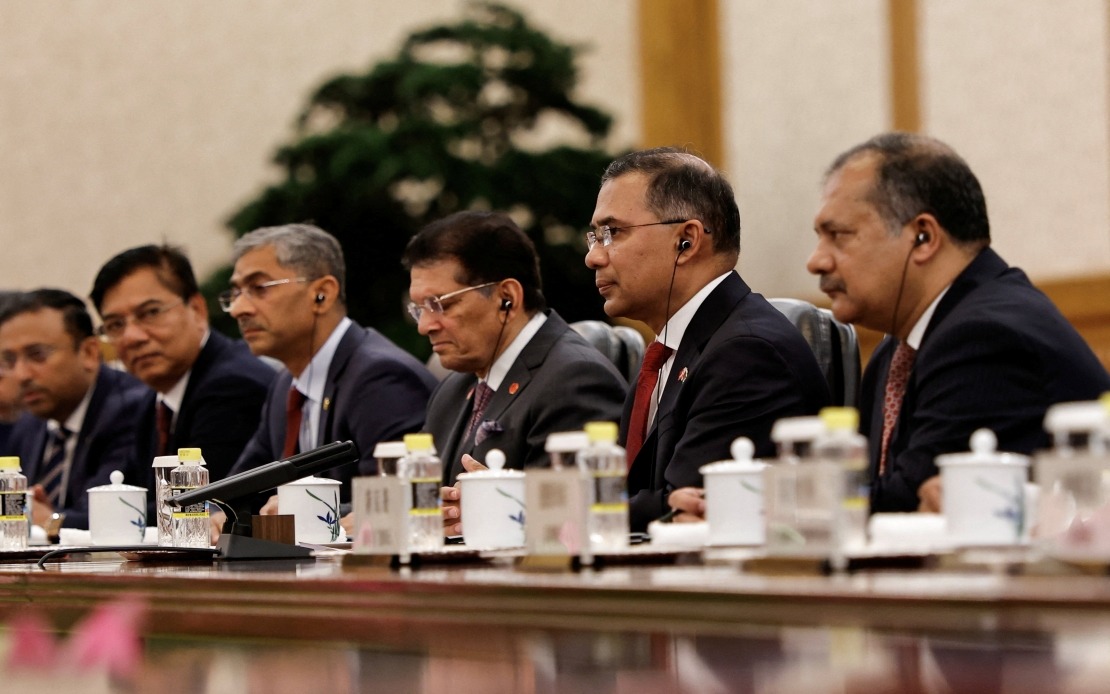
Bangladesh has secured substantial commitments from Chinese investors across multiple strategic sectors, with twelve companies pledging a combined US$9.2 billion in fresh capital following Prime Minister Tarique Rahman's four-day visit to China from June 22 to 26. The proposed investments mark a significant deepening of economic ties between the two countries and signal renewed confidence in Bangladesh's development trajectory among major Chinese conglomerates actively expanding their regional footprint.
The breadth of sectoral involvement reveals a coordinated strategy to address Bangladesh's critical infrastructure and manufacturing deficiencies. Projects span energy generation and exploration, port development and logistics, waste management and environmental technology, textile manufacturing, and digital infrastructure. This diversification across complementary sectors suggests the investments have been structured to create integrated economic ecosystems rather than isolated ventures, potentially amplifying their cumulative impact on employment and productivity. Bangladesh Commerce Minister Khandakar Abdul Muktadir underscored that these flows would help narrow the country's persistent trade deficit with China, a concern that has grown as Beijing has become Dhaka's largest import source.
The centrepiece of the investment portfolio is Sichuan Road and Bridge Group's US$4.5 billion commitment to upgrade the crucial Dhaka-Chattogram highway through a public-private partnership model. This corridor represents Bangladesh's most vital commercial artery, connecting the capital to the principal port city. Modernisation of this route carries implications far beyond bilateral trade, affecting regional logistics networks across South Asia and potentially enhancing Bangladesh's role as a transit hub for goods moving through the subcontinent.
Port infrastructure features prominently in the investment slate, reflecting China's broader strategic interests in maritime connectivity and trade facilitation. China Civil Engineering Construction Corporation (CCECC) has earmarked US$650 million specifically for developing and operating the Mongla Port Economic Zone, encompassing warehousing and logistics capabilities that would position this secondary port as a genuine alternative to the congested Chattogram Port. Additionally, the two governments have agreed to establish a Chinese industrial park in Chattogram itself, creating an anchor facility for manufacturing and assembly operations.
Environmental technology and waste management present another significant investment vector. Shanghai SUS Environment Company plans to commit US$890 million toward constructing waste-to-energy plants, addressing a critical urban challenge in Bangladesh's burgeoning cities while generating revenue-producing electricity. Similarly, Zhongxin Environmental Protection Group's US$1.65 billion e-waste recycling project in the Payra Port Industrial Zone on the Bay of Bengal tackles the growing problem of electronic waste while creating downstream value through material recovery and refining operations.
Energy security considerations underpin several proposals. China Future Energy Group Holding Limited's US$250 million gas field exploration initiative responds to Bangladesh's ongoing need to diversify and secure its energy supplies, while Huaxin Textile Industry Company's plans to install a 200 megawatt captive solar power plant in Payra addresses the manufacturing sector's voracious electricity demands. This emphasis on energy capacity reflects both parties' understanding that Bangladesh's industrial expansion is fundamentally constrained by power availability.
Manufacturing capabilities are being deliberately expanded across multiple value chains. Huaxin Textile's US$190 million investment encompasses recycled cotton and yarn production alongside cylindrical lithium battery manufacturing, positioning Bangladesh within critical supply chains for textiles and battery components. Shenzhen Kaifa Technology's US$250 million smart metre manufacturing facility targets the instrumentation needs of Bangladesh's evolving power grid, creating scope for technology transfer and domestic industrial capability development.
Logistics infrastructure receives particular emphasis, with SF Express committing US$180 million to develop cold-chain and warehouse capabilities in Mongla, approximately 230 kilometres from Dhaka. This specialised logistics investment recognises the growing importance of temperature-controlled supply chains for agricultural exports and perishable goods, sectors where Bangladesh possesses comparative advantages that remain underexploited due to infrastructure limitations.
The timing and scale of these commitments reflect shifting geopolitical and economic calculations. The joint communiqué issued at the visit's conclusion emphasised strengthening cooperation in trade, e-commerce, industrial clusters, and supply chain integration, positioning Bangladesh as a complementary node within Chinese-led regional economic networks. For Bangladesh, these investments promise to generate tens of thousands of employment opportunities while enhancing export competitiveness through improved infrastructure and manufacturing capacity. From China's perspective, Bangladesh offers a lower-cost manufacturing alternative to mainland operations, proximity to South Asian markets, and participation in port infrastructure that supports Belt and Road Initiative objectives.
For Malaysian observers and investors, this trajectory warrants attention. Bangladesh's emergence as a preferred destination for major Chinese capital deployments reflects competitive dynamics within ASEAN's broader neighbourhood. The focus on port development and manufacturing capability in Bangladesh could influence regional supply chain configurations and logistics hub competition. Malaysian ports and manufacturing zones face implicit benchmarking against Bangladesh's improved capabilities, particularly regarding cost-competitiveness and infrastructure quality.
The success or otherwise of these proposed investments will significantly influence Bangladesh's economic trajectory and regional competitive positioning over the coming decade. Implementation challenges remain substantial, from land acquisition and environmental compliance to technical coordination and financing arrangements. However, the sheer magnitude of commitments and diversity of participating Chinese enterprises suggest serious intention beyond typical speculative proposals. Should the majority of these projects materialise substantially as conceived, Bangladesh would experience transformative infrastructure development and manufacturing capability expansion that would rebalance South Asian economic geography.

