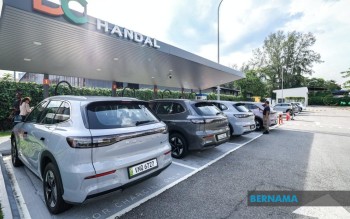
Malaysia's electric vehicle market is poised for significant growth over the next three to five years, with Chinese smart charging technology increasingly playing a role in that expansion. Xi'an LINCHR New Energy Technology Co Ltd, a major player in EV charging solutions, has brought this message to the Global Automotive and Technology Expo (GATE 2026) currently underway at the Malaysia International Trade and Exhibition Centre (MITEC) from August 26 to 28, where the company is showcasing its innovations and exploring local partnerships.
The relationship between EV adoption and charging infrastructure development is symbiotic, according to LINCHR chairman Yuan Qingmin. Constraints in either one inevitably ripple through the other, he explained, meaning Malaysia cannot accelerate its EV transition without ensuring that the charging network grows in tandem. China's early dominance in both EVs and charging systems has given it valuable lessons, yet Yuan cautioned against simply transplanting that experience wholesale into the Malaysian context. "Technology transfer is not about simply replicating China's experience, but adapting it to Malaysia's local conditions through localisation and research and development," he stated, highlighting a critical principle often overlooked in international technology partnerships.
LINCHR's involvement in Malaysia extends beyond mere exhibition presence. The company is actively collaborating with local EV charger manufacturer Swift Bridge Technologies Sdn Bhd to develop a charging infrastructure ecosystem tailored to Malaysian needs. This partnership encompasses multiple layers: charging infrastructure standards, product design, technology integration, and engineering specifications. Such deep collaboration reflects an understanding that successful technology transfer requires local expertise and buy-in, not external solutions imposed from above.
The company's credentials in its home market are substantial. LINCHR's testing technology solutions command more than 70 per cent of China's market share, giving it considerable experience in scaling EV charging networks. However, Yuan emphasised that overseas expansion demands a different approach than domestic market penetration. Technology transfer to local partners and investing in local research and development capacity are not optional extras but essential components of successful market entry. Without these investments, foreign technology providers risk offering solutions that function technically but fail to address regional specificities.
The risks of inadequate localisation are real and quantifiable. Simply replicating Chinese charging technology without adaptation may satisfy baseline technical requirements, but it will not necessarily suit Malaysia's distinctive operating environment. This principle is not theoretical but grounded in concrete engineering decisions. LINCHR has, for instance, adopted an oil-immersed insulation design for the printed circuit boards (PCBs) of its charging stations specifically to enhance resistance to salt spray corrosion. Malaysia's tropical climate—characterised by high humidity, intense heat, and coastal salt exposure in many regions—demands such modifications. Equipment designed for China's varied but generally drier inland conditions would degrade rapidly in Malaysian conditions without such protection.
Standardisation and testing frameworks are equally important to this localisation effort. LINCHR, Swift Bridge, and the Standards and Industrial Research Institute of Malaysia (SIRIM) formalised their commitment to this approach through a tripartite cooperation agreement signed in March of last year. Since then, the three parties have been collaborating on developing charging infrastructure testing and certification standards appropriate for Malaysian conditions, while simultaneously upgrading the equipment and facilities available in SIRIM's testing laboratories. This institutional approach ensures that Malaysia is not dependent on foreign testing and certification bodies but builds domestic capacity for quality assurance.
The GATE 2026 platform provides LINCHR an opportunity to engage directly with the constellation of stakeholders driving Malaysia's charging infrastructure sector. Government agencies, energy companies, grid operators, and industry players all converge at such exhibitions, creating conditions for relationship-building and knowledge exchange that would be difficult to replicate through bilateral negotiations alone. Yuan noted that such engagement is vital for understanding local requirements, regulatory expectations, and market dynamics that differ significantly from China's experience.
Looking forward, the technological landscape of EV charging is evolving rapidly. The industry is moving beyond simple unidirectional charging—vehicles drawing power from the grid—toward more sophisticated configurations. As EVs become increasingly connected and intelligent, they will function as flexible loads capable of charging at home, at workplaces, during periods of vehicle idleness, or whenever grid conditions and price signals make charging economical. The next frontier involves vehicle-to-grid (V2G) technology, where EVs can discharge stored electricity back into the grid during peak demand periods. This transformation positions electric vehicles not merely as electricity consumers but as distributed mobile energy storage resources that interact dynamically with grid infrastructure.
For Malaysia specifically, this evolution carries implications for how charging standards and testing protocols are developed. A framework designed solely for one-directional charging will require substantial revision as bidirectional systems become commonplace. The ongoing collaboration between LINCHR, Swift Bridge, and SIRIM positions Malaysia better than many developing economies to navigate this transition, since the partnership is grounded in the principle of continuous technological adaptation rather than static standardisation. This approach recognises that today's cutting-edge technology standards will quickly become tomorrow's constraints unless the framework itself remains flexible and responsive to innovation.
The LINCHR case illustrates a broader lesson for Malaysia's technology development strategy. Foreign investment and know-how can accelerate progress, but only when coupled with genuine local partnership and commitment to understanding context-specific requirements. The company's willingness to invest in local R&D and collaborate with domestic standards bodies suggests that the most productive technology transfer arrangements are those built on reciprocal learning rather than one-directional knowledge flow. As Malaysia's EV market accelerates, ensuring that the charging infrastructure underlying that growth is specifically designed for local conditions—rather than retrofitted from elsewhere—will prove increasingly important to achieving sustainable, rapid, and economically efficient adoption.

