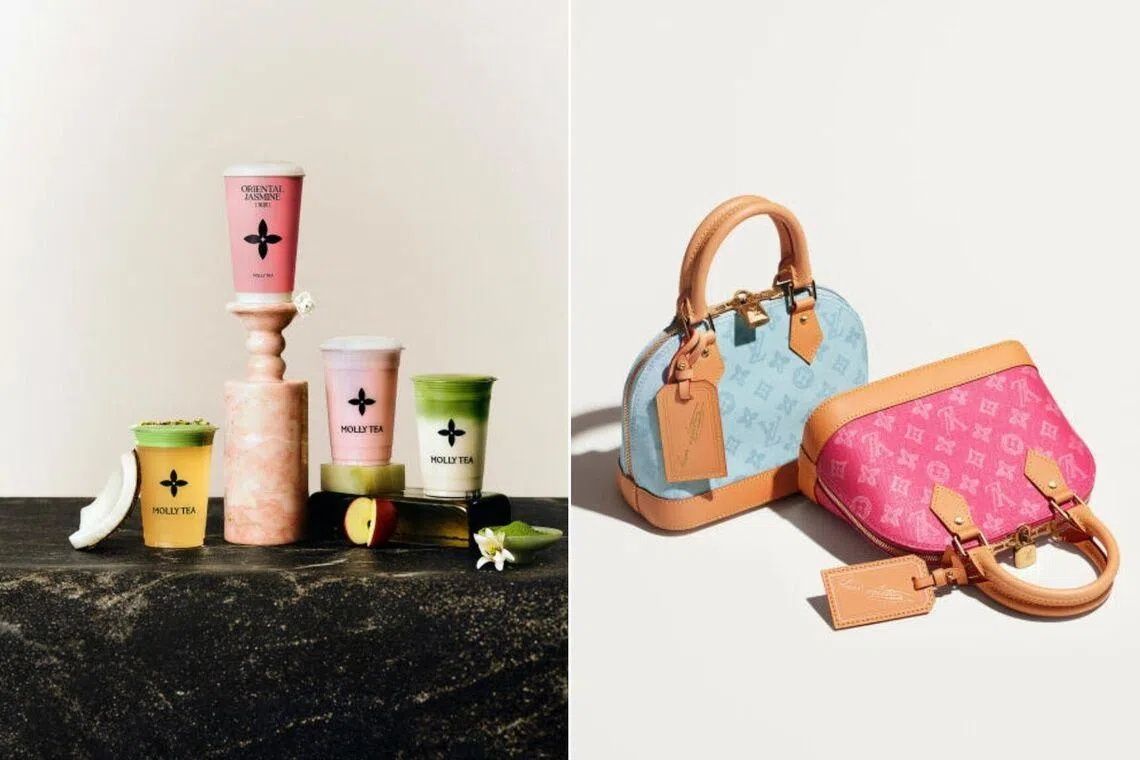
A Chinese court has dealt a significant blow to Molly Tea, a Shenzhen-based milk tea operator, by ordering the company to compensate French luxury giant Louis Vuitton with 10.3 million yuan (approximately US$1.5 million) for trademark infringement. The Suzhou Intermediate People's Court in Jiangsu province determined on June 29 that Molly Tea's four-petal flower graphic emblem violated seven of Louis Vuitton's registered trademark designs. Beyond the financial penalty, the court has mandated that Molly Tea cease using the disputed logo and issue a public apology to the French brand. The company has already signalled its intention to appeal the ruling to a higher tribunal, setting the stage for a prolonged legal battle that extends far beyond the immediate parties involved.
The case originated when Louis Vuitton initiated legal proceedings in May 2025, seeking redress for what it contended was a deliberate mimicry of its iconic monogram motifs. The crux of the dispute centres on the visual similarity between Molly Tea's brand symbol and the distinctive four-petal flower pattern that Louis Vuitton has cultivated as a core element of its global luxury identity. This comparison has struck a chord with the Chinese public, who have engaged in spirited discussion across social media platforms about the boundaries of trademark protection and the legitimate use of cultural design elements. Online engagement with the case has been extraordinary: a hashtag addressing the Louis Vuitton lawsuit garnered over 360 million views, while related discussions accumulated more than 18.7 million reads, reflecting the widespread interest this matter has generated within China.
Molly Tea's trademark journey provides important context for understanding the court's decision. Beginning in March 2024, the milk tea chain and its associated businesses submitted multiple trademark applications to the China National Intellectual Property Administration, primarily featuring floral design elements intended to cover restaurant services, accommodation offerings, advertising, and convenience food products. The intellectual property office proved largely unreceptive to these applications, rejecting the vast majority on grounds that remain procedurally standard. Of the applications Molly Tea filed, only the trademark containing the Chinese characters for "Molly Tea" itself successfully navigated the registration process, suggesting that examiners had reservations about the company's floral motif claims from an early stage.
Public sentiment regarding the verdict has remained decidedly mixed, reflecting deeper uncertainties about intellectual property law in the regional context. Some observers contend that Molly Tea's floral emblem bears such striking resemblance to Louis Vuitton's signature pattern that the similarity cannot be attributed to coincidence. Conversely, other commentators and online users have argued that the visual differences between the two designs are sufficiently pronounced and that the companies operate in fundamentally distinct market segments, serving audiences with little overlap. This division of opinion has become increasingly layered as some netizens have questioned whether Louis Vuitton's celebrated pattern truly represents an original innovation or whether it may itself derive inspiration from traditional Chinese cultural motifs that predate the luxury brand's appropriation of them.
Kang Lixia, a partner at Beijing Standzer IP Firm, has offered professional guidance on the appeal prospects and the broader legal framework governing such disputes. She confirmed that either party dissatisfied with the judgment possesses the statutory right to pursue an appeal, though success in such proceedings hinges substantially on the appellant's capacity to marshal persuasive evidence demonstrating the originality and distinctiveness of its design. Importantly, Kang emphasised that ornamental patterns and designs rooted in traditional Chinese culture constitute elements of the public domain and thus remain available for use by any applicant seeking to incorporate them into commercial offerings. This principle creates inherent tension with trademark law's protective aims, as it acknowledges that certain design elements should remain universally accessible rather than becoming the exclusive property of any single commercial entity.
The application of China's trademark registration framework, however, introduces complexity that favours earlier applicants. The "first to file" principle that underpins Chinese Trademark Law establishes that when multiple parties simultaneously seek to register identical or substantially similar marks for the same or comparable goods, the earliest applicant secures exclusive trademark rights while all subsequent filings face rejection. In this instance, because Louis Vuitton had already registered its floral pattern well before Molly Tea filed its applications, the French luxury house enjoyed a decisive temporal advantage. Kang further highlighted that despite the two companies being registered within different trademark classes, Louis Vuitton's status as an earlier-registered and internationally celebrated mark qualifies it for cross-class protection under Chinese law—a provision that allows its intellectual property rights to extend beyond its immediate product categories into domains that might normally be considered unrelated, thereby creating substantial barriers for companies filing later trademark applications.
Liu Bin, an intellectual property lawyer practising at Beijing Zhongwen Law Firm, has advocated for a more measured and balanced assessment of the dispute, one that acknowledges the legitimate complexity at its heart. Under the operative legal framework, Liu explained, protection afforded to figurative marks—visual symbols used in commerce—does not demand that a contested design be absolutely identical to a registered trademark. Rather, the determinative legal question focuses on whether ordinary consumers exposed to both marks would likely experience confusion regarding their source or association. This consumer-confusion standard introduces significant subjectivity into trademark disputes, as judicial determinations ultimately rest on assessments of how reasonably educated purchasers would perceive and interpret the relevant symbols.
A central point of public perplexity that Liu identified concerns the proper treatment and fair utilisation of traditional Chinese cultural patterns within modern commercial trademark frameworks. Many observers within China have reached the conclusion that since floral motifs and other ornamental designs derived from traditional culture constitute public resources accessible to all, no individual commercial entity should possess exclusive proprietary rights to deploy them. This reasoning reflects a broader cultural sensibility that emphasises the collective heritage embodied in traditional aesthetics rather than their transformation into privately controlled intellectual property. However, Liu stressed a critical distinction that trademark law itself upholds: intellectual property protection is not intended to grant exclusive rights to traditional cultural elements themselves, but rather to the specific brand recognition and commercial goodwill that enterprises generate through their deployment of these elements in the marketplace.
Liu's articulation of this principle offers important clarity for Malaysian and Southeast Asian business operators seeking to navigate similar trademark disputes in their own jurisdictions. He insisted that while traditional design elements should indeed remain accessible to all and be actively preserved and transmitted to future generations, the commercial marks deployed in contemporary business contexts must scrupulously avoid creating marketplace confusion or replicating earlier-registered trademark designs. This approach attempts to balance two competing values: the preservation and fair use of cultural heritage on one hand, and the protection of legitimate commercial interests and consumer protection on the other. For regional enterprises considering whether to incorporate traditional motifs into their branding strategies, the Molly Tea case serves as a cautionary example that careful design differentiation and thorough prior search of existing trademark registrations represent essential precautions before launching branded products or services.

