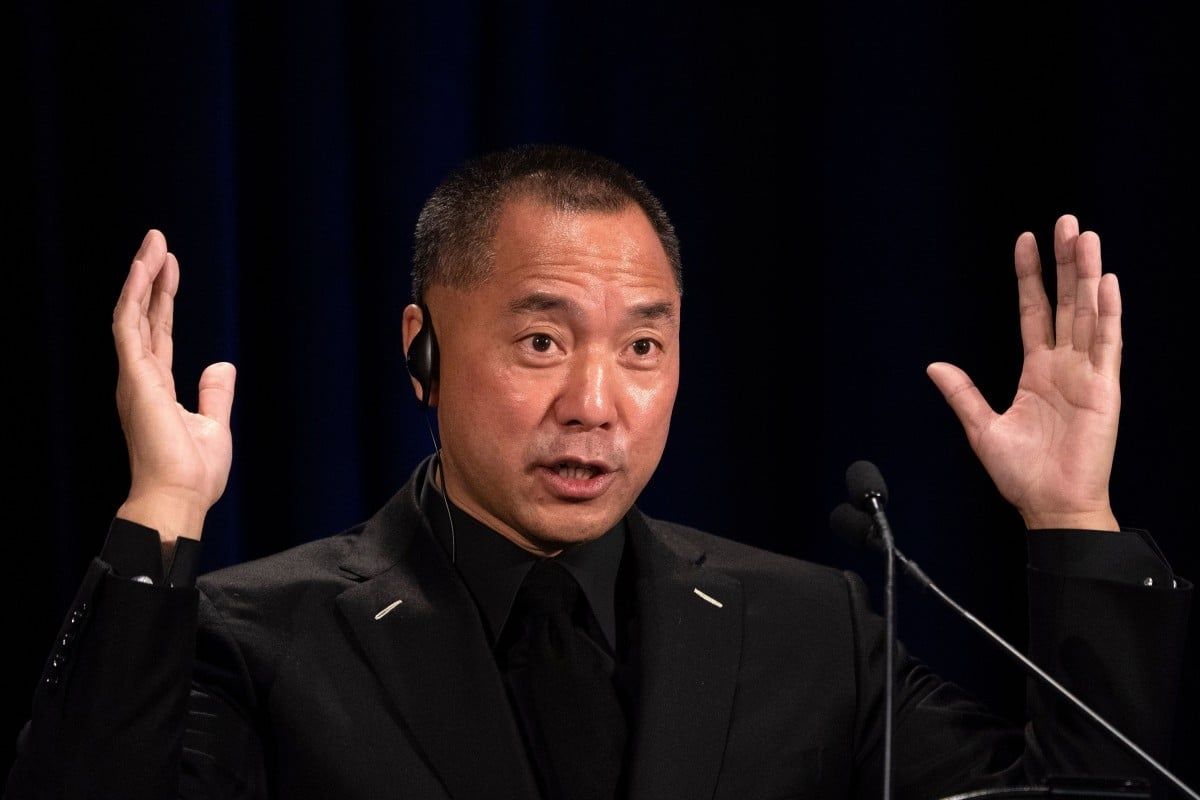
Guo Wengui, once among China's wealthiest entrepreneurs, was sentenced to three decades in a New York federal prison on June 30 for perpetrating an extensive financial fraud that devastated more than 1,000 investors across the globe. Judge Analisa Torres delivered the judgment in Manhattan, describing how the defendant systematically exploited individuals who sought democratic change in China, siphoning their resources to fund an extravagant lifestyle far removed from the austere circumstances of ordinary citizens.
The 57-year-old tycoon, who departed China roughly a decade ago and subsequently reinvented himself as an American-based dissident opposing the Communist Party, presented himself as a victim during his sentencing hearing. Claiming he suffered from acute illness, Guo complained about his jail conditions and disputed prosecutors' assertions that he was exaggerating medical complaints. He briefly mentioned vomiting multiple times whilst being returned to custody before his court appearance, a claim that drew visible displays of sympathy from the gallery filled with his supporters.
When given the opportunity to address the court regarding the criminal allegations, Guo focused narrowly on his stated motivation for relocating to America, asserting that he came explicitly to undermine the Chinese Communist Party rather than engaging substantively with the fraud charges leveled against him. His deflection from accountability became a central theme in Judge Torres' remarks from the bench, where she emphasized that Guo remained entirely unwilling to acknowledge responsibility for his actions and instead maintained the implausible position that his conduct generated no financial harm whatsoever.
The judge articulated particular concern about Guo's pattern of leveraging his supporters to silence and intimidate victims who attempted to speak publicly about their experiences. The sentencing incorporated profound testimony from defrauded investors, including Wei Chen, whose statement that the scheme "destroyed my life" and that of her family resonated throughout the courtroom. Judge Torres also referenced correspondence from numerous victims describing the devastation wrought upon their families—lost life savings, psychological anguish, damaged relationships, and profound shame resulting from poor investment decisions.
Throughout the lengthy trial lasting seven weeks, prosecutors established that Guo orchestrated his fraudulent operation between 2018 and 2023, convincing hundreds of thousands of prospective investors to channel more than one billion dollars into entities under his control. These included his media venture GTV Media Group Inc., entities collectively branded as the Himalaya Farm Alliance, and the Himalaya Exchange. The prosecution successfully secured convictions on nine of twelve criminal counts, demonstrating systematic deception across thousands of victims ensnared by promises of extraordinary financial returns.
The extraordinary wealth accumulated through these illicit activities enabled Guo to maintain an unprecedented standard of luxury. Prosecutors documented his acquisition of multiple mansions, yachts, high-performance racing vehicles, bespoke designer apparel, and opulent furnishings befitting a lifestyle at the apex of American excess. His residence, strategically positioned overlooking Central Park in Manhattan, and his membership at President Donald Trump's Mar-a-Lago golf club in Florida exemplified his seamless integration into elite American circles prior to his arrest and detention without bail three years ago.
Guo's sudden ascent in American political and business spheres during his self-imposed exile proved extraordinarily rapid. He cultivated a particularly close relationship with conservative political strategist Steve Bannon, with whom he jointly announced an initiative purportedly designed to overthrow China's government in 2020. This positioning as a democratic reformer and government critic provided essential credibility for his various financial schemes, allowing him to attract investors genuinely sympathetic to causes opposing Beijing whilst simultaneously enriching himself through systematic deception.
The sentencing judgment required Guo to forfeit $889 million in restitution, though the practical likelihood of full recovery remains uncertain given the defendant's history of asset concealment and offshore financial arrangements. As he departed the courtroom following the pronouncement of sentence, his assembled supporters responded with applause and vocal encouragement, underscoring the continued loyalty he maintained among his followers despite the comprehensive documentary evidence of his criminal conduct presented throughout the trial.
Guo's defense strategy centered on portraying him as a victim of relentless persecution orchestrated by Chinese authorities spanning decades. His lawyers submitted documentation alleging severe physical torture endured within China from 1993 to 2022, requiring multiple surgical interventions to remedy resulting injuries and disfigurements. They argued that the Chinese Communist Party's campaign against him extended beyond domestic law enforcement, asserting implausibly that the party had recruited American business, entertainment, and political elites to conspire against their client.
The defense team attempted to characterize the sentencing as validation of China's purported smear campaign against their client, arguing that imposing a lengthy prison term would embolden further efforts to eliminate Chinese dissidents from American public life. They referenced comparable fraud cases receiving substantially lighter sentences of two-to-four years imprisonment, though prosecutors refuted such comparisons as fundamentally inapplicable given the unprecedented scale and systematic nature of Guo's criminality. The defense narrative regarding his origins—that his family became the largest shareholder of China's premier securities exchange before political persecution forced his international relocation through Hong Kong, London, and ultimately to New York in 2017—failed to persuade the court.
China's Ministry of Foreign Affairs formally acknowledged the sentencing judgment, reiterating that Guo remains wanted by Chinese authorities under multiple criminal allegations encompassing rape, abduction, corruption, and additional charges that Guo consistently dismissed as politically motivated fabrications. An international Interpol "Red Notice" amplifies Beijing's request for his arrest and potential extradition, establishing a complex legal landscape in which Guo now faces extended incarceration within American custody whilst simultaneously remaining a target of Chinese law enforcement. This dual legal exposure has profound implications for how other Chinese dissidents operating within American territory might assess their own security and vulnerability to transnational prosecution efforts.

