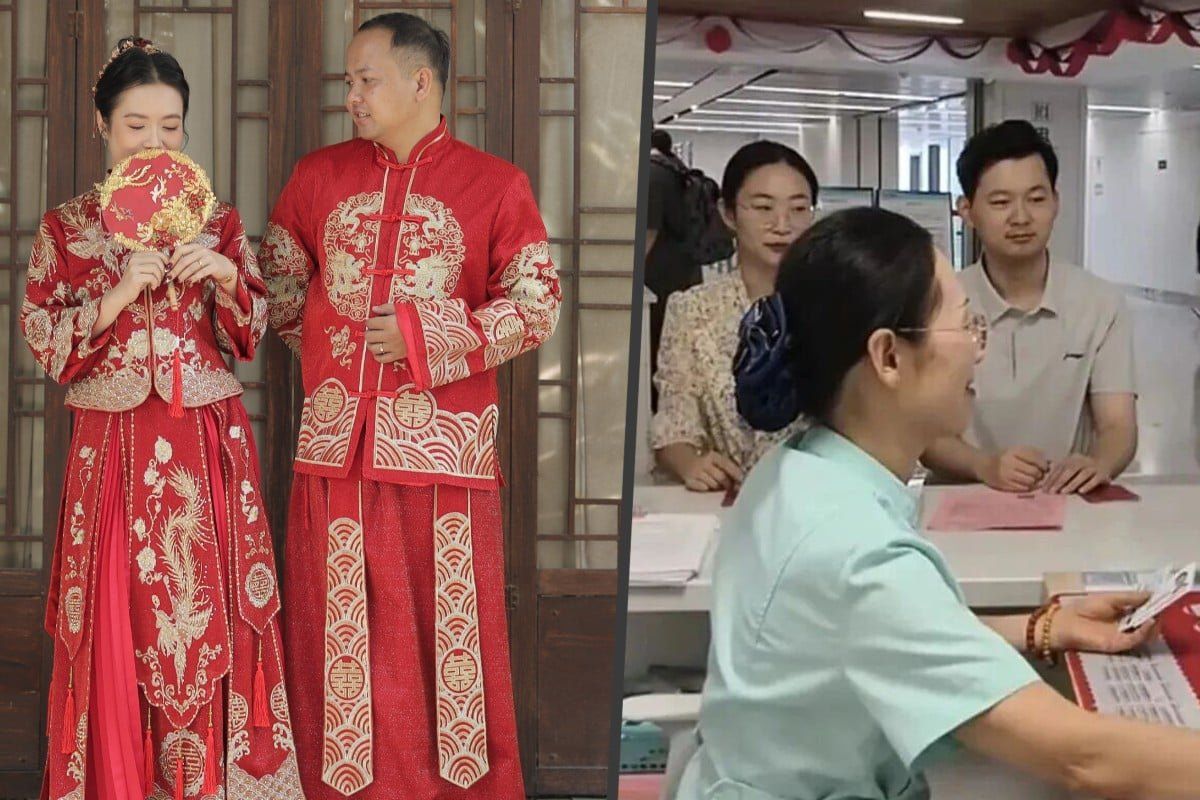
China's battle against declining marriage rates has taken an unusual turn, with authorities opening registration desks in hospitals, banks, airports, and nightclubs—venues that would have seemed absurd for such formal ceremonies just months earlier. The Maternal and Child Health Hospital of Linzi District in Zibo City, Shandong province, joined the growing roster of unconventional marriage venues in August when it launched registration services during China's Qixi Festival, capitalising on what officials claim is a logical bundling of premarital health checks, registration, and prenatal guidance under a single roof. This move came shortly after the Postal Savings Bank of China in Tianjin made headlines as the nation's first financial institution to offer marriage registration, prompting online observers to joke that only a hospital could top the novelty—a prediction that proved prescient.
The proliferation of creative registration venues reflects changes introduced in May last year that fundamentally restructured how Chinese couples formalise their unions. The regulatory reform eliminated the requirement for couples to present household registration booklets and permitted marriages to be registered outside the couple's hukou, or household registration location. These procedural simplifications opened the door for civil affairs bureaus to partner with unconventional locations, transforming marriage registration from a bureaucratic chore confined to government offices into an experience that could occur in scenic temples, metro stations, parks, and tourist attractions. Guangzhou Baiyun International Airport in Guangdong province became the nation's first airport to issue marriage certificates in January, sweetening the offer with complimentary access to its observation deck. Meanwhile, temples in Beijing and Nanjing now host couples marrying in traditional attire, while a Shanghai nightclub partnered with local authorities to conduct special certification ceremonies within its premises.
The scale of this transformation has been remarkable. Within one year of the regulatory changes, China established over 500 marriage registration sites outside traditional civil affairs bureaus, with more than 1,300 additional outdoor locations collaborating to issue certificates. This decentralisation represents a deliberate strategy by authorities to remove friction from the marriage process, betting that convenience and novelty might encourage reluctant couples to formalise their relationships. The expansion appears particularly concentrated in major urban centres and tourist destinations, suggesting that local governments view accessible registration as both a demographic investment and a potential draw for wedding-related spending.
Initial indicators suggested the strategy held promise. In the third quarter of last year, 1.61 million couples registered marriages nationwide, representing a 22.5 per cent year-on-year increase that momentarily suggested the tide had turned. Full-year figures for last year reflected sustained momentum, with 6.76 million marriage registrations—a gain of 657,000 couples compared to 2022. However, this apparent success proved fragile. Data from the first half of this year revealed a sharp reversal, with marriages declining by 7.5 per cent year-on-year to 3.28 million couples, suggesting that either the novelty factor had dissipated or the underlying impediments to marriage ran deeper than bureaucratic inconvenience.
China's demographic crisis forms the backdrop to this unprecedented expansion. The nation faces a structural decline in marriage rates as young adults, particularly women, increasingly question whether marriage remains essential or desirable. Multiple social, economic, and cultural factors converge to suppress demand: youth face anxiety about financial stability, housing affordability has become prohibitively expensive for many prospective couples, and younger generations increasingly reject traditional assumptions that marriage constitutes a necessary life milestone. These anxieties are compounded by concerns about family conflicts and the perceived loss of personal autonomy that marriage entails—realities that no amount of convenient registration venues can address.
The distinction between marriage and divorce services highlights additional complexities in Beijing's approach. While simplified procedures theoretically apply to both formalising and dissolving unions, many of the newly established outdoor registration sites deliberately eschew divorce services, citing the necessity for more extensive documentation. This asymmetry reveals official anxiety about enabling divorce as easily as marriage, suggesting that the government's primary objective remains increasing marriage registrations rather than facilitating equitable access to the full spectrum of matrimonial services. For couples contemplating the long-term viability of their relationships, this imbalance sends a subtle but unmistakable message about state priorities.
Public reaction has ranged from pragmatic support to outright scepticism. Social media users have dismissed the initiatives as addressing symptoms rather than root causes, with one critic pointedly asking whether young people were actually avoiding marriage because they couldn't locate registration facilities. Another commenter sardonically suggested establishing divorce services atop Mount Everest, mocking the notion that location-based convenience could overcome fundamental apprehensions about matrimony. The most sophisticated critiques acknowledge that the real obstacles preventing young Chinese from marrying involve the confidence to navigate decades of potential financial hardship, intergenerational family dynamics, and existential questions about life purpose—challenges that no bureaucratic innovation can resolve.
The expansion of marriage registration sites also reflects broader tensions within China's state apparatus. Local governments, under pressure to improve demographic indicators, have embraced creative solutions that generate positive statistics while requiring relatively modest fiscal investment. Partnering with temples, airports, nightclubs, and hospitals allows authorities to claim progress on marriage promotion without substantial budget allocation, though the effectiveness of these gestures in reversing demographic decline remains questionable. The strategy embodies a particular conception of governance in which administrative accessibility is mistaken for addressing substantive social grievances.
For Southeast Asian observers, China's experience offers instructive lessons about demographic policy. Malaysia, Thailand, and Vietnam all confront similar pressures of declining birth rates and marriage postponement among younger cohorts. While China's approach might appear absurd on its surface, it represents a serious—if ultimately limited—government attempt to confront a strategic challenge. The relative failure of convenience-based solutions suggests that addressing demographic decline requires confronting harder questions about economic security, gender equality, work-life balance, and the fundamental role of marriage in modern society. These are questions that no civil affairs bureau, however creatively located, can adequately resolve through policy alone.

