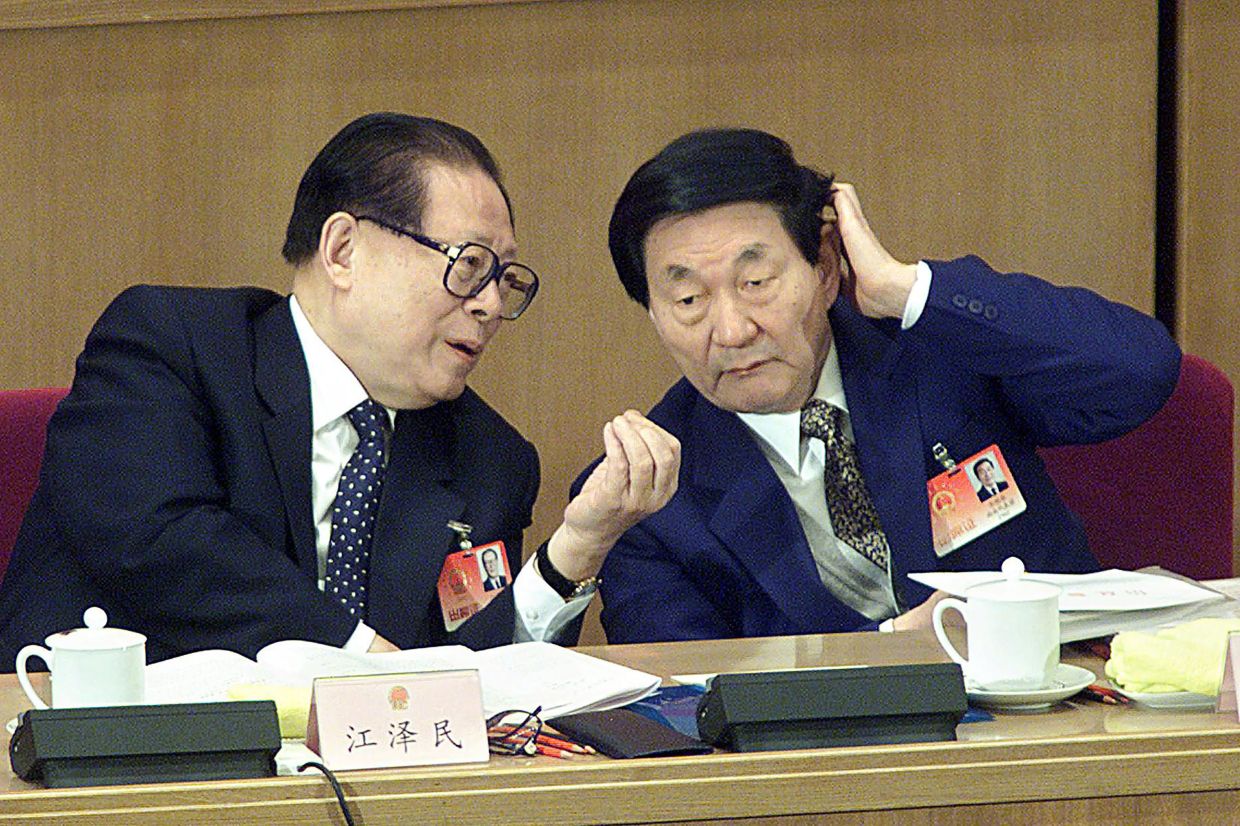
The death of Zhu Rongji and the centennial celebration of Jiang Zemin's birth within a single week have brought two of China's most consequential late leaders into sharp focus, prompting a rare moment of national reflection on a transformative period that now feels increasingly distant. Zhu, who passed away on August 12 at the age of 97, was accorded a full state funeral on August 18 with flags at half-mast nationwide, while Jiang, who died in 2022 at 96, was honoured with a major ceremony in Beijing on August 17 drawing thousands of attendees. The back-to-back tributes have resurrected memories of the 1998-2003 partnership between these two figures, a partnership that oversaw China's entry into the World Trade Organisation, rapid economic expansion, and the country's consolidation as a rising global power.
President Xi Jinping's personal attendance at both events underscores their symbolic importance to the current leadership. At Jiang's commemoration in the Great Hall of the People, Xi delivered a 40-minute address emphasizing Jiang's "indelible contributions" to the party and nation, framing his predecessor's achievements within a continuum that leads directly to Xi's own era of "national rejuvenation" and Chinese-style modernisation. Similarly, Xi appeared at Zhu's funeral at Babaoshan Revolutionary Cemetery alongside members of the Politburo Standing Committee, observing the traditional ritual of three bows before the deceased's body. These carefully choreographed displays of respect serve multiple audiences: they acknowledge the historical significance of departed leaders while simultaneously asserting continuity between past and present leadership, a critical message in Chinese political culture.
Yet beneath the official veneration lies an undercurrent of tension that analysts say reflects deeper anxieties about China's present trajectory. The renewed prominence of Jiang and Zhu arrives at a moment when the country faces sluggish economic growth, a troubled property sector burdened by developer defaults, mounting local government debt, and escalating friction with Western nations. For ordinary Chinese citizens and intellectuals, the memorials have triggered a melancholic comparison between the sense of possibility and rapid wealth creation that characterised the reform decades and the more constrained economic landscape of today. This nostalgic sentiment, though carefully muted in public discourse, has surfaced across Chinese social media through coded language, old photographs, and veiled tributes designed to circumvent censorship algorithms.
The official narrative construction around Jiang presents his legacy as a foundational chapter within a larger historical arc that culminates in Xi's leadership, not as an alternative model to the current regime. According to Lee Jong-hyuk, an associate professor at Sungkyunkwan University specialising in Chinese politics, "In this narrative, Jiang is not presented as an alternative to Xi but as one of the leaders who contributed to the party's continuing historical mission." The same framing applies to Zhu: his official obituary emphasized his steadfast support for successive party leaderships, from Hu Jintao to Xi, thereby integrating him into the continuity narrative rather than positioning him as representing a distinct governing philosophy. During the commemoration ceremony, Xi lauded Jiang's "political conviction and loyalty," his "innovative spirit," and his "far-sighted and strategic thinking" in navigating crises such as the 1998 floods and the Asian financial crisis—qualities deliberately positioned as lessons for China's contemporary challenges.
However, the political sensitivities surrounding public expressions of admiration for these departed leaders reflect the government's anxiety about comparisons that might prove unflattering to the present. Several pieces paying tribute to Jiang and Zhu were rapidly removed from social media platforms following their posting, including a notable essay by economist Zhao Jian that drew contrasts between the security and optimism of thirty years ago and the current climate of anxiety. Observers noted that many online tributes employed euphemisms and nicknames—such as "the Elder" for Jiang—to evade content filters. This pattern of censorship and self-censorship indicates that Beijing views unrestricted nostalgia for the reform era as potentially destabilising, particularly given that major leadership reshuffles are expected at the Communist Party congress scheduled for late 2027.
Daria Impiombato, a senior analyst at the Mercator Institute for China Studies, observed that "The leadership will be concerned about image management in the lead-up to the party congress. At this moment in particular, it's all about party-building. It's all about loyalty." The timing of these commemorations thus carries implications far beyond historical reflection; they occur in a period when the party is consolidating its ranks and ensuring unified messaging ahead of critical succession planning. The festive tone of Jiang's centennial celebration, marked by commemorative stamps and a twelve-episode television documentary series that aired nightly on state channels, stands in deliberate contrast to any potential criticism of the status quo.
The legacies of Jiang and Zhu themselves are far more complex and contested than the official encomiums suggest. Jiang ascended to power after Deng Xiaoping selected him from relative obscurity to replace the purged party chief Zhao Ziyang following the 1989 Tiananmen Square crackdown. His tenure was marked by diplomatic rehabilitation, including the normalisation of US-China relations and China's successful assertion of itself as an indispensable player in global affairs. Yet domestically, his rule witnessed systematic suppression of dissent, including violent campaigns against the Falun Gong movement, and widespread corruption within party and state institutions. His "Three Represents" doctrine famously brought private business entrepreneurs into Communist Party membership, an ideological shift that effectively broadened the party's base but also blurred the line between capitalist elites and party cadres.
Zhu's contribution to China's transformation centred on sweeping economic restructuring that proved equally consequential and problematic. His advocacy for and implementation of China's WTO accession fundamentally reoriented the economy toward export-led growth and global supply-chain integration, a strategy that generated extraordinary wealth for coastal regions and foreign investors. However, his aggressive overhaul of state-owned enterprises resulted in the displacement of more than 30 million workers from formal employment, creating a traumatic social adjustment that persists in collective memory. Perhaps more significantly, his 1994 tax-sharing reform, which transferred fiscal revenues from local governments to the central treasury, inadvertently set in motion the dynamics that would eventually produce today's property crisis: strapped for revenue, local governments increasingly relied on land sales to developers as their primary income source, inflating a bubble that has now deflated with devastating consequences for municipal finances and millions of homeowners.
These historical complexities are largely absent from official commemoration rhetoric, which presents Jiang and Zhu as unambiguously visionary leaders whose contributions should inspire contemporary policymakers. Xi's invocation of Jiang's qualities—his capacity to navigate domestic and external crises, his willingness to make bold strategic decisions, his commitment to party discipline and national purpose—reads as a coded appeal for party unity in the face of mounting economic and geopolitical challenges. The implicit message is that the current administration, like its predecessors, possesses the wisdom and resolve to steer China through its present difficulties, even as the public's lived experience suggests that the magic of the reform era has faded.
For regional observers, particularly in Malaysia and Southeast Asia, these commemorations carry significant implications. The reform era under Jiang and Zhu marked China's economic opening and its deepening integration into regional and global markets, a shift that created unprecedented opportunities for trade partnerships and investment flows throughout Asia. The apparent exhaustion of that growth model, combined with Beijing's more assertive posture toward regional disputes and international competition, suggests that the era of mutual benefit and limited friction that characterised much of Sino-ASEAN economic relations may be giving way to a more competitive and fractious phase. Malaysia, as a major recipient of Chinese investment and a crucial node in Belt and Road Initiative corridors, remains deeply invested in understanding whether and how Beijing's current leadership can generate new sources of dynamism comparable to those unleashed during the Jiang-Zhu years.
The subterranean anxiety evident in social media tributes to these departed leaders points to a deeper crisis of confidence in China's current trajectory. While the party's official channels emphasise continuity and the validation of Xi's leadership through association with his predecessors' achievements, grassroots sentiment suggests a different interpretation: that the world of rapid growth, abundant opportunity, and hopeful futures represented by Jiang and Zhu has been superseded by a more constrained and anxious present. This disconnect between official narrative and popular perception creates a delicate political challenge for Beijing as it navigates the dual imperative of acknowledging the importance of its reform heritage while discouraging any suggestion that current policies have fallen short by comparison. The memorials thus stand as monuments not merely to past achievements but also to unresolved questions about China's future direction and the party's capacity to recapture the transformative dynamism of previous decades.

