China's push to harness artificial intelligence for scientific breakthroughs faces a fundamental constraint: the country depends overwhelmingly on foreign suppliers for the sophisticated equipment needed to generate the experimental data that AI systems require to learn and improve. This structural vulnerability has emerged as a critical bottleneck in Beijing's bid to compete globally in AI-driven research, as restrictions from Washington tighten the supply of cutting-edge precision instruments that underpins both basic science and technological innovation across the nation.
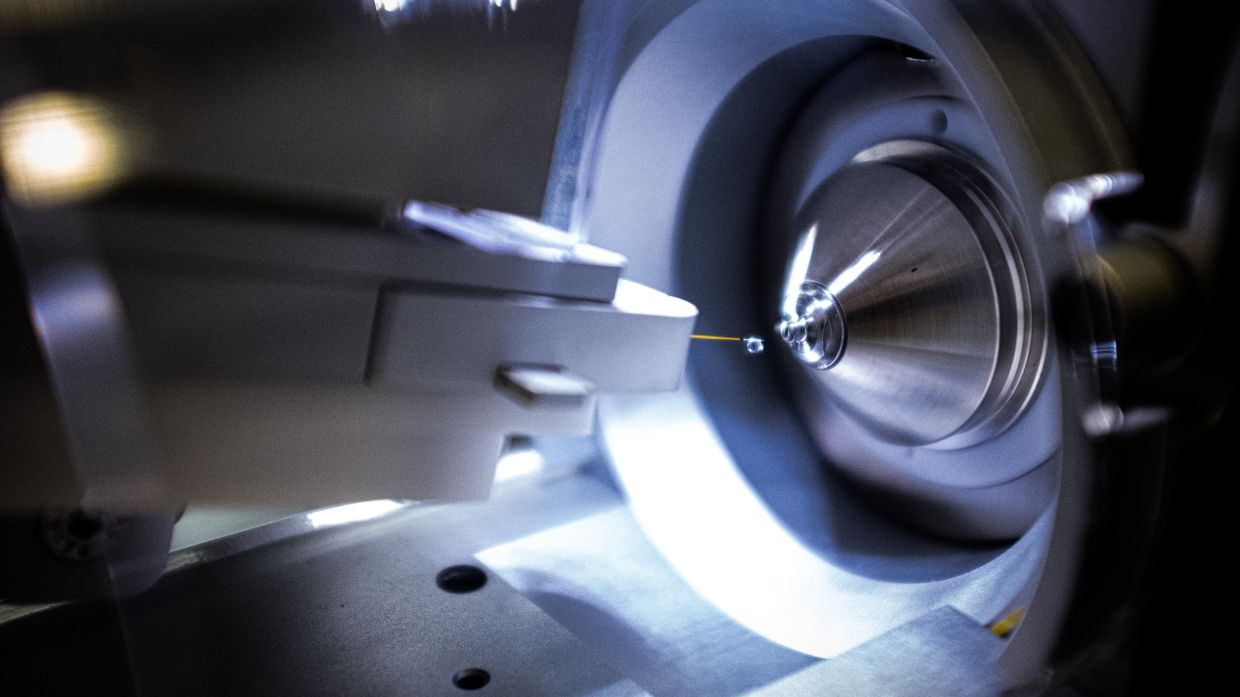
The limitation became starkly apparent during remarks at Shanghai's recent "AI for Science" conference, where Weinan E, a mathematician at Peking University and member of the Chinese Academy of Sciences, highlighted the paradox facing Chinese researchers. Advanced instruments such as mass spectrometers are indispensable for collecting the high-quality experimental data that trains and validates the machine-learning models driving scientific discovery. Without domestic sources for such equipment, E explained, the effort resembles "cooking without rice"—the essential ingredient is missing. This metaphor captures a genuine crisis in China's research ecosystem, where insufficient access to first-hand data constrains the entire AI-for-science endeavour.
The scale of China's import dependence is staggering. In 2024 alone, the country imported nearly US$17 billion in scientific equipment, with more than three-quarters of major research instruments coming from overseas suppliers. These figures underscore not merely a preference for foreign goods but a systemic inability to produce domestically competitive alternatives. A December report by Beijing consulting firm Puhua Policy documented this reality, while research firm LeadLeo identified even sharper dependencies in specific categories: China imports 83 per cent of its mass spectrometers and chromatographs, and 75 per cent of its spectrometers. Optical instruments and biological tissue analysis equipment show near-total foreign reliance, creating cascading vulnerabilities across the research enterprise.
Beyond the raw statistics lies a consequential operational problem. The reliance on imports drives up equipment costs, lengthens maintenance cycles, and delays after-sales support—inefficiencies that cumulatively slow scientific progress and undermine research quality. Chinese laboratories struggle with supply interruptions, lengthy procurement periods, and dependence on foreign technicians for repairs. These frictions compound, eroding the competitive edge that China seeks in AI-powered discovery. The situation parallels earlier vulnerabilities in semiconductors and other strategic technologies, suggesting that Beijing faces a broader strategic weakness in controlling critical upstream inputs to innovation.
The challenge has intensified as Washington weaponises export controls to restrict Chinese access to precisely these instruments. During Donald Trump's first term, over 42 per cent of China-related entries on the US export-control list involved advanced technologies. Those measures have persisted and expanded under Trump's second administration, driven by national-security concerns that advanced equipment and data could facilitate China's military modernisation and weapons development through AI applications. In January, the US Department of Commerce introduced fresh restrictions on high-parameter flow cytometers and certain mass spectrometry equipment, explicitly citing risks that these technologies enable "high-quality, high-content biological data" suitable for developing AI and biological design tools. The move directly targets the infrastructure underlying China's scientific AI ambitions.
Weinan E identified a second, equally structural challenge: the gap in foundational AI models themselves. Chinese artificial-intelligence systems lag significantly behind their American counterparts in fundamental capabilities, a disparity E described as a top-tier risk that cannot be minimised. He argued that the gap reflects not merely differences in resources or talent but fundamentally different approaches to building AI for scientific tasks. The United States has concentrated on strengthening general-purpose foundation models—the large language models that form the backbone of AI—and integrating them with automated research infrastructure that can conduct experiments autonomously. China, by contrast, has pursued an application-driven strategy, building scientific AI systems tailored to specific research domains from the outset.
This divergence in strategy exposes a conceptual disagreement about how to advance AI science. E cautioned that simply grafting scientific capabilities onto existing open-source models represents a "false premise." Complex scientific problems demand not post-training refinements but stronger underlying models—a distinction that hints at fundamental architectural differences between American and Chinese approaches. The American path invests in better general tools; the Chinese path optimises for specific applications. Neither guarantees success, but the American approach appears to have secured an advantage in flexibility and adaptability, qualities increasingly valuable as scientific AI continues to mature.
Emerging from these constraints, E articulated a diagnosis of systemic rigidity in China's research establishment and proposed radical structural reforms. He called for three fundamental "breaks" in the traditional research system. First, the scientific community must dissolve disciplinary boundaries that isolate fields from one another, enabling cross-disciplinary collaboration where novel insights often emerge. Second, researchers must bridge the persistent divide between theoretical work and experimental investigation, recognising that the best science integrates both modes seamlessly. Third, and perhaps most provocatively, Chinese institutions must dismantle the wall separating academia from industry, acknowledging that practical innovation and commercial development increasingly drive scientific progress.
E further advocated overhauling how research contributions are measured and rewarded. The traditional academic system privileges peer-reviewed publications as the primary metric of achievement, but this framework, E suggested, undervalues equally important contributions like developing datasets, creating software tools, and building research infrastructure. These unglamorous but indispensable resources enable other researchers to work more efficiently and effectively. Without recognising such contributions in hiring, promotion, and funding decisions, Chinese institutions will continue allocating talent and resources suboptimally. The implication is sharp: China's research system itself, not merely its equipment suppliers, requires fundamental restructuring to unlock the potential of AI for science.
The convergence of these challenges—equipment dependence, model gaps, supply-chain fragility, and institutional rigidity—creates a complex predicament for Chinese policymakers and scientists. China cannot easily overcome its reliance on Western instruments while facing escalating US export controls. It cannot instantly close the gap in foundational AI models through policy alone. Yet the country's historical trajectory suggests determination to pursue these objectives regardless. Whether China can restructure its research ecosystem, accelerate domestic instrument development, and narrow AI capability gaps remains an open question with profound implications not only for Chinese science but for the global technology competition. For Southeast Asia and other regions seeking to maintain technological independence, China's struggle offers both a cautionary tale about supply-chain vulnerability and an object lesson in the integrated nature of modern scientific and economic power.

