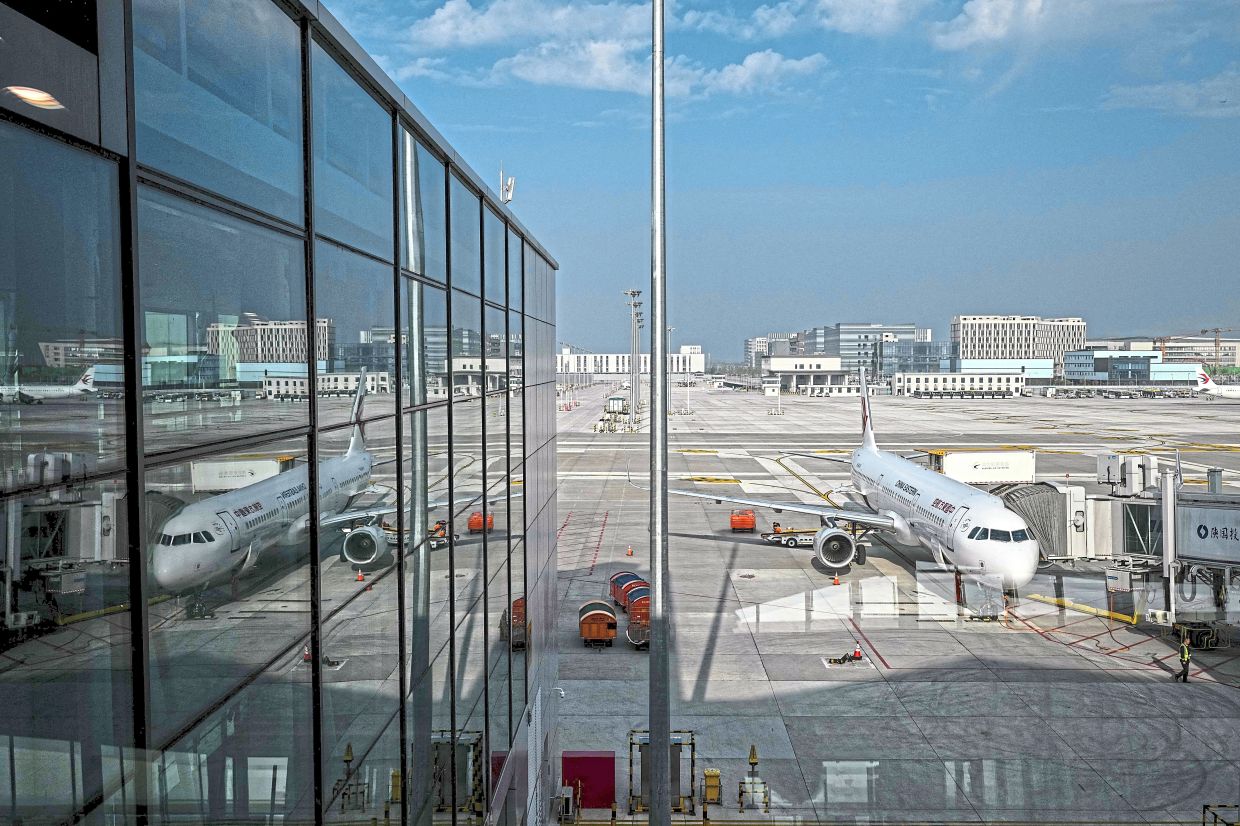
China's aviation sector faces an escalating crisis as the country's three largest carriers—Air China, China Eastern Airlines, and China Southern Airlines—reported staggering first-half losses totalling 8.2 billion yuan, extending a painful streak of unprofitability that has now persisted for seven consecutive years. The dismal results, announced this week, sent shares tumbling across Hong Kong and mainland exchanges and have reignited concerns about the structural challenges facing China's post-pandemic recovery in air travel.
The magnitude of the losses underscores a sharp turnaround in fortunes for carriers that had managed modest first-quarter profits. Air China posted a net loss of 2.3 billion yuan, nearly 27 percent worse than the corresponding period last year, while China Eastern reported losses of 2.2 billion yuan and China Southern recorded the steepest decline at 3.7 billion yuan—more than double its loss from the same period in 2025. This dramatic deterioration within a single half-year contrasts sharply with the carriers' combined first-quarter profit of 4.82 billion yuan, driven by robust demand during the Lunar New Year holiday period. The pivot from gains to losses reveals the extreme volatility that has come to characterize China's aviation market.
The primary culprit behind the carriers' financial distress is the sustained elevation in jet fuel costs, which has become the industry's most pressing challenge. Fuel expenses surged between 35 and 38 percent at each of the three airlines during the first half, driven by geopolitical tensions in the Middle East and broader oil market pressures. Unlike their counterparts in Europe and other parts of Asia, Chinese carriers employ minimal fuel hedging strategies, leaving them acutely vulnerable to sudden price movements. This structural weakness has proven devastating, particularly as international oil benchmarks remain more than 50 percent above pre-conflict levels, and observers note that recovery to normal pricing may remain years away.
What makes the situation more vexing for airline executives and investors is that revenue streams actually expanded substantially across all three carriers. Air China's top-line income grew 10.5 percent, China Eastern's increased 11.1 percent, and China Southern posted a 9.7 percent gain, propelled by international demand that proved surprisingly resilient. European routes in particular benefited as passengers rerouted away from Middle Eastern hubs disrupted by regional instability, creating unexpected revenue opportunities. Yet this encouraging demand picture has been wholly insufficient to offset the operational cost pressures, exposing a fundamental imbalance between the carriers' pricing power and their exposure to commodity shocks.
Domestic market dynamics have further constrained the airlines' ability to pass higher costs to consumers. China's carriers cannot replicate the substantial fare increases that American airlines have implemented, as weaker domestic economic conditions combined with competition from high-speed rail networks and self-drive holidays have made passengers far more price-sensitive. This structural constraint on pricing flexibility means that even with rising passenger volumes, the carriers cannot achieve the margin improvements necessary to restore profitability. The phenomenon reflects deeper weakness in the Chinese economy that extends well beyond the aviation sector.
Fortuitously, the peak summer season, which traditionally delivers the strongest profitability for Chinese carriers, has brought virtually no relief. Instead, meteorological conditions have conspired to worsen the situation. An unusually intense typhoon season has ravaged domestic route schedules precisely when passenger demand should be at its annual zenith. With 21 typhoons having formed across the northwestern Pacific and South China Sea through mid-year—nine more than the historical norm for the same period—flight cancellations and disruptions have accumulated steadily. Flight Master, an aviation analytics firm, projects that Chinese carriers will transport just 142 million passengers across domestic and international routes in July and August, representing a contraction of 3.6 percent compared to last year. Should this forecast materialise, it would mark the first contraction during the peak summer season since 2022, when COVID-19 lockdowns had essentially frozen the nation's domestic travel market.
Looking ahead, the analytical consensus has become decidedly pessimistic. HSBC analysts project that the three carriers will collectively post losses of approximately 16.8 billion yuan throughout 2026, a figure that stands in stark contrast to market consensus estimates predicting combined profitability of 1.3 billion yuan. This dramatic downward revision reflects mounting scepticism about the carriers' ability to navigate the convergence of high fuel costs, subdued domestic demand, and weather-related disruptions. The share price performance has reflected this growing anxiety, with all three carriers' Shanghai-listed shares declining at least 36 percent so far in 2026. None of the three carriers felt sufficiently confident in their prospects to declare interim dividends, a symbolic admission that cash preservation has become the governing priority.
The carriers have nonetheless moved forward with expansion of their domestic aircraft operations, signalling continued faith in the long-term Chinese aviation market despite near-term tribulations. China Eastern expanded its fleet of domestically manufactured COMAC C919 narrow-body jets to 17 units after receiving three additional aircraft in the first half, while Air China and China Southern each operated 11 C919s. These deliveries represent Beijing's broader initiative to develop indigenous commercial aviation capabilities and reduce reliance on Western suppliers. However, even this program faces headwinds, as China Eastern subsequently announced it expects to receive 13 fewer C919 deliveries between 2026 and 2028 than previously forecast, presumably reflecting revised demand assumptions and production constraints.
The convergence of these challenges has created an unusually toxic operating environment for an industry that remains strategically important to China's economic ambitions. The carriers' inability to escape losses despite robust revenue growth exposes the limitations of demand-side recovery in an environment characterised by cost inflation that carriers cannot pass through to consumers and operational disruptions beyond management's control. For Malaysian and Southeast Asian aviation observers, the Chinese carriers' distress carries implications extending beyond shareholder returns. It signals deepening economic fragility in the region's largest economy, suggests that commodity exposure remains a persistent vulnerability for Asian carriers, and demonstrates that nominal revenue growth cannot be mistaken for genuine financial recovery. The path to sustained profitability for China's aviation sector appears considerably longer and more uncertain than most market participants had anticipated even six months ago.

