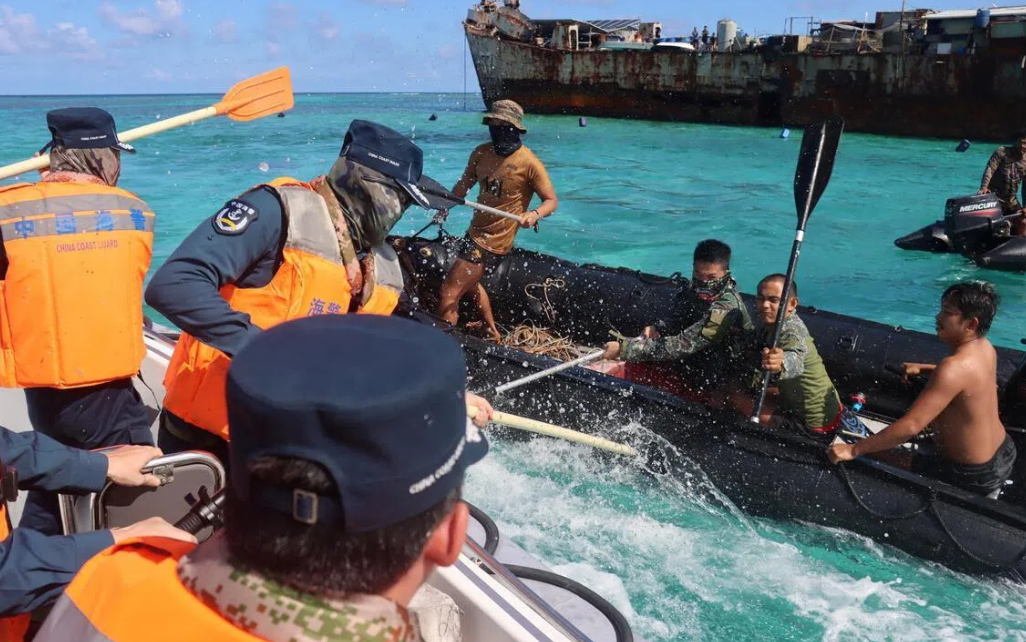
Tensions in the South China Sea escalated sharply this week when Beijing summoned the Philippine ambassador to lodge a formal protest over what it characterised as deliberate provocation by Manila at Ren'ai Reef, known internationally as the Second Thomas Shoal. The confrontation, which occurred on Monday, saw the Philippine military accuse the China Coast Guard of striking a Filipino sailor with a baton as vessels approached a grounded ship that has long served as a Philippine military outpost in disputed waters. China's foreign ministry responded on Tuesday by insisting that the Philippines had initiated the clash before reversing blame, describing Manila's account as a distortion of facts designed to inflame the situation.
The disputed Second Thomas Shoal sits at the heart of one of Asia's most volatile flashpoints, where overlapping territorial claims create a recurring friction point between Beijing and Manila. China asserts sovereignty over nearly the entire South China Sea, a waterway through which trillions of dollars in global commerce passes annually, despite a 2016 international arbitration ruling that found its expansive claims lack legal foundation. The Philippines, Vietnam, Malaysia, Brunei, and Taiwan all maintain competing claims in the region, and the narrow waters serve as a constant stage for maritime encounters between government vessels and military assets. These incidents have become sufficiently routine that analysts view them as a predictable consequence of the contested nature of the waterway rather than singular aberrations.
The timing of this latest clash coincides with a significant diplomatic gathering in Manila, where US Secretary of State Marco Rubio has arrived to participate in the Association of Southeast Asian Nations summit. Rubio's presence underscores Washington's pivot toward reinforcing its security commitments throughout Southeast Asia at a moment when regional anxieties about Chinese assertiveness are at heightened levels. The secretary of state has signalled openness to meeting Wang Yi, his Chinese counterpart, though no formal bilateral engagement has been publicly arranged. This mirrors a pattern of diplomatic engagement established over recent months, with the two officials having met during an Asean gathering in Kuala Lumpur last year and subsequently in Munich in February, suggesting a rhythm of regular contact despite underlying strategic tensions.
In a pointed commentary published across Philippine media outlets, Rubio articulated Washington's strategic vision for Southeast Asia, emphasising the centrality of freedom of navigation to the region's security and prosperity. He framed American security commitments as a stabilising force essential to preventing a single power from dominating the region's maritime domain and leveraging control over trade routes as a coercive instrument. The implicit reference to China reflected growing American concern that Beijing's assertive posture toward contested waters could reshape regional geopolitics in ways disadvantageous to smaller nations and to broader international norms governing navigation and commerce. Rubio's commentary served as a rhetorical reinforcement of America's regional presence precisely when such reassurance carries particular weight among Southeast Asian capitals.
The incident immediately drew condemnation from Washington, which characterised China's conduct as dangerous and aggressive. Australian Foreign Minister Penny Wong similarly weighed in with criticism of what she termed destabilising and dangerous behaviour, reflecting broader alignment among traditional security partners of the United States in viewing China's actions through a lens of regional destabilisation. These statements carry significance beyond symbolic value, as they signal to Manila that its allies remain attentive to developments in the South China Sea and willing to articulate concerns about Chinese maritime conduct. For a country like the Philippines, which has pursued a pragmatic balancing act between China and the West, such support from aligned nations provides diplomatic cover for maintaining its presence at Second Thomas Shoal.
The Second Thomas Shoal holds particular strategic and symbolic importance as a location where Philippine forces have maintained a permanent garrison, comprising a small contingent aboard a deliberately grounded vessel. This presence, though modest in military terms, represents a tangible assertion of Philippine sovereignty and a physical anchoring of Manila's territorial claims in waters where China disputes that authority. Every resupply mission to the shoal becomes a potential flashpoint, as routine logistics take on political dimensions given the contested nature of the location. The fact that such an ostensibly routine operation triggered a violent confrontation underscores how militarised the South China Sea has become and how easily incidents can spiral into diplomatic crises.
China's assertion that the Philippines provoked the encounter and subsequently distorted the narrative reflects a broader pattern of conflicting accounts that characterise these maritime incidents. Beijing routinely frames Filipino actions as provocative, asserting that Manila ventures into waters where Chinese authority is paramount. This framing, combined with China's legal claims grounded in historical assertions rather than contemporary international law, creates a fundamental mismatch in how the two nations conceptualise the dispute. For Beijing, Filipino activity at Second Thomas Shoal constitutes an intrusion; for Manila, it represents the legitimate exercise of maritime rights within its continental shelf. This conceptual divide ensures that each incident will generate competing narratives that reflect incompatible understandings of legal rights and maritime jurisdiction.
The broader context of these recurring clashes involves the militarisation of the South China Sea, where China has deployed increasingly sophisticated coast guard vessels and equipped them with equipment capable of inflicting physical harm. The striking of a Filipino sailor with a baton, while perhaps minor in isolation, exemplifies how China's maritime enforcement has become more assertive and forceful in recent years. This escalation in the tactics employed by Chinese maritime personnel reflects broader strategic calculations about how aggressively Beijing can project power without triggering responses that would fundamentally destabilise regional relationships or provoke military escalation. The calibration remains imperfect, however, as incidents like the assault on Filipino personnel generate diplomatic friction and international attention.
For Southeast Asian nations including the Philippines, Malaysia, and Vietnam, these recurring incidents highlight the limitations of regional responses and the necessity of international frameworks to manage maritime disputes. The Association of Southeast Asian Nations, as a collective entity, has struggled to present a united front against Chinese assertiveness, partly because member states maintain varying relationships with Beijing and partly because consensus-based decision-making inhibits forceful collective action. The presence of Rubio at the Asean summit reflects American recognition that regional cohesion requires external reinforcement and that individual Southeast Asian nations may lack sufficient leverage to resist Chinese pressure without allied support. This dynamic places nations like the Philippines in a delicate position, dependent on external allies to counterbalance regional power asymmetries.
Looking forward, the trajectory of South China Sea tensions will likely remain volatile as long as overlapping claims persist without resolution and as Chinese maritime enforcement capabilities continue advancing. For Malaysia and other regional observers, the Second Thomas Shoal incident serves as a reminder that proximity to disputed waters carries risks and that economic interests in maintaining stable sea lanes require active management and diplomatic vigilance. The involvement of major powers like the United States in regional disputes, while providing counterweight to Chinese assertiveness, also risks transforming localized maritime conflicts into proxy competitions between global powers. The challenge for Southeast Asian policymakers involves maintaining pragmatic engagement with all major powers while protecting core maritime interests and national sovereignty in contested waters.

