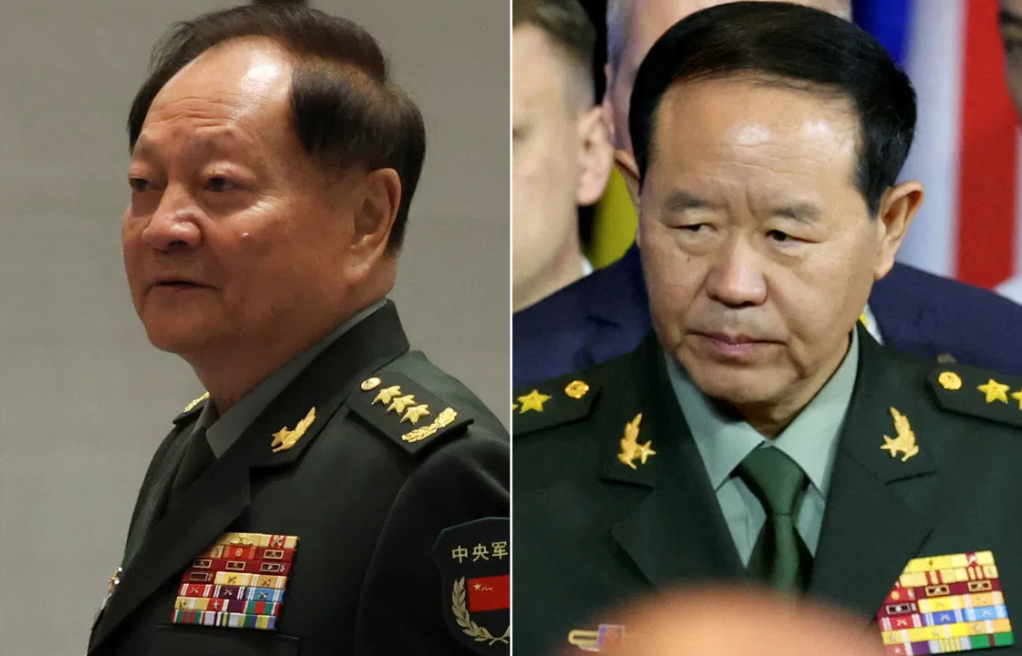
China's government has expelled two high-ranking military figures from the Central Military Commission, the nation's top defence authority, after investigations uncovered what officials characterised as serious breaches of party discipline and legal obligations. The decision, announced on Friday through state media Xinhua, represents a significant reshuffling at the pinnacle of China's defence apparatus and underscores the ongoing nature of anti-corruption measures that have reshaped the military hierarchy over recent years.
Zhang Youxia, who held the position of vice-chairman at the CMC and sat on China's elite Politburo, and Liu Zhenli, a CMC member and chief of the CMC's Joint Staff Department, have both been removed from the state version of the commission following the announcement. Their departure leaves the commission with just two active members still in post, including President Xi Jinping himself, a dramatic reduction from the seven-member body that existed previously. The Standing Committee of the National People's Congress formally announced the removals by publishing an updated roster of parliamentary deputies from which both officers' names were conspicuously absent.
Understanding the significance of these removals requires recognising the intricate dual structure through which China's military operates. The country maintains parallel Communist Party and state CMC bodies that function as a unified institution, though they maintain separate formal nomenclature. While Friday's announcement addressed Zhang and Liu's positions within the state CMC specifically, neither has been publicly or formally stripped of their roles within the party's Central Military Commission at this juncture. This distinction matters substantially, as it leaves open the possibility of further action or suggests that party-level removal may follow.
Zhang occupied a particularly consequential position as Xi's deputy in military affairs, making his removal a notable development in the power structure surrounding China's supreme leader. His tenure represented a key post in the defence establishment hierarchy, and his removal signals that no position, regardless of proximity to Xi, is exempt from investigation during this prolonged anti-corruption campaign. The investigation that preceded his removal underscores that the scrutiny extends throughout the senior echelons of command, suggesting that the anti-corruption apparatus continues to operate with considerable autonomy and reach.
The latest purges form part of a comprehensive anti-corruption initiative that Xi initiated in 2012, a campaign that has fundamentally reshaped China's military leadership over the past decade. The initiative has resulted in investigations, removals, and purges affecting scores of senior officers and defence ministry officials. Last month, Xi himself called upon senior Communist Party leadership to intensify the fight against corruption within military institutions, indicating that the campaign remains a priority despite the considerable organisational changes it has already wrought.
The removals announced Friday encompassed additional military and civilian officials beyond Zhang and Liu. Lieutenant General Zhong Shaojun, a former director of the CMC General Office, and General Ju Qiansheng, who previously commanded the military's Strategic Support Force, also lost their parliamentary seats. These removals suggest a broader sweep affecting various sections of the defence establishment, from operational command structures to administrative organs. The inclusion of individuals from strategic technology sectors indicates that scrutiny is not confined to uniformed military personnel alone.
Civilian officials with defence connections have also been caught in the investigation net. Gao Shiwen, formerly mayor of Nanchang in southern China, was removed after the parliamentary announcement. Significantly, Shiwen's career included previous employment at China Aerospace Science and Technology Corporation, a state-owned enterprise responsible for critical aerospace and defence programmes. This detail suggests that anti-corruption investigations extend into the broader defence-industrial complex beyond purely military structures, potentially reflecting concerns about procurement practices, contract management, or strategic technology stewardship.
Separately, the political advisory structure has undertaken complementary action. Zhao Zongqi, a former commander of the Western Theatre Command who held responsibility during the 2020 border clashes between China and India, was stripped of his advisory body membership by China's top political advisory body this week. Zongqi's removal, occurring in close temporal proximity to Zhang and Liu's dismissals, suggests that multiple investigatory and disciplinary channels are operating in coordination, each targeting different institutional domains within the broader security apparatus.
For regional observers and policymakers in Southeast Asia, these developments carry implications worth considering. The purges demonstrate that military modernisation and restructuring remain active priorities for Beijing, with leadership keen to ensure that corruption does not compromise defence capability. The removal of the Western Theatre Command's former chief is particularly noteworthy given that theatre's responsibility for areas bordering Southeast Asian nations and the broader Indo-Pacific region. Any instability, investigation-driven distraction, or power vacuum in that command structure could influence Beijing's strategic posture toward neighbouring countries.
The scale of these removals—reducing the CMC to merely two active members—raises questions about institutional continuity and decision-making processes during this transitional period. While Xi's personal presence ensures ultimate authority remains clear, the practical challenges of operating the commission with such depleted membership merit consideration. This may necessitate temporary modifications to how military affairs are coordinated or accelerate the promotion of replacement personnel into senior roles, processes that themselves can generate uncertainty or discord within the ranks.
The anti-corruption campaign's persistence after more than a decade suggests that either systemic disciplinary challenges remain embedded within military institutions, or that the campaign serves broader purposes beyond simple anti-corruption enforcement. The comprehensive nature of investigations—touching uniformed officers, defence ministry civilians, aerospace executives, and regional commanders—indicates a thoroughgoing effort to ensure loyalty, eliminate potential rival power bases, or consolidate control over strategic sectors. For external parties monitoring Chinese military developments, these purges represent both an assertion of Xi's control and a potential window into organisational vulnerabilities or tensions within the defence establishment that merit careful observation.

