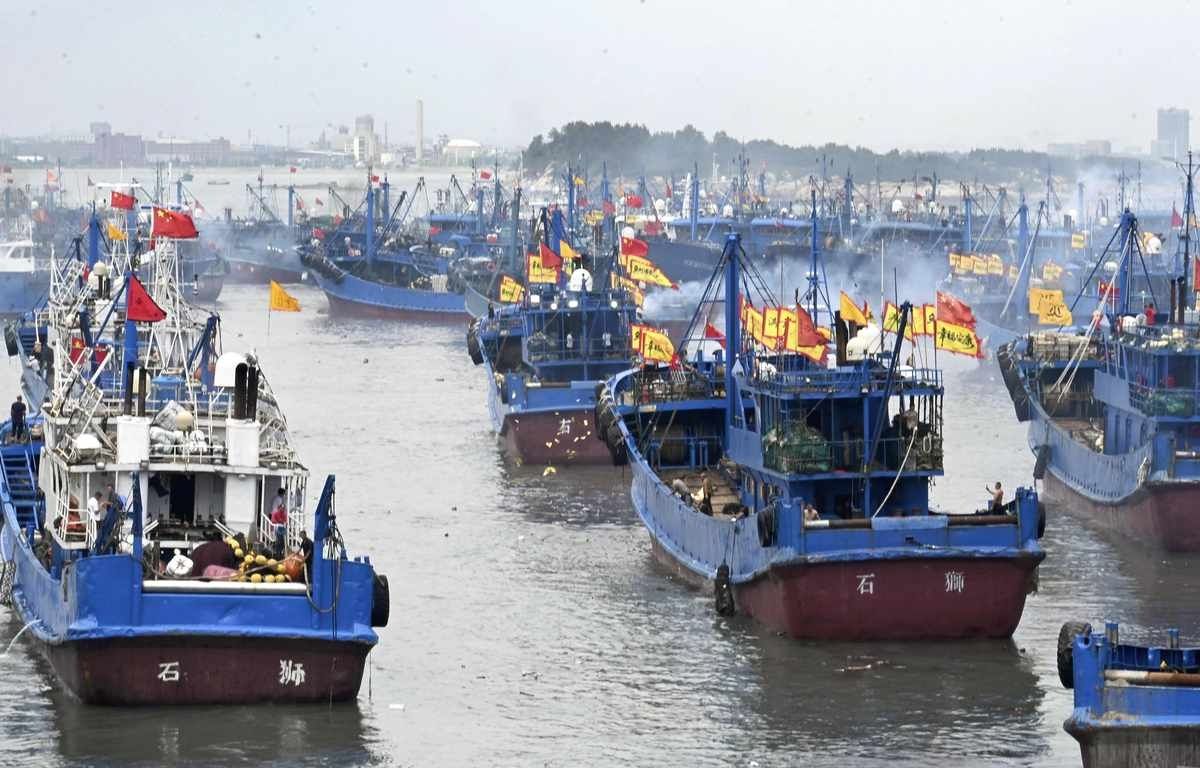
The resumption of Chinese fishing operations in the East China Sea marks a significant moment in an already fraught territorial dispute. On August 15, China ended its seasonal fishing moratorium that had restricted its vessels from operating in contested waters, including those surrounding the Senkaku Islands and the Taiwan Strait. Within 24 hours, the impact was visible: 654 fishing boats departed from the port of Shishi alone on Sunday morning, August 16, many displaying Chinese flags alongside red and yellow banners traditionally signifying hopes for abundant catches and safe voyages. The ceremonial departure, complete with the sound of firecrackers echoing across the harbour, underscores the cultural and economic significance of this fishing season for coastal communities in Fujian Province.
The timing of the ban's lifting carries particular weight given the deteriorating relationship between Tokyo and Beijing. Historically, the waters around the Senkaku Islands have been flashpoints for confrontation. In August 2016, a coordinated incursion saw Chinese Coast Guard vessels accompanied by 200 to 400 fishing boats descend upon the area, a manoeuvre that Japan interpreted as calculated intimidation. Tokyo lodged a formal protest, characterising the episode as a unilateral escalation that violated regional stability. The incident occurred shortly after the Arbitral Tribunal in The Hague ruled against China's expansive sovereignty claims in the South China Sea, a decision that Beijing viewed with considerable displeasure and that observers believed motivated the subsequent show of force around the Senkaku Islands.
What makes the current situation noteworthy is the apparent shift in Beijing's approach to managing these sensitive waters. In recent years, Chinese local authorities have quietly discouraged fishermen from operating in areas near Japan, ostensibly to prevent accidents that could trigger diplomatic crises. This restraint has been evident in a dramatic reduction in incursions: the Japan Coast Guard issued 81 warnings to Chinese fishing vessels operating in Senkaku territorial waters in 2021, but that figure plummeted to just four by 2025. The decline suggests a degree of coordination between Beijing's maritime authorities and fishing communities, though the strictures have remained informal rather than explicitly coercive.
However, recent signals from Chinese officialdom suggest a possible recalibration of this cautious approach. On August 7, authorities in Quanzhou—the city administering Shishi—issued directives to strengthen surveillance of sensitive waters, language that could be interpreted as tacit permission for fishing operations to resume in contested zones under official oversight. More tellingly, the annual fishing notice issued this year contains a notable omission. Previous announcements, including last year's guidance, explicitly warned against "cross-border fishing in sensitive waters such as those of South Korea, North Korea and Japan." The notice dated April 30 this year, by contrast, mentioned only prohibitions on fishing in the China-South Korea interim measures area, conspicuously deleting any reference to Japanese waters. Diplomatic sources regard this deletion as potentially significant, suggesting that Chinese policymakers may be preparing the ground for renewed activity in disputed zones.
Fishermen themselves appear to be reading these signals with interest. A fisherman in his 50s, speaking anonymously to reporters on Saturday, acknowledged that the waters around the Senkaku Islands remain extraordinarily productive fishing grounds. He noted the delicate calculus that operating crews must navigate: venturing too close to Japan invites apprehension by Chinese surveillance authorities, yet no explicit prohibition has been formally announced. "We haven't been told outright not to go there," he explained, capturing the ambiguity that characterises Beijing's current posture. This deliberate vagueness may serve multiple purposes for the Chinese government—it preserves deniability whilst signalling to Japanese counterparts that fishing pressure may resume, whilst simultaneously allowing for course correction if diplomatic circumstances demand.
For Japan, the situation demands close attention precisely because the calculus governing these waters has shifted. The Senkaku Islands, known as the Diaoyu Islands in China, represent far more than a fishing dispute; they constitute a symbolic and strategic flashpoint in a broader competition for regional dominance. Tokyo's ability to maintain effective control over these waters depends partly on the ability to manage the frequency and character of Chinese maritime incursions. A renewed influx of fishing vessels, particularly if coordinated with Chinese government assets, could serve as a pressure point designed to test Japan's resolve and perhaps to normalise Chinese presence in the area through repetition and incremental expansion.
The broader context underscores why Japan views these developments with apprehension. Japan-China relations have deteriorated markedly in recent years over multiple issues: territorial disputes, historical grievances, competition for regional influence, and growing divergence on geopolitical questions involving the United States and other powers. Fishing rights might seem marginal compared to these weightier concerns, yet maritime incidents have historically possessed the capacity to escalate tensions rapidly. A collision at sea, perceived harassment of fishing vessels, or a confrontation between coast guard forces could easily spiral into a serious diplomatic crisis. Beijing's apparent recalibration of its fishing policy therefore signals not merely an economic adjustment but potentially a willingness to apply renewed pressure on territorial claims through civilian maritime activity.
Japan's monitoring apparatus will likely intensify in the coming weeks as the fishing season progresses. The Japan Coast Guard will presumably increase patrols and documentation of Chinese fishing vessel movements, establishing a baseline against which future escalations can be measured. Simultaneously, Tokyo will likely maintain diplomatic channels to convey its concerns regarding any systematic effort to overwhelm Japanese administrative control through coordinated fishing operations. The delicate balance that has existed—wherein China refrains from provocative action whilst Japan tolerates Chinese fishing presence under certain conditions—may be shifting toward a renewed contestation of these waters.
The implications extend beyond the bilateral relationship. Southeast Asian nations, particularly the Philippines and Vietnam, which face their own territorial disputes with China in the South China Sea, will be watching carefully how Japan manages this challenge. Any indication that China successfully uses fishing fleet coordination to establish new patterns of presence and access could embolden similar tactics elsewhere in the region. Conversely, should Japan successfully maintain its administrative authority and deter large-scale Chinese fishing incursions, it would send an important signal about the costs of maritime adventurism in contested waters. The resumption of fishing in the East China Sea therefore merits careful observation not merely as a bilateral matter but as a potential harbinger of broader shifts in how China pursues its territorial ambitions in East and Southeast Asia.

