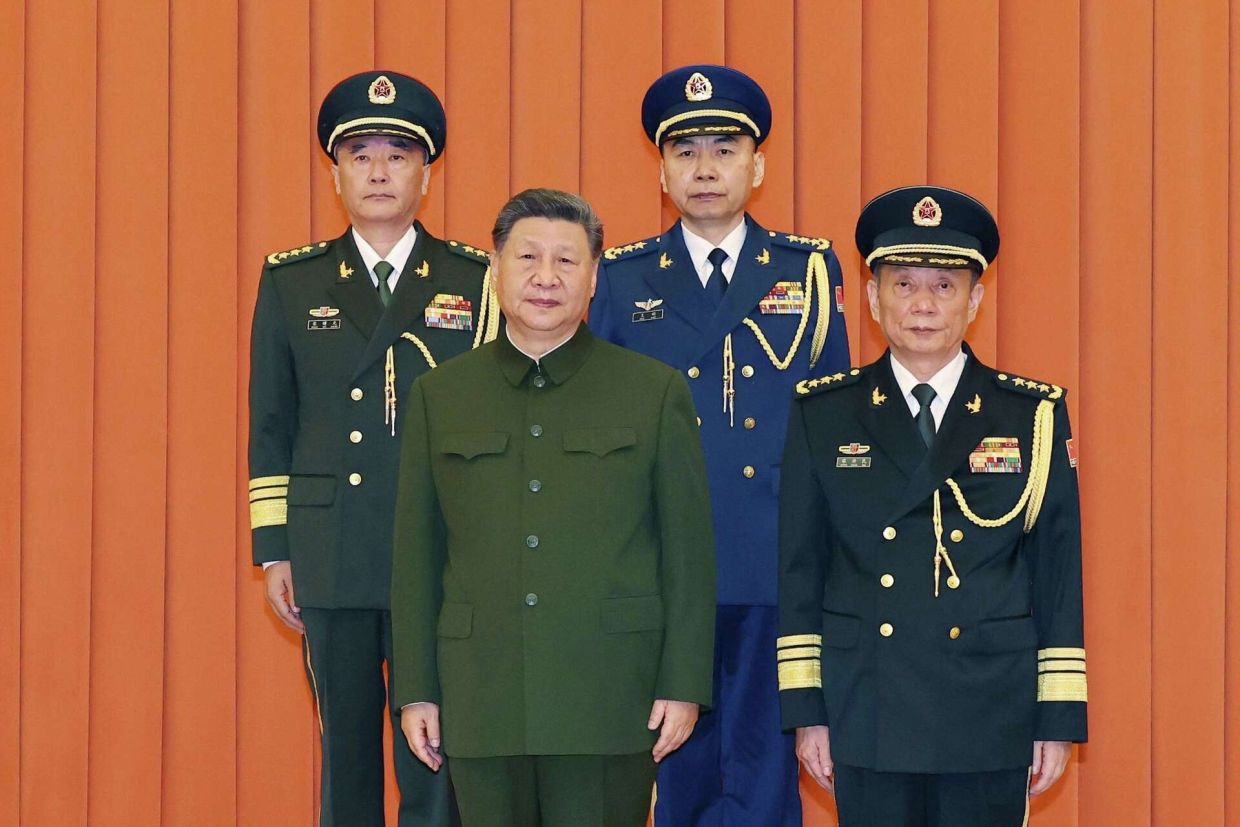
China's military has elevated two senior officers to the rank of general in a move that observers view as potentially laying groundwork for significant leadership changes within the country's defence establishment. The promotions, announced at a formal ceremony on Friday, July 3, represent the latest chapter in an extensive anti-corruption drive that has systematically removed numerous high-ranking commanders from their positions. Zhang Shuguang and air force commander Wang Gang received their promotions directly from President Xi Jinping, who holds the additional portfolio of military chief and chairs the Central Military Commission, the apex body overseeing China's armed forces.
The timing and pattern of these appointments suggest strategic intent beyond simple personnel rotation. Zhang's elevation carries particular significance, as he has simultaneously been designated to lead the Central Military Commission's anti-corruption investigation unit. This dual appointment positions him at the intersection of both military advancement and the institutional machinery responsible for rooting out graft and disloyalty within defence ranks. The consolidation of investigative authority within the newly promoted general's purview underscores the systematic nature of the ongoing purge and Xi Jinping's determination to ensure tight control over the military's personnel decisions.
The scale of the anti-corruption campaign has fundamentally altered the composition of the Central Military Commission itself. Ordinarily a seven-member body that serves as the command centre for China's defence policy and military operations, the commission has been reduced to barely functional capacity through these investigations. Currently, only two members remain actively engaged in their roles: Xi Jinping as chairman and Vice Chair Zhang Shengmin. Multiple former vice chairs, including the military's senior-ranking general, have been removed or effectively sidelined through the corruption process, leaving substantial vacancies that must eventually be filled.
The implications of such widespread removals from China's top military body extend beyond mere housekeeping. The purge reflects Xi Jinping's broader consolidation of power within the military establishment since he assumed control of the Communist Party and state apparatus. By systematically removing potential rivals and entrenched interests, Xi has reshaped the military into an institution more directly aligned with his strategic vision and less beholden to legacy power networks that might have constrained his authority. This reorganisation serves the dual purpose of eliminating potential sources of resistance to his policies while simultaneously demonstrating to remaining officers that loyalty to the Communist Party and its leader is prerequisite for career advancement.
For Malaysia and other Southeast Asian nations, these developments carry strategic relevance given China's growing military assertiveness in the region. A military leadership that has been purged of potential institutional checks and reshaped around loyalty to a single paramount leader may be more willing to pursue aggressive foreign policy objectives. The reduction of institutional constraints within the Central Military Commission could theoretically enable faster decision-making on matters affecting neighbouring countries, including tensions in the South China Sea where Malaysia, among other nations, has competing territorial interests and maritime claims.
The expected announcement of a completely restructured Central Military Commission later in the following year, at the conclusion of the current five-year term, suggests that these current promotions represent transitional arrangements rather than final resolutions. Zhang and Wang may be auditioning for permanent positions on the reconstituted commission, or they may serve as trusted lieutenants implementing Xi's vision while others are evaluated for longer-term roles. The staggered nature of these changes indicates a carefully choreographed process designed to maintain institutional continuity while fundamentally altering the power balance within military leadership.
The anti-corruption campaign itself demands examination regarding its authenticity versus its political utility. While corruption undoubtedly exists within China's military, observers note that the campaign has disproportionately affected senior officers who might represent rival power centres or resistance to Xi's policies. This blending of legitimate anti-graft efforts with political consolidation reflects patterns seen elsewhere in Xi's governance, where institutional reforms and anti-corruption drives frequently serve to eliminate competitors and concentrate authority. The transparency and due process in these investigations remain limited, with some removed officers receiving minimal public explanation for their dismissals.
For regional analysts, the pattern is instructive. Military purges coupled with the elevation of loyal subordinates typically precede either major policy shifts or significant organisational restructuring. The timing suggests that China may be preparing not only new military leadership but potentially revised strategic approaches. Whether these relate to Taiwan, maritime disputes in the South China Sea, or broader Indo-Pacific strategy remains to be determined, but the architectural changes underway within the military establishment warrant close monitoring by neighbouring countries.
The promotion of Wang Gang, the air force commander, holds additional significance given the increasing emphasis on air and naval power within Chinese military doctrine. Elevating an air force officer signals the continued priority being placed on modernising and expanding aerospace capabilities, essential for any military hoping to project force across the Taiwan Strait or throughout the South China Sea. The elevation of air force leadership alongside army-linked figures suggests a balanced approach to military modernisation rather than favour toward any single service branch.
These developments underscore the extent to which personality-driven governance has come to characterise the highest levels of Chinese political and military institutions. Rather than institutional checks and collective decision-making forums, power is increasingly concentrated in the hands of Xi and his closest allies. The seven-member commission, theoretically a collegial body, has become a vehicle for implementing the paramount leader's will. This centralisation may enhance decision-making speed and coherence but at the cost of institutional safeguards and the moderating influence of competing perspectives within the military's highest councils.

