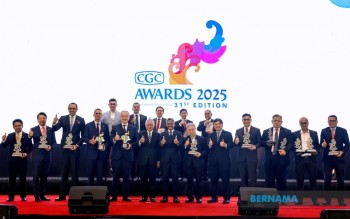
Malaysia's credit guarantee authority has recognised 32 outstanding micro, small and medium enterprises and their financial partners in a landmark ceremony that underscores the critical importance of resilience and inclusive growth in the nation's entrepreneurial landscape. The 31st CGC Awards 2025, presented by Credit Guarantee Corporation Malaysia Bhd, celebrated businesses and ecosystem players demonstrating adaptability and collaborative spirit amid an increasingly complex operating environment.
CGC chairman Datuk Mohammed Hussein framed resilience not merely as access to financing but as a deeper characteristic rooted in the discipline and conduct of business owners themselves. His remarks reflected a philosophical shift in how policymakers understand enterprise sustainability—moving beyond capital injection to emphasise the personal attributes that enable companies to navigate disruption. This perspective carries particular weight for Malaysian businesses confronting volatile commodity prices, supply chain fragmentation, and shifting consumer preferences, challenges that test the mettle of operators across sectors.
The structural support extending across Malaysia's financial ecosystem remains crucial to translating such resilience into tangible outcomes. Datuk Mohammed Hussein articulated a multi-stakeholder model whereby government establishes regulatory stability, research bodies facilitate technology commercialisation, large corporations integrate smaller suppliers into their value chains, and financial institutions function as catalysts for growth capital. This ecosystem approach recognises that no single actor—whether lender, regulator, or entrepreneur—can sustain business expansion in isolation.
CGC's deepening commitment to Bumiputera enterprise participation reflects both policy priority and pragmatic business strategy. The corporation channelled RM223 million in guarantees to 27 Bumiputera companies during the preceding year, demonstrating tangible commitment to broadening ownership participation in high-value sectors. Such allocation patterns matter significantly for Malaysia's medium-term economic inclusivity, as Bumiputera participation in commerce remains concentrated in certain industries and regions, with gaps persisting in technology-intensive and export-oriented segments.
Environmental, social and governance-linked guarantees reached RM1.2 billion, surpassing the RM1 billion target and signalling market alignment with sustainability imperatives. This threshold-breaking performance suggests growing appetite among Malaysian enterprises for financing tied to responsible business practices. For regional investors and trading partners, such metrics indicate Malaysia's preparedness to meet international standards on climate transition and corporate governance, enhancing the nation's competitive positioning in global supply networks.
The awards spanned three distinct categories recognising both financial and non-financial institutions alongside emerging enterprises. Alliance Bank Malaysia Bhd and CIMB Islamic Bank Bhd secured the Best Financial Partner accolade, acknowledging their scaled commitment to guarantee utilisation and MSME engagement. OCBC Al-Amin Bank Bhd's recognition in the Bumiputera category and Maybank Islamic Bhd's special recognition award reflect the growing sophistication of Islamic finance in serving proprietors previously marginalised from conventional banking relationships.
The participation of development finance institutions—notably Bank Simpanan Nasional and SME Development Bank Malaysia—underscores the hybrid financing landscape essential for Malaysian enterprises. These institutions function as counter-cyclical providers, stepping in when commercial lenders retreat, thereby maintaining credit continuity for viable businesses during downturns. Their presence within the awards taxonomy validates their structural role in inclusive growth architecture.
The launch of Bank Negara Malaysia-CGC Portfolio Guarantee and Portfolio Guarantee-i schemes represents a significant operational scaling, introducing RM10 billion in shared-risk financing capacity targeting approximately 12,100 MSMEs. These schemes redistribute lending risk between financial institutions and the guarantee corporation, incentivising banks to extend credit to borrowers perceived as higher-risk while protecting institutional balance sheets. For Malaysian entrepreneurs, the mechanism reduces collateral requirements and approval friction, particularly consequential for asset-light businesses in services and technology sectors.
The dual-scheme structure—encompassing conventional and Islamic financing pathways—reflects Malaysia's positioning as a dual financial system with growing Islamic finance sophistication. Entrepreneurs can access capital aligned with their operational preferences and religious obligations, expanding the addressable market for credit products and reducing financing constraints rooted in product misalignment rather than creditworthiness.
These guarantee schemes address a persistent challenge in Malaysian MSME development: the productivity-growth gap whereby viable businesses cannot access growth capital due to information asymmetries and limited collateral. By introducing standardised risk-sharing terms, the schemes enable financial institutions to deploy capital toward business expansion, productivity enhancement, and sustainability transitions—activities generating multiplier effects throughout regional economies and employment bases.
CGC's commitment through its Group 2030 strategic framework to deepen MSME impact while advancing financial inclusion positions the corporation as integral to Malaysia's economic resilience agenda. Sustained collaboration with government agencies, financial institutions, and corporate buyers creates reinforcing feedback loops whereby MSME development supports larger corporate supply chains, government revenue bases, and employment stability—interconnections particularly vital for a mid-income economy navigating structural transformation toward higher-value activities.
For Southeast Asian observers, Malaysia's guarantee-based approach offers instructive lessons in risk-sharing architecture and institutional design. As regional economies grapple with MSME capitalisation constraints and uneven financial access, Malaysia's evolution toward portfolio guarantees and ecosystem collaboration provides a replicable framework adapted to local contexts and financial sophistication levels. The awards ceremony thus represents more than ceremonial recognition; it signals institutional commitment to scaling inclusive growth mechanisms essential for shared prosperity and economic resilience across the enterprise landscape.

