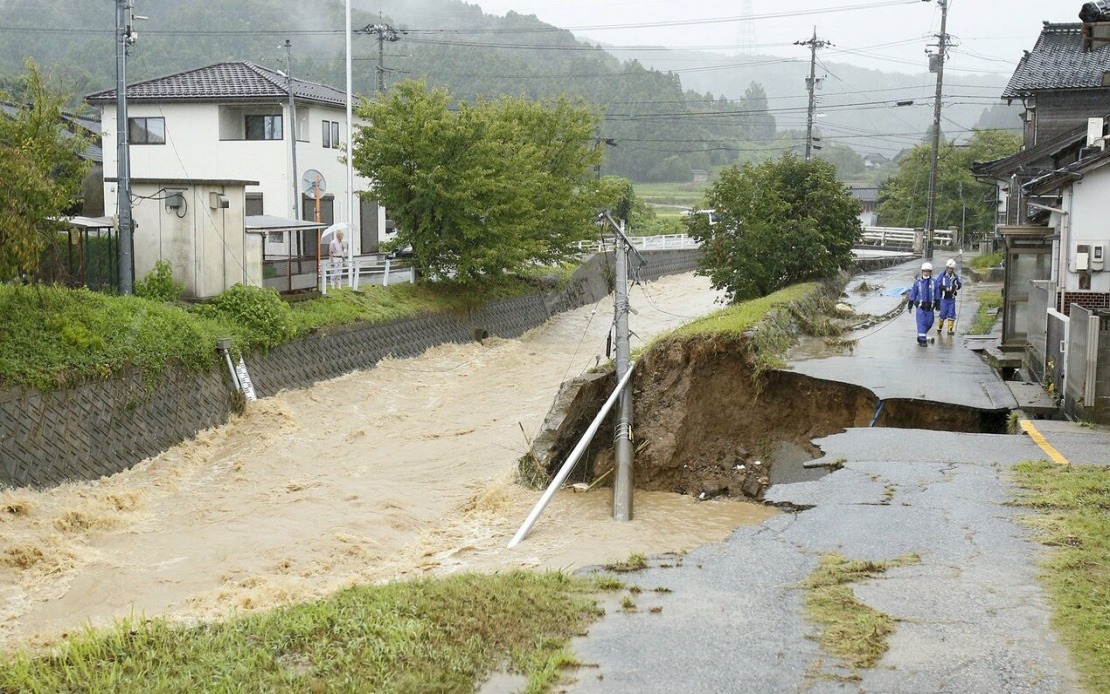
Central Japan faced a meteorological crisis on Thursday as torrential downpours swept across multiple prefectures, unleashing a cascade of environmental hazards including landslides and severe flooding. The Japan Meteorological Agency responded by issuing its most critical alert status for designated municipalities, signalling that dangerous conditions had either already materialised or were imminent. The deluge left residents scrambling to comply with evacuation orders while emergency services prepared for potential mass-casualty incidents across the affected region.
The scope of the warning reflected the gravity of the situation. Five municipalities across Ishikawa and Toyama prefectures—Himi, Hakui, Shika, Hodatsushimizu, and Nakanoto—received the Level 5 designation, the highest classification in Japan's weather alert system. This classification is reserved for scenarios where a major disaster has either transpired or is virtually certain to occur. Approximately 180,000 residents across these jurisdictions received formal advisories to either evacuate to designated shelters or implement immediate protective measures to preserve their safety. Local government authorities urged vigilance particularly against terrain instability and water-related hazards.
The rainfall statistics underscored the exceptional nature of the weather event. Within a twelve-hour window ending at 7:20 am on Thursday, Himi and Hakui each recorded precipitation exceeding 300 millimetres, a threshold that established new records for these locations. Hodatsushimizu received over 200 millimetres during the same period, also setting a historical benchmark. These figures represented rainfall intensity far exceeding typical seasonal patterns and triggering immediate hydrological stress across the landscape.
On the ground, the consequences manifested swiftly and dramatically. A firefighter in his fifties serving with a local volunteer corps in Himi reported to Kyodo News that a river had breached its banks, with multiple motor vehicles now submerged beneath the floodwaters. These stranded vehicles symbolised the rapid deterioration of conditions and the danger posed to motorists caught unawares by the sudden inundation. Despite the widespread damage and displacement, the Ishikawa prefectural government reported no confirmed fatalities as of the last update, though rescue operations were still underway in some areas.
The meteorological setup driving this extreme weather system involved a convergence of destabilising factors. A weather front extending from the Sea of Japan was progressing eastward through the northern and eastern portions of the country, with projections indicating southward movement throughout Friday. This frontal boundary, combined with a cold-air mass and a trough of low atmospheric pressure, created conditions of extreme instability. The Japan Meteorological Agency anticipated that rainfall would persist, with forecasts suggesting up to 200 millimetres across the Hokuriku region and 150 millimetres in the Kanto-Koshin and Tokai areas over the following 24 hours.
Niigata Prefecture, which shares a border with Toyama, also experienced significant heavy rain during the same period, extending the geographic footprint of the weather system. The multi-prefecture impact suggested a large-scale weather pattern rather than a localised phenomenon, complicating relief coordination and stretching emergency response resources across a wider territory. This geographical spread increased the challenge for authorities attempting to manage evacuations and rescue operations simultaneously across multiple jurisdictions.
The current crisis occurred against the backdrop of a similar but more devastating event earlier in August. Just weeks prior, the Chiba Prefecture municipalities near Tokyo received a Level 5 warning due to comparable atmospheric conditions, resulting in substantial flooding and a death toll of thirteen individuals. That incident had demonstrated the lethal potential of such weather systems, with floodwaters immobilising thousands of vehicles—at one point, approximately 2,500 automobiles were abandoned across prefectural roadways as residents fled rising waters. The recent memory of that tragedy lent additional urgency to evacuation protocols and public warnings in the current situation.
For Malaysia and other Southeast Asian nations, Japan's experience with extreme precipitation events carries instructive value. While Southeast Asia's climate differs substantially from temperate Japan, the region faces its own torrential rainfall challenges during monsoon seasons. The efficiency of Japan's warning systems, evacuation procedures, and meteorological forecasting capabilities offer models worth studying as Southeast Asian countries enhance their disaster preparedness infrastructure. Malaysia in particular experiences annual flooding during monsoon periods, and examining how technologically advanced societies operationalise early warning systems provides perspective on best practices in public safety communication.
The vulnerability of modern motorised transport networks to flash flooding, as evidenced by the submerged vehicles in both the current and prior events, also merits consideration. Malaysian urban planning authorities grapple with similar challenges as vehicular congestion increases and drainage infrastructure struggles to accommodate intensifying rainfall events. The Japanese experience suggests that improving infrastructure resilience and public awareness about the dangers of attempting to drive through floodwaters remains essential, regardless of a nation's technological advancement.
As rescue operations continued and weather systems tracked their projected paths, Japanese authorities maintained heightened vigilance. The convergence of a mobile weather front with unstable atmospheric layers suggested that rainfall intensity could fluctuate unpredictably throughout the forecast period. Residents heeding evacuation guidance faced extended displacement, with uncertainty about when conditions would stabilise sufficiently to permit safe return. The incident underscored that even highly developed nations with sophisticated meteorological agencies remain vulnerable to nature's extremes when atmospheric conditions align to produce exceptional precipitation events.

