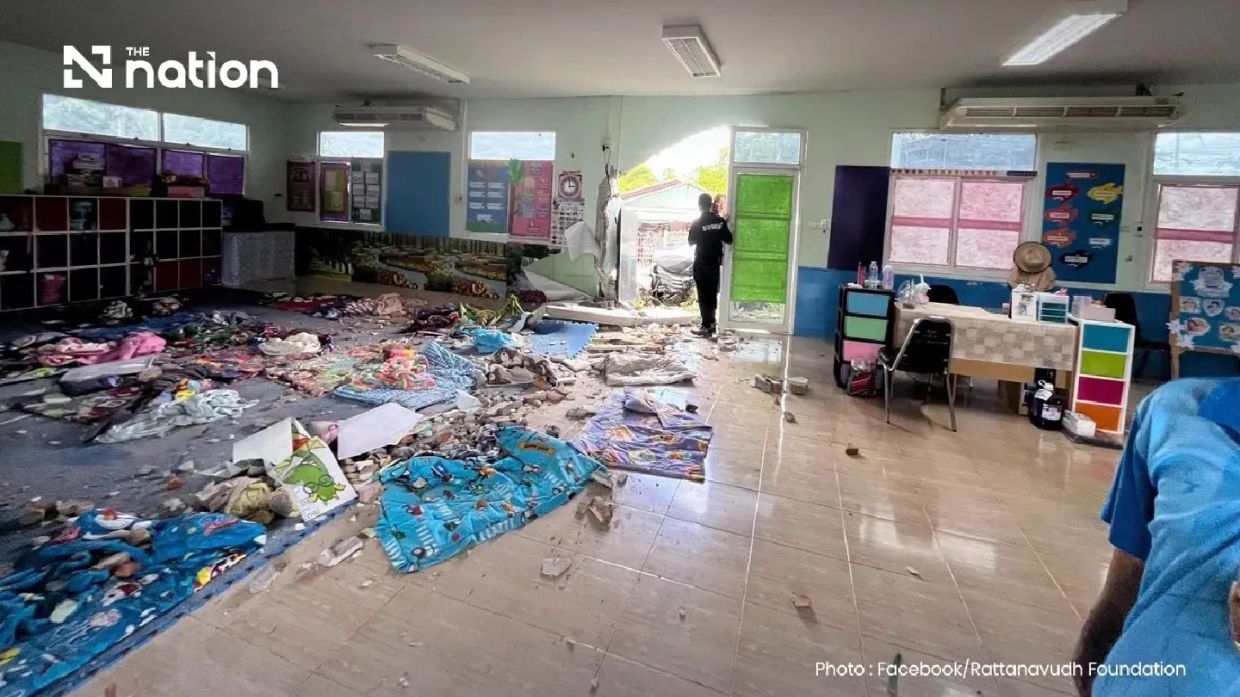
A private saloon car careened out of control and ploughed through a classroom at the Ban Nong Song Ton Child Development Centre in Mueang Kanchanaburi district on Friday, August 7, 2026, leaving 15 children with injuries in what residents describe as a shocking and terrifying incident. The vehicle struck the facility during afternoon rest time, when young children were lying down for their nap, transforming an ordinary afternoon into a crisis that would ripple through the local community and raise fresh concerns about childcare facility safety in Thailand.
The collision caused significant structural damage to the building, with the force of impact dislodging debris and fragments that scattered across the classroom. The 15 injured children sustained a variety of wounds, predominantly head injuries, along with trauma from the debris field created by the crash. Beyond the physical injuries, many of the children experienced psychological shock from the unexpected and violent intrusion into their safe space. The remaining 19 children who were present but uninjured at the facility escaped the immediate path of the vehicle, though they too would have witnessed the chaos and disruption of the emergency response that followed.
Emergency responders mobilised swiftly once the Rattanavudh Foundation received the alert. Personnel from both the Rattanavudh Foundation and the Phithak Kan Foundation arrived at the scene to conduct urgent assessments and administer first aid to the injured children. The coordinated response reflected Thailand's established protocols for childcare emergencies, yet it also highlighted the vulnerability of young children in institutional settings to sudden, unforeseeable hazards. Emergency and rescue vehicles rapidly transported all 15 injured children to Phaholpolpayuhasaena Hospital, where medical staff conducted thorough examinations to evaluate the extent of injuries and rule out internal or delayed complications.
The hospital's assessment brought initial relief to parents and staff. All 15 injured children were confirmed as safe following their medical evaluation, meaning that despite the severity of the incident—a vehicle penetrating a classroom filled with sleeping toddlers—no fatalities occurred and no injuries were deemed life-threatening. This outcome, while fortunate, underscores both the resilience of young bodies and the role of chance in determining the consequences of such accidents. Had the vehicle struck at a slightly different angle, velocity, or time, the outcome could have been vastly different.
The incident raises critical questions about vehicle access to childcare facilities across Thailand and throughout Southeast Asia. Most child development centres are designed primarily with paediatric welfare and educational programming in mind, rather than with structural protections against vehicle intrusion. The Ban Nong Song Ton centre, like many similar facilities in the region, appears to have had insufficient bollards, barriers, or boundary systems to prevent unauthorised vehicle entry into active classroom spaces. This gap in safety infrastructure represents a broader vulnerability affecting thousands of childcare facilities across Thailand, Malaysia, and neighbouring countries.
Investigators would need to determine whether the crash resulted from mechanical failure, driver error, medical emergency experienced by the driver, or another cause entirely. Understanding the root cause becomes essential for preventing similar incidents elsewhere. If driver error or an acute medical event triggered the loss of control, implementation of stricter safety barriers around childcare facilities becomes increasingly justified. If mechanical failure proved responsible, it points to inadequate vehicle maintenance standards that regulators should address.
For Malaysian readers, this incident carries particular resonance given that childcare centre safety remains an evolving concern domestically. Malaysia's rapid urbanisation and increasing reliance on institutional childcare have created growing demand for such facilities, yet not all centres operate under equally stringent safety standards. The Kanchanaburi incident serves as a cautionary reminder that physical infrastructure must keep pace with expanded use, and that vehicle barriers around children's spaces merit serious consideration in facility planning and retrofitting.
The psychological impact on the children who experienced this trauma should not be underestimated. Even children who sustained no physical injuries witnessed a terrifying event that could influence their sense of safety in institutional settings. Parents entrust childcare staff with their children's wellbeing during working hours, operating under an assumption that the facility provides a secure environment. Incidents of this magnitude, however rare, shake that confidence and prompt broader societal conversations about acceptable risk levels in shared spaces.
Thailand's response to this incident will likely influence how other regional nations approach childcare facility safety standards. If the government implements new requirements for vehicle-exclusion infrastructure or conducts audits of existing centres, neighbouring countries including Malaysia may adopt similar measures. The incident also underscores the importance of regular emergency drills and staff training at childcare facilities, ensuring that workers can respond swiftly and appropriately when unexpected crises occur, minimising panic and potential secondary injuries.
The broader context of childcare safety extends beyond individual incidents to encompass systemic approaches. Facility design, staff training, emergency protocols, vehicle access controls, and regular safety audits together form a comprehensive framework for protecting young children. This Kanchanaburi crash represents a single, dramatic failure point in that framework. Moving forward, authorities across Thailand and the region would benefit from examining where similar vulnerabilities exist and implementing measured but effective improvements that balance facility accessibility with genuine protection of children in their care.

