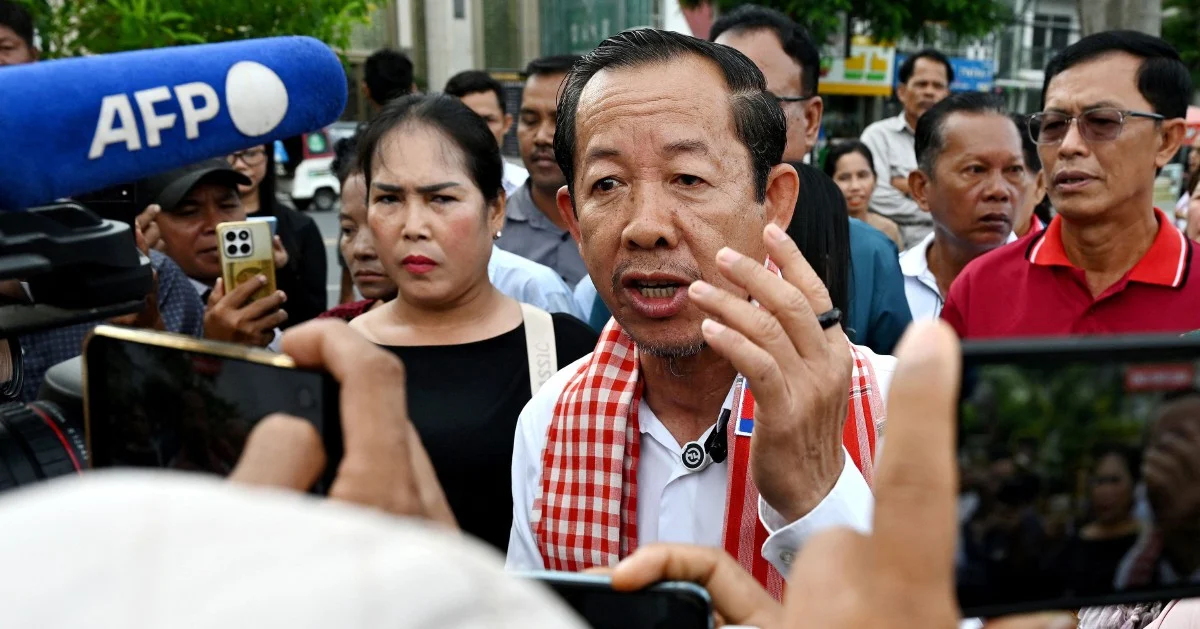
Cambodia's top court has delivered a mixed decision regarding opposition politician Rong Chhun, suspending his prison sentence while simultaneously maintaining his prohibition from participating in elections. The ruling, delivered on Friday in Phnom Penh, represents a partial reprieve for the veteran activist but stops short of fully restoring his political rights, according to statements from his legal representatives.
The Supreme Court's decision to suspend the custodial sentence marks a significant development in Rong Chhun's legal battle, potentially allowing him to remain active in civil society work rather than serving time in confinement. However, the maintenance of the electoral ban represents an enduring constraint on his ability to participate in formal democratic processes, effectively sidelining him from Cambodia's political arena during any upcoming elections.
Rong Chhun has been a prominent figure within Cambodia's opposition movement and labour activism, representing a class of politicians who have faced increasing legal pressure in recent years. The suspension of his imprisonment, while the electoral restriction remains intact, reflects the complexities of Cambodia's judicial system and its relationship with the country's broader political establishment.
The election ban carries particular significance in Southeast Asia's political landscape, where Cambodia has faced international scrutiny regarding democratic freedoms and institutional independence. Such restrictions on opposition figures have become flashpoints in debates about political pluralism and judicial impartiality across the region, with implications extending beyond Phnom Penh's immediate political circles.
For Malaysian observers of Southeast Asian politics, Cambodia's handling of opposition figures provides instructive parallels and contrasts. While Malaysia has experienced its own turbulent relationship with election law and opposition politics, the mechanisms by which candidates are barred from running differ in character and transparency, offering comparative insights into how various democracies in the region navigate contested political terrain.
The legal framework underlying such electoral bans in Cambodia remains opaque to many international observers, with questions persisting about the grounds for disqualification and the due process afforded to affected politicians. The Supreme Court's decision provides limited clarity on these procedural matters, leaving observers to speculate about the specific legal provisions invoked and the court's reasoning.
Rong Chhun's case reflects broader patterns within Cambodian politics where legal instruments have been deployed against opposition elements with increasing frequency. Multiple opposition figures have faced similar restrictions or custodial sentences in recent years, creating a chilling effect on political participation and raising concerns among human rights advocates about the independence of the judicial system.
The suspension of imprisonment rather than outright acquittal suggests a middle-ground approach that may reflect internal political calculations within Cambodia's leadership. Such partial concessions can serve multiple purposes—reducing international criticism while maintaining mechanisms of political control over designated opposition figures—and are not uncommon in Southeast Asian political contexts.
For Cambodia's civil society organisations and advocacy networks, the outcome presents a pragmatic if incomplete victory, allowing Rong Chhun to continue working on labour and social issues outside formal electoral politics. However, the permanence of the electoral ban leaves him constitutionally incapable of translating popular grassroots support into parliamentary representation, fundamentally limiting his political trajectory.
The Supreme Court's decision will likely shape discussion within regional human rights circles about Cambodia's democratic trajectory. International organisations monitoring political freedoms in Southeast Asia frequently cite such cases as evidence of selective judicial processes and unequal treatment of opposition figures, though defenders of Cambodia's governance argue these restrictions serve legitimate public order objectives.
Looking forward, the implications of this ruling extend beyond Rong Chhun individually. The precedent suggests that Cambodia's courts may favour suspending sentences for opposition figures while maintaining electoral restrictions, a formula that potentially addresses international pressure for leniency whilst preserving government control over who can contest elections. This approach reflects the intricate balance between maintaining a veneer of legal due process while constraining genuine political competition.
The decision underscores enduring tensions within Cambodia's political ecosystem between openness to democratic participation and institutional mechanisms designed to preserve the dominance of established power structures. As Cambodia navigates its electoral cycles and international relations, cases like Rong Chhun's will continue influencing perceptions of the kingdom's commitment to pluralistic governance and respect for opposition voices.
%22%2F%3E%3C%2Fpattern%3E%3C%2Fdefs%3E%3Crect%20width%3D%22100%25%22%20height%3D%22100%25%22%20fill%3D%22url(%23phmhnbg)%22%2F%3E%3Crect%20width%3D%22100%25%22%20height%3D%22100%25%22%20fill%3D%22url(%23phmhnbp)%22%2F%3E%3Ctext%20x%3D%2250%25%22%20y%3D%2250%25%22%20text-anchor%3D%22middle%22%20dominant-baseline%3D%22central%22%20fill%3D%22rgba(255%2C255%2C255%2C0.95)%22%20font-family%3D%22Georgia%2C%20'Times%20New%20Roman'%2C%20serif%22%20font-weight%3D%22700%22%20font-size%3D%22226%22%20letter-spacing%3D%22-0.02em%22%3EDeputy%3C%2Ftext%3E%3C%2Fsvg%3E)