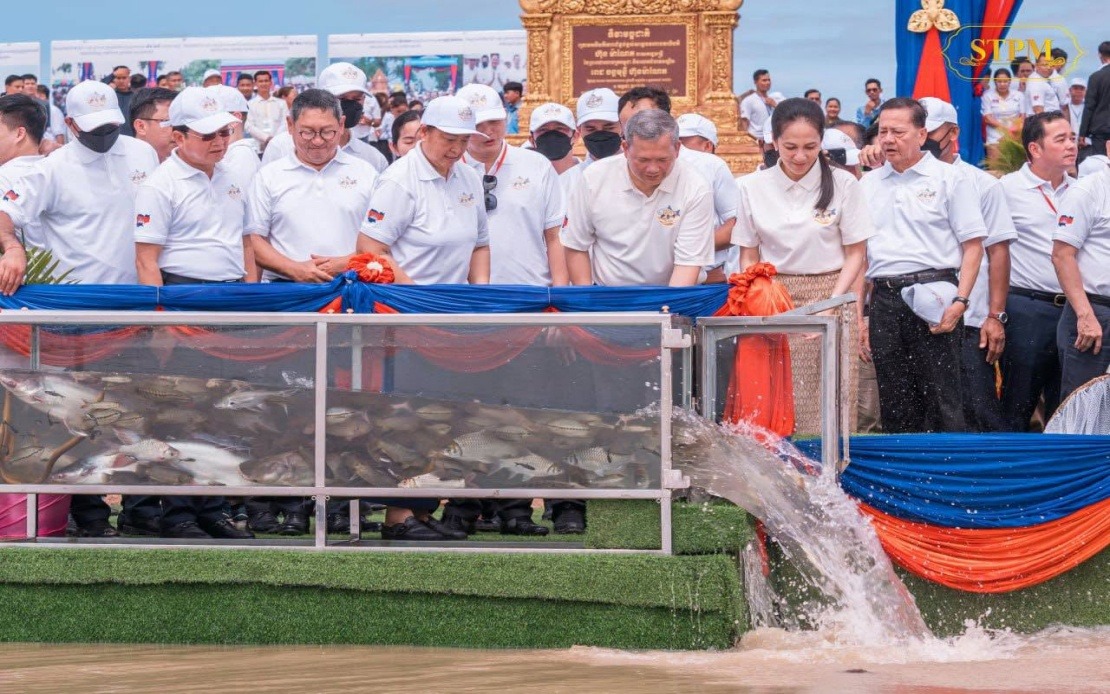
Cambodia's Prime Minister Hun Manet has escalated the government's efforts to safeguard the country's aquatic resources by ordering a comprehensive clampdown on illegal fishing activities in strategically important spawning zones. The directive, announced during National Fish Day celebrations in Svay Rieng Province, reflects growing concern about the degradation of marine ecosystems and the economic pressures facing Cambodia's fishing communities, whose livelihoods depend entirely on healthy fish stocks.
Hun Manet emphasised that protecting Cambodia's waters is not merely an environmental concern but a matter of national food security and economic survival. He positioned fisheries as a fundamental pillar of the kingdom's development, equating the sector's importance to agriculture itself—terming agriculture the "nation's stomach" while describing fisheries as its "source of protein." This framing underscores how deeply fishing is woven into Cambodia's social fabric, with thousands of families deriving income from both small-scale traditional fishing and commercial aquaculture.
Central to the Prime Minister's strategy is the deployment of military units stationed around Tonle Sap lake, Southeast Asia's largest freshwater lake and a critical ecosystem that sustains Cambodia's fishing industry. Hun Manet disclosed that armed forces have been engaged in combating natural resource crimes for the past two years, operating across both terrestrial and marine environments. The decision to utilise military resources reveals a pragmatic acknowledgment that Cambodia currently lacks sufficient specialised law enforcement personnel dedicated to natural resource protection. Rather than continuing indefinite military involvement, Hun Manet signalled an intention to reduce such reliance by strengthening civilian law enforcement capacity and establishing permanent border patrols—a gradual transition that signals institutional maturation.
The enforcement strategy specifically targets large-scale clam dredging operations, which Hun Manet identified as particularly destructive to traditional fishing communities. Clam harvesting using mechanised dredging devastates seabed habitats, destroys breeding grounds, and competes directly with artisanal fishers who depend on accessible coastal resources. By ordering an immediate halt to these operations, the government prioritises the survival of smaller-scale livelihoods over industrial extraction—a choice with significant implications for coastal employment and social stability across provinces like Svay Rieng.
Protecting fish during breeding seasons represents another critical focus. Illegal fishing during spawning periods can decimate fish populations before juveniles reach maturity, creating cascading ecological collapses that threaten future yields. Cambodia's freshwater and marine systems support migratory species that move between the Mekong River system and Tonle Sap, making coordinated seasonal protection essential. By enforcing temporal restrictions on fishing activities, authorities aim to preserve reproductive cycles and maintain sustainable population levels.
To demonstrate commitment to conservation, the government simultaneously undertook a mass stocking initiative, releasing 1.5 million fish and aquatic species into the Vai Ko River during the National Fish Day celebration. Such replenishment exercises, while symbolically significant and providing immediate ecological benefit, represent a supplement rather than a substitute for habitat protection and enforcement. They signal to fishing communities that the government actively invests in maintaining fish supplies, potentially earning cooperation from stakeholders whose compliance is essential to long-term success.
Cambodia's approach offers relevant lessons for Southeast Asian nations facing similar challenges. Illegal fishing thrives in regions where enforcement capacity remains weak, surveillance infrastructure is limited, and economic desperation drives communities to unsustainable harvesting practices. The region's shared waterways—the Mekong River and associated deltas—create transnational dimensions to the problem, requiring coordination that often exceeds individual nations' capabilities. Hun Manet's decision to mobilise military resources reflects a recognition that environmental crime requires resources and logistical capacity traditionally associated with security services.
However, this strategy carries inherent tensions. Military-led enforcement can antagonise fishing communities if perceived as heavy-handed or if operations disrupt legitimate livelihoods. Success depends on accompanying measures: alternative income generation for affected fishers, transparent communication about conservation rationales, and genuine investment in civilian law enforcement capacity. Without these complementary policies, enforcement risks generating resentment that undermines compliance.
For Malaysian observers, Cambodia's situation mirrors challenges within Malaysia's own territorial waters and shared maritime zones. The Straits of Malacca and Malaysian sections of the South China Sea experience illegal fishing by foreign vessels and sophisticated transnational criminal networks. Malaysia's own experience suggests that technological solutions—satellite monitoring, vessel tracking systems, rapid-response maritime patrols—combined with regional cooperation prove more effective than military deployment alone. Cambodia might benefit from similar technological investments to enhance surveillance capabilities while reducing reliance on personnel-intensive operations.
The institutional dimension also matters significantly. Hun Manet's stated goal of reducing military involvement implies development of specialised civilian agencies equipped with training, equipment, and legal authority comparable to maritime law enforcement bodies in developed nations. Building such capacity requires sustained budget allocation and technical training—areas where international cooperation through ASEAN frameworks could provide meaningful support.
Cambodia's freshwater ecosystems differ fundamentally from Malaysia's primarily maritime environment, yet both nations confront common adversaries: economically motivated criminal networks, inadequate enforcement resources, and populations whose survival depends on aquatic resource access. The effectiveness of Hun Manet's crackdown will depend not merely on military mobilisation but on establishing permanent institutional frameworks that balance conservation imperatives with livelihood protection—a challenge that defines fisheries governance across the entire Southeast Asian region.

