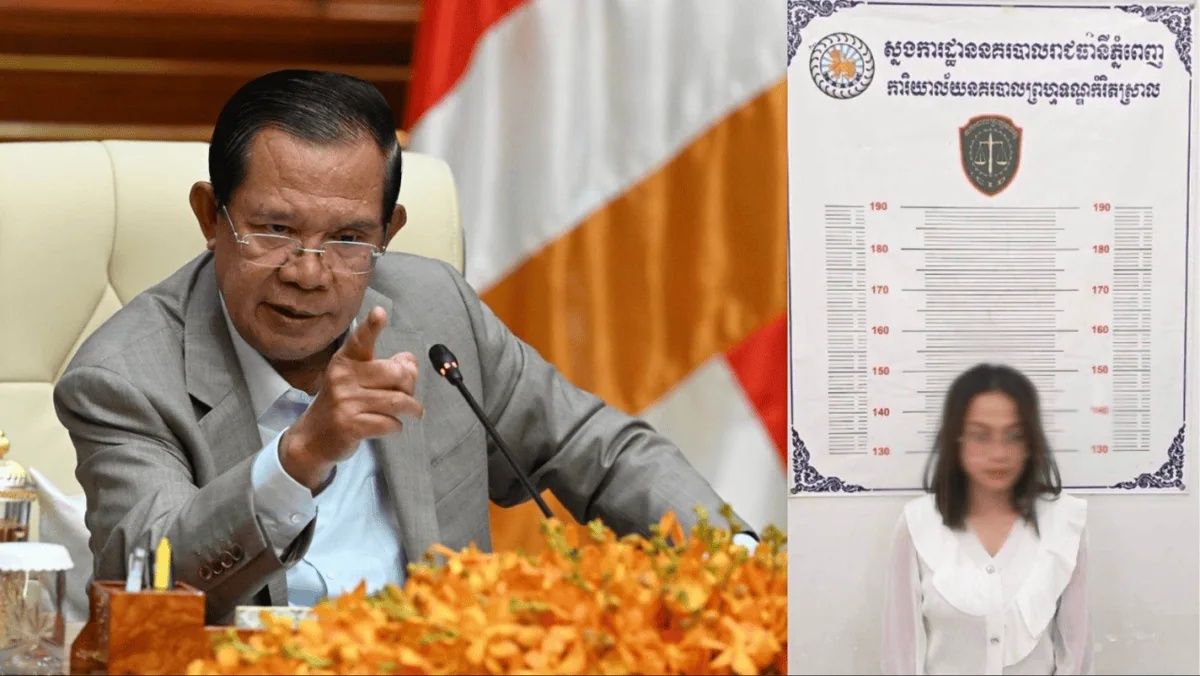
Cambodia's Senate president Hun Sen has instructed government agencies to intensify legal proceedings against individuals whose conduct and speech he contends undermines the dignity of women and traditional Khmer values. During discussions with representatives from the National Council for Women on Friday, Hun Sen directed the council and the Ministry of Women's Affairs to assume the role of plaintiffs in court cases targeting what he characterizes as language and behaviour that erodes societal respect for women and institutional integrity.
The directive emerges from specific incidents that have drawn the attention of Cambodian leadership. Hun Sen referenced an unidentified woman who allegedly deployed offensive language to disparage government bodies and state employees. According to the Prime Minister, officials have already called upon this individual and her spouse to provide a written apology for their conduct. The case exemplifies what Hun Sen sees as a pattern requiring systemic intervention through the judicial framework.
A second prominent example involved a woman named Chenda Sovannary, whose dispute with a soldier over a mobile phone transaction escalated into verbal abuse. Hun Sen expressed particular concern about this incident, questioning why a disagreement over a commercial matter would prompt derogatory speech targeting a military personnel. His comments suggest frustration with what he perceives as a broader erosion of respect for state workers and uniformed personnel across society.
The Cambodian leader's framing of this initiative reveals his perspective on social cohesion and institutional respect. Rather than presenting the measure as a restriction on freedom, Hun Sen contended that protecting social values represents a legitimate function of government, comparable to how international technology platforms enforce community standards and ethical guidelines. His comparison to corporate content moderation suggests an attempt to normalize the proposed enforcement mechanism by reference to widely accepted private-sector practices that regulate user conduct.
Implementing this approach would require substantial coordination across multiple government departments. Hun Sen specifically tasked the National Council for Women to work alongside the Ministry of Interior, the Ministry of Information, the Ministry of Culture and Fine Arts, and the Ministry of Post and Telecommunications in constructing an institutional framework designed to monitor and protect what officials describe as Khmer women's dignity and values. This multi-agency structure indicates the government's intention to create a formal system rather than ad-hoc enforcement.
The surveillance component of the initiative carries particular significance. Hun Sen explicitly called for dedicated monitoring of social media platforms, particularly Facebook, where instances of profanity and personal insults proliferate. He envisioned a dedicated team whose responsibility would encompass systematic tracking of such incidents, suggesting technological and human resources allocated toward identifying and flagging potentially actionable instances of abusive speech across digital platforms.
Hun Sen's characterization of these measures as safeguarding rather than restricting reflects a common pattern in regional governance where officials distinguish between limitations on speech and protections of societal norms. By positioning the initiative as defensive—protecting values under threat rather than censoring expression—Cambodian leadership frames the policy within a nationalist and conservative context that resonates with traditional concepts of social harmony and institutional respect.
The timing and emphasis of this directive warrant attention from those monitoring governance trends across Southeast Asia. Cambodia's approach illustrates how governments in the region navigate tensions between digital-era communication patterns and traditional authority structures. The focus on women's values and social morality, while presented through the language of protection, simultaneously creates mechanisms through which state institutions can expand oversight of public speech and comportment. The involvement of women-focused agencies in prosecuting speech cases adds another interpretive layer, potentially instrumentalizing gender-focused governance frameworks for broader social control objectives.
For Malaysia and other Southeast Asian observers, Cambodia's initiative demonstrates evolving approaches to managing online discourse and social behaviour in rapidly digitalizing societies. The delegation of enforcement authority to specialized councils rather than maintaining such functions exclusively within traditional security apparatus represents one tactical variation on how regional governments address perceived threats to social order. Whether characterizing problematic speech as a women's protection issue, a cultural preservation concern, or a national dignity matter, the underlying mechanism remains consistent: expanding state capacity to identify, prosecute, and penalize individual expression deemed inconsistent with official definitions of appropriate conduct.
The practical implications extend beyond Cambodia's borders. Governments throughout Southeast Asia face similar pressures as social media usage expands and digital communication enables rapid spread of criticism, satire, and dissent. Cambodia's framework—combining multi-agency coordination, dedicated monitoring infrastructure, and framing enforcement as protection of values rather than restriction of rights—offers a template that other administrations might adopt or adapt. For Malaysian audiences, the Cambodian experience provides instructive precedent regarding how governance structures can evolve to accommodate digital-age communication while maintaining institutional prerogatives.
Hun Sen's emphasis that such measures should not be mischaracterized as authoritarian governance underscores the rhetorical sophistication accompanying such initiatives. By invoking corporate content standards and positioning enforcement as protection of women and social values, officials attempt to preempt criticism that such mechanisms represent expanded state control over expression. This rhetorical strategy proves particularly significant in contexts where international scrutiny of governance standards remains heightened and where civil society organizations continue advocating for digital rights protection. The question of whether such frameworks genuinely advance women's dignity or primarily extend state surveillance capacity remains contested among rights advocates and observers.

