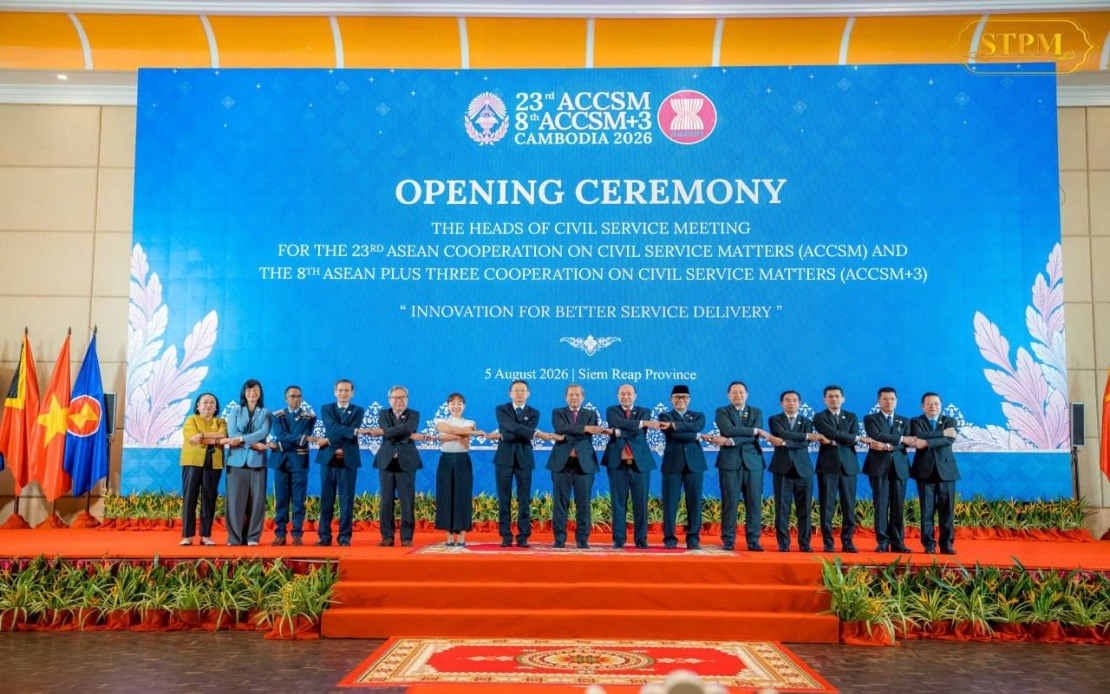
Cambodian Prime Minister Hun Manet has made a compelling case for ASEAN to embrace artificial intelligence and digital technologies as tools for enhancing public administration, but with a crucial caveat: the region must prioritise the needs of ordinary citizens and institutional readiness over the rush to adopt cutting-edge systems. Speaking at high-level governance conferences held in Siem Reap from August 3 to 5, Hun Manet articulated a vision for digital transformation that balances innovation with the practical realities facing Southeast Asian governments.
The gatherings—the 23rd ASEAN Cooperation on Civil Service Matters and the 8th ACCSM Plus Three—brought together senior civil service officials from across the region under the theme "Innovation for Better Service Delivery". Hun Manet's intervention reflects growing momentum within ASEAN toward modernising government operations, yet his framing reveals underlying anxieties about whether the bloc's diverse economies can implement such changes equitably. The Cambodia Premier stressed that technology adoption cannot be a one-size-fits-all exercise; instead, each member state must be permitted to progress at a pace suited to its own institutional capacity and developmental stage.
Hun Manet's central argument rests on a fundamental principle: that innovation in public services must be anchored in robust institutional frameworks and skilled human resources. This perspective challenges the often techno-optimistic narratives that dominate policy discussions, where new tools are presented as panaceas. In Southeast Asia, where civil service capacity varies significantly across countries and even within regions of individual nations, such institutional grounding becomes essential. Without adequate training, proper governance structures, and clear operational procedures, introducing AI systems into government agencies risks creating new inefficiencies rather than eliminating existing ones.
The emphasis on narrowing development gaps resonates particularly with smaller ASEAN economies and those with less advanced technological infrastructure. Nations such as Cambodia, Laos, and Myanmar face genuine constraints in deploying sophisticated AI systems for public administration, from limited IT expertise to inadequate digital infrastructure in rural areas. Hun Manet's call for a "sustainable pace" provides cover for these countries to avoid the pressure of keeping up with more technologically advanced neighbours like Singapore and Thailand, which have already invested heavily in smart governance initiatives. This inclusive framing could help prevent a two-speed ASEAN where technological advancement becomes another marker of inequality.
Beyond domestic implementation, Hun Manet positioned innovation as essential to collective regional resilience. He linked digital transformation directly to ASEAN's capacity to tackle transnational challenges—climate disasters, economic imbalances, and poverty—that no single nation can resolve independently. This strategic linkage between technological modernisation and addressing existential regional problems elevates the conversation beyond administrative efficiency to matters of survival and prosperity. For Malaysian readers, this resonates with concerns about how digital tools can support regional coordination on issues like flood management, disease surveillance, and economic cooperation.
The prime minister's advocacy for ACCSM as a platform for knowledge-sharing and policy harmonisation underscores a recognition that ASEAN's strength lies in coordinated action rather than fragmented national efforts. This suggests potential avenues for developing shared standards around AI implementation in government, mutual capacity-building through secondment and training programmes, and collective procurement of technology solutions that might achieve economies of scale. Malaysia, with its relatively advanced digital infrastructure and civil service capacity, could emerge as a key facilitator in these efforts, potentially positioning its own innovations as models for regional adoption.
Hun Manet's remarks also implicitly acknowledge the risks of rapid digitalisation without proper planning. Southeast Asia has witnessed numerous examples of technology projects that failed because they did not account for local contexts, language requirements, or user behaviour. An AI system deployed in one country's social welfare agency may not function appropriately in another with different demographics, governance structures, or administrative traditions. The call for institutional capacity-building and human resources development thus represents a hard-won lesson from previous development initiatives.
The timing of these comments carries additional weight given broader geopolitical tensions affecting the region. As major powers compete for influence through technology transfer and digital infrastructure projects, ASEAN's commitment to autonomous, people-centred innovation becomes a form of resistance against technological dependence. By emphasising regional cooperation and mutual learning rather than reliance on external vendors, Hun Manet articulated a vision of digital sovereignty—where Southeast Asian nations retain agency over how and when they adopt transformative technologies.
For Malaysian policymakers and civil servants attending these conferences, Hun Manet's message offers both opportunity and caution. The opportunity lies in Malaysia's potential to lead regional capacity-building efforts and export its own innovations across ASEAN. The caution concerns the risks of exporting solutions designed for Malaysia's context to nations with vastly different circumstances. The emphasis on sustainable pace and institutional foundations suggests that the next phase of ASEAN's digital transformation will be characterised less by rapid deployment and more by careful, collaborative implementation that respects diverse starting points and development trajectories across the ten-member bloc.

