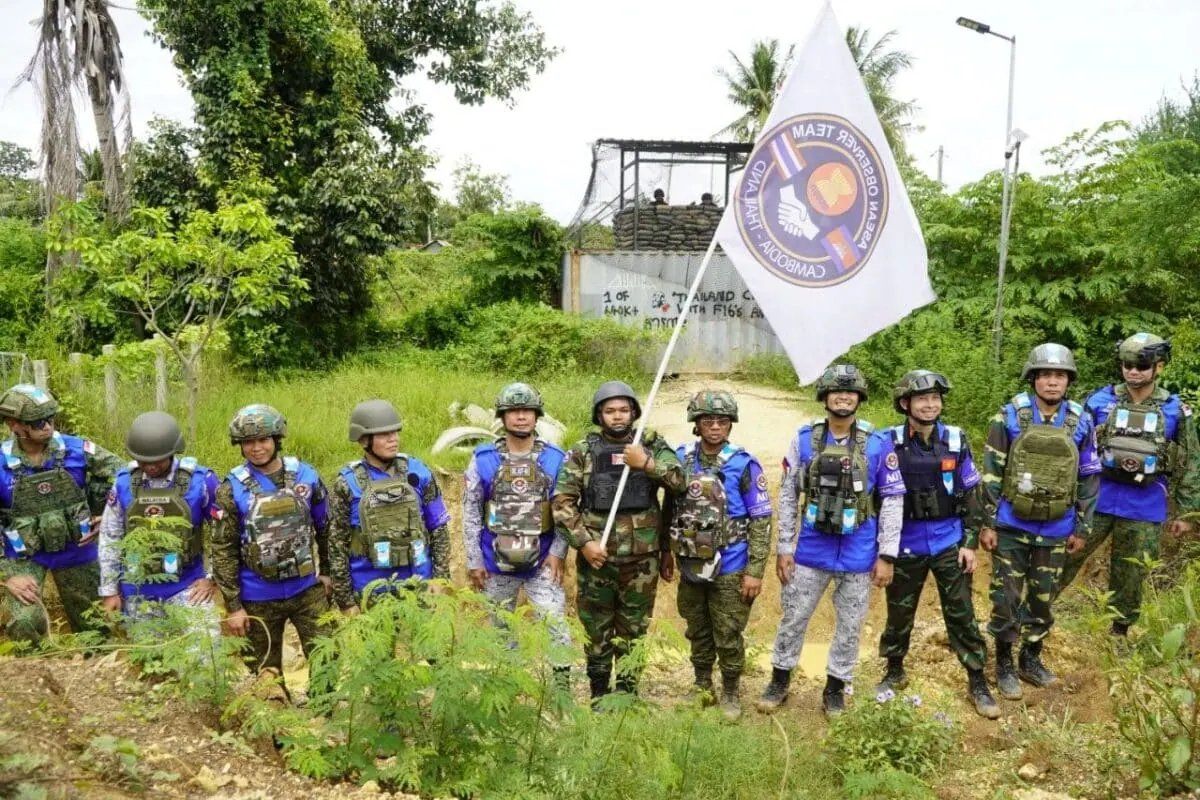
Cambodia's Information Minister Neth Pheaktra has responded sharply to Thailand's dismissal of territorial encroachment allegations by highlighting the growing roster of international observers documenting conditions along the contested frontier. His counterargument, delivered on Monday, suggests that the presence of third-party monitors—including Asean officials, foreign diplomats and United Nations envoys—fundamentally alters the nature of the dispute between the two nations. Where once the disagreement remained a matter of competing claims from Bangkok and Phnom Penh, the involvement of external observers has begun to create an independent documentary record of the physical situation on the ground, potentially constraining Thailand's ability to dismiss Cambodian concerns as unsubstantiated.
Thailand's position, articulated by Air Chief Marshal Prapas Sornchaidee of the Joint Information Center, reiterated the standard Bangkok argument: that Thai military and security infrastructure serves only to protect troops and civilians whilst safeguarding Thai sovereignty over areas Thailand considers legitimate Thai territory. Prapas maintained that Thailand harbours no policy of invading or occupying neighbouring states and that military presence alone cannot determine international boundaries. He further suggested that territorial disputes should be resolved through established legal frameworks—maps, documentary evidence, and the Joint Boundary Commission, or JBC—rather than through assertions of military control. On this procedural principle, both nations ostensibly agree that technical and legal mechanisms must settle the border question, though they disagree fundamentally about which mechanisms apply and what the evidence demonstrates.
Pheaktra's rebuttal concentrated on what he portrayed as a crucial development: the demilitarisation of the factual record. Shipping containers, razor wire barriers, and other infrastructure changes in areas Cambodia claims as its own can no longer be dismissed as Cambodian propaganda or disputed only through official government statements. The Asean Observer Team in Cambodia, led by a Philippine official, has recently inspected three separate locations in Banteay Meanchey province, documenting 116 containers arrayed across 24 distinct sites. At Boeung Trakuon in Thma Puok district, observers confirmed the presence of 44 containers at 14 locations, whilst Chouk Chey and Prey Chan villages contained a further 72 containers spread across ten locations. Cambodia reports that approximately 13,259 people, including more than 3,400 children, remain unable to return to their homes across these three areas.
The significance of third-party observation extends beyond merely counting containers or documenting infrastructure. Pheaktra emphasised that foreign diplomatic missions and international observers have themselves visited these locations and witnessed the physical situation directly. This independent verification strips away the possibility of either side simply dismissing reports as propaganda or misrepresentation. United Nations Special Rapporteur Tom Andrews visited the border region during his July mission and subsequently reported that whilst approximately 650,000 Cambodians were displaced during the earlier conflict, more than 20,000 remain unable to return home. Andrews documented conversations with displaced communities who attributed their displacement to occupation by Thai security forces, and he called for their safe return to Cambodian territory.
Yet Pheaktra must navigate a delicate distinction: whilst external observers can document humanitarian conditions and physical changes, observation alone does not constitute an official determination of sovereignty or international boundary demarcation. The Asean Observer Team's mandate concerns verification of ceasefire compliance rather than territorial adjudication. Andrews' role focuses on human rights rather than border law. Neither body possesses authority to settle the boundary question definitively. Nonetheless, Pheaktra's strategic emphasis on third-party documentation serves to establish facts beyond either nation's unilateral claim, making it progressively more difficult for Thailand to dismiss Cambodian concerns without confronting international witnesses.
The minister directly challenged Thailand's implicit argument that security requirements and military necessity could justify controlling territory that Cambodia regards as sovereign Cambodian soil. In memorable language, Pheaktra stated that shipping containers are not border markers, barbed wire is not a treaty, trenches are not boundary maps, and flags are not title deeds. This formulation exposes what Cambodia views as the core problem: Thailand's apparent willingness to create physical control over disputed territory under the rubric of security and self-defence. Cambodia's legal position rests on the Franco-Siamese treaties and conventions, historical maps and boundary documents, the 2000 Cambodia-Thailand border Memorandum of Understanding, the 2003 Terms of Reference, and the ongoing JBC process. These mechanisms, Cambodia insists, constitute the only legitimate framework for boundary determination.
Thailand's rebuttal, predictably, emphasises reciprocal constraints: neither nation can determine sovereignty through unilateral public declarations, and Thailand will not abandon security measures merely because Cambodia demands cessation of activities Bangkok regards as legitimate protection of Thai territory and personnel. This intractability reflects a fundamental disagreement not about procedure but about facts: Thailand genuinely contends that it is protecting its own sovereignty and troops within Thai territory, whilst Cambodia genuinely contends that Thai forces are using security justifications as a pretext for establishing physical control over Cambodian land. No amount of procedural agreement about the proper mechanisms for boundary settlement can resolve this underlying factual dispute if the two nations inhabit radically different understandings of the ground truth.
Pheaktra's emphasis on international observation thus represents Cambodia's strategic attempt to break this impasse by introducing external verification of conditions that neither nation can credibly deny to third parties. If international observers confirm the presence of containers, barriers, and other infrastructure, and if diplomatic missions verify that these installations prevent Cambodian civilians from returning home, then Bangkok faces growing pressure to either remove the obstacles or explain why security considerations justify what Cambodia characterises as occupation of sovereign Cambodian territory. The observation does not automatically award Cambodia the border dispute, but it does complicate Thailand's ability to maintain that all its activities are purely defensive and non-provocative.
The humanitarian dimension adds weight to Cambodia's argument. The ceasefire agreement of December 27 includes a provision—Point 4—requiring that affected civilians be permitted to return to their homes on their respective sides without impediment and with assurance of safety and dignity. If more than 20,000 Cambodians cannot return because Thai security infrastructure occupies the territory, then Cambodia can argue that Thailand is breaching the ceasefire agreement itself, not merely disputing border delineation. Pheaktra's claim that a ceasefire should not function as a licence to create new facts on the ground appeals to international norms about conflict termination: agreements ending hostilities typically aim to preserve territorial status quo and prevent military expansion under the guise of security.
For regional observers and Southeast Asian nations navigating this dispute, the expansion of third-party documentation may gradually shift the diplomatic pressure. Malaysia, Singapore, Indonesia, and other Asean members have stakes in maintaining stability and predictability in territorial arrangements. Repeated assertions by Thailand that it is merely defending its own territory become harder to sustain when independent observers document infrastructure expansion and civilian displacement. Conversely, Cambodia's invocation of international observation and third-party witnesses demonstrates awareness that raw military control, absent international legitimacy, faces mounting diplomatic cost. The dispute thus enters a new phase where facts on the ground remain contested, but the contestation increasingly occurs before independent witnesses whose credibility neither nation can easily undermine without apparent bad faith.
The broader implication for Cambodia-Thailand relations and Southeast Asian stability hinges on whether third-party observation can eventually translate into pressure for resolution. If the JBC process can leverage the independent documentation to narrow disagreements about relevant maps, historical treaties, and boundary conventions, then observation might facilitate progress toward demarcation. If, however, Thailand interprets third-party verification as unnecessary interference in its sovereign affairs, the documentation may harden positions rather than moderate them. Pheaktra's gambit—to transform the boundary dispute from a bilateral rhetorical contest into a matter subject to international scrutiny—represents Cambodia's effort to leverage Asean solidarity and UN engagement in hopes of tilting the diplomatic balance. Whether this strategy succeeds depends partly on whether the international community views Thai activities as legitimate border management or as factual expansion that undermines the legitimacy of Thailand's negotiating position.

