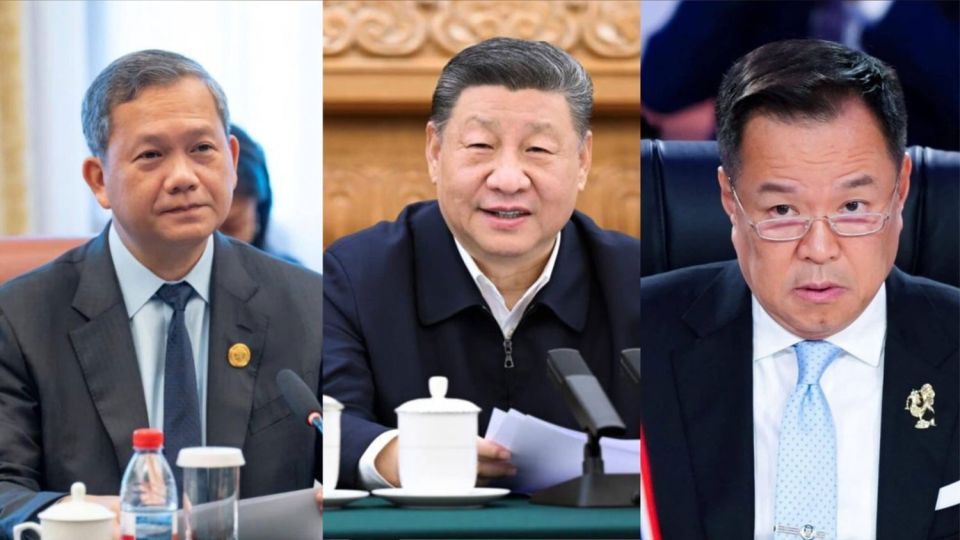
The prime ministers of Cambodia and Thailand will converge in Shanghai later this month for the World AI Conference 2026, presenting an opportunity for renewed dialogue on regional tensions that have festered since December. Hun Manet and Anutin Chanvirakul have accepted invitations from Chinese President Xi Jinping to open the conference on July 17, marking a significant diplomatic engagement between the two Southeast Asian nations at a high-profile international forum. Both leaders are scheduled for bilateral meetings with Xi and Chinese Premier Li Qiang during the visit, signalling the weight Beijing places on maintaining its influence with crucial regional partners.
Cambodia's delegation reflects the seriousness with which Phnom Penh approaches the engagement. Accompanying Hun Manet will be Foreign Minister Prak Sokhonn, Defence Minister Tea Seiha, and Sun Chanthol, first vice-chairman of the Council for the Development of Cambodia. Thailand has similarly mobilised its diplomatic machinery, with Prime Minister Anutin bringing Foreign Minister Sihasak Phuangketkeow. The composition of these teams underscores that substantive discussions on bilateral relations are anticipated beyond the conference's official agenda.
Yet the Shanghai meeting takes place against a backdrop of substantive disagreement between the two neighbours. The Cambodian and Thai governments have not engaged in formal border negotiations since December, when international mediation last brought them together. During their brief encounter at the ASEAN Future Forum in Hanoi in early June, Manet and Anutin exchanged handshakes before photographers but held no substantive talks addressing the territorial dispute that continues to affect tens of thousands of civilians. This public courtesy masked an underlying impasse that has proven resistant to conventional diplomacy.
Cambodia's foreign ministry framed the Shanghai visit in terms of deepening the Cambodia-China relationship, emphasising how the trip would advance their Comprehensive Strategic Partnership of Cooperation and strengthen what officials call the Diamond Cooperation Framework. The language employed suggests Phnom Penh views this engagement primarily as an opportunity to cement ties with Beijing rather than as a platform for resolving its dispute with Thailand. Similarly, Thailand's foreign ministry issued a statement focused on strengthening the Thailand-China partnership, indicating both nations see the conference primarily through the lens of their respective relationships with Beijing.
Observers have speculated that China's significant economic and geopolitical leverage over both Cambodia and Thailand could be instrumental in pushing them toward a negotiated settlement. As a major trading partner and strategic ally of both nations, Beijing theoretically possesses the diplomatic capital to incentivise compromise and create conditions for productive talks. The presence of senior Chinese leadership at bilateral meetings offers an appropriate forum for such encouragement. However, whether Beijing will actively intervene remains uncertain, particularly given the complexities of the dispute and the domestic political constraints facing both governments.
Kin Phea, director of the International Relations Institute at Cambodia's Royal Academy, has identified what he sees as the fundamental obstacle to resolution: Thailand's internal power dynamics and the military's apparent autonomy from civilian oversight. According to Phea, the Thai military has systematically failed to implement agreements negotiated between the civilian governments, instead continuing to occupy Cambodian territory and taking unilateral actions without civilian restraint. This structural problem means that even when Thailand's civilian administration reaches consensus with Cambodia, enforcement remains problematic if the military chooses to disregard such commitments.
Phea's analysis points to a critical vulnerability in the diplomatic process. The Thai military's capacity to operate independently of governmental agreements effectively renders any bilateral consensus fragile and subject to unilateral breach. This dynamic has paralysed the Joint Boundary Commission, the institutional mechanism designed to manage border demarcation disputes. For Cambodia, this represents a fundamental challenge to the principle of negotiating with governments whose commitments they can reasonably expect to be honoured. The asymmetry in implementation capacity between the two nations has become a defining feature of the dispute.
The analyst has called on China to adopt a more assertive mediation role, leveraging its influence to enforce compliance with the Fuxian Consensus reached in December 2025—a Chinese-brokered agreement that both nations had ostensibly embraced. According to Phea, China should press Thailand to demonstrate respect for this consensus through concrete actions: withdrawing troops from occupied areas, returning to substantive negotiations, and enabling the Joint Boundary Commission to function without obstruction. Without active Chinese enforcement of compliance, bilateral agreements risk remaining merely aspirational documents.
The territorial situation on the ground remains dire for affected Cambodian civilians. Approximately 20,000 Cambodian nationals remain displaced from their homes in areas under Thai military control, representing an ongoing humanitarian consequence of the dispute. These communities have endured separation from their property and livelihoods for an extended period, with no clear timeline for return. The continued occupation perpetuates both the practical hardship for these populations and the underlying source of bilateral tension that diplomatic processes must eventually address.
The Shanghai conference represents a moment when enhanced pressure could theoretically be applied. The convergence of both prime ministers in a setting where Chinese leadership is present offers a platform for direct engagement on the border question. Whether Hun Manet and Anutin will use this opportunity to advance negotiations, whether China will facilitate or encourage such discussions, and whether any breakthrough is achievable given Thailand's internal constraints remain open questions. The diplomatic script for Shanghai remains unwritten, and the stakes for Myanmar and broader regional stability are consequently significant.

