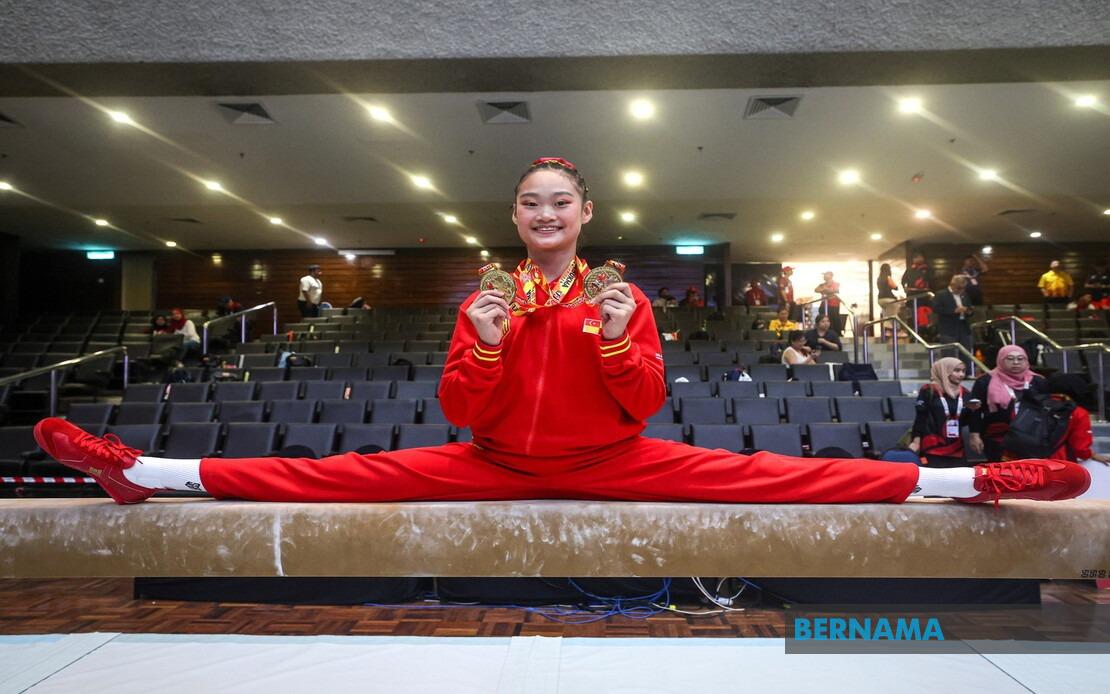
Selangor's rising gymnastics talent Cadence Teh Zi Qi delivered a commanding double gold performance at the Malaysia Games 2026, successfully reclaiming the women's individual all-around championship while spearheading the home state's dominance in the team event. Competing at Dewan Canselor Tun Abdul Razak on the Universiti Kebangsaan Malaysia campus in Bangi, the 17-year-old national gymnast amassed 48.550 points across all four apparatus to consolidate her position as one of the region's emerging gymnastics stars.
Cadence's triumph came through measured performances that showcased both technical proficiency and competitive maturity. Her vault earned 12.050 points, uneven bars garnered 11.400 points, the balance beam yielded an impressive 13.350 points, and floor exercise contributed 11.750 points. This comprehensive scoring pattern demonstrates her well-rounded abilities across the discipline's demanding technical requirements, an essential foundation for elite-level international competition.
The competition for the all-around crown reflected strong talent development across Malaysia's states. Sarawak's Aurin Zulkarnain mounted a credible challenge with 44.500 points to secure silver, while the bronze medal was split between Federal Territories' Annabelle Ho Syin Yee and Penang's Amanda Ching Lee Wern, each recording 42.250 points. The relatively tight scoring between second and third place indicates the depth of competitive standard Malaysian gymnastics has achieved at the junior elite level, suggesting the nation's pipeline for international representation continues to strengthen.
Beyond her individual accolades, Cadence contributed significantly to Selangor's women's team victory, joining teammates Nicole Wong Ziyi, Airisha Zuraidi, Wong Zi Qi, Leong Yee Shean, and Haifa Izzazi Mohd Faizul to accumulate 169.300 points across the team event. This commanding performance underscores Selangor's systematic development approach to gymnastics, where individual champions are cultivated within a structured team environment that emphasizes collective excellence.
Federal Territories advanced to the silver medal position with 166.300 points, demonstrating competitive consistency from a state that has historically produced notable gymnastic talents. Johor completed the podium with a bronze medal score of 157.000 points, reflecting the geographical spread of gymnastics competency across the peninsula's major population centers. The gap between first and third place, while notable at approximately 12 points, remains within the margin that effective coaching interventions and athlete development can address in future competitions.
Cadence's post-competition reflections revealed valuable insights into the mental and physical challenges elite junior gymnasts navigate during high-stakes competition. She candidly acknowledged a difficult start on the uneven bars apparatus, where nervousness affected her proprioceptive awareness, resulting in a fall that could have derailed her championship aspirations. Rather than allowing this setback to compound, she effectively shifted her psychological state for subsequent apparatus, demonstrating the resilience that distinguishes champions from competent competitors. Her recovery on the balance beam produced the highest apparatus score of the day, suggesting she recalibrated her confidence and focus as the competition progressed.
Her strategic approach to difficulty adjustment reveals sophisticated understanding of competitive gymnastics management. Cadence deliberately reduced the technical difficulty of her vault routine to a Tsukahara pike, prioritizing clean execution and points retention over risky high-difficulty maneuvers that might have generated marginally higher scores but carried substantially greater error risk. Conversely, she elevated her balance beam routine to the level she intends to perform at the 2026 Asian Games, using the SUKMA competition as a controlled environment to validate more ambitious choreography before international deployment.
The young gymnast identified two critical developmental priorities moving forward. First, she acknowledges the need to enhance her psychological management capabilities, particularly her ability to regulate pre-competition and in-competition anxiety that manifested during the uneven bars segment. Second, she aims to strengthen her capacity to maintain focus intensity across the four-apparatus sequence, recognizing that consistency of concentration correlates directly with execution quality in gymnastics. Both areas represent psychological skills that respond to systematic coaching and mental performance training interventions.
Cadence's trajectory carries significance for Malaysian gymnastics' broader competitive standing in Southeast Asia. Her successful defense of the all-around title at the national championship level, combined with her intentional preparation for Asian Games competition, suggests the Malaysian gymnastics federation is cultivating athletes capable of competing substantively at continental level. The presence of multiple medalists across apparatus finals demonstrates she faces legitimate domestic competition that will sharpen her skills through regular exposure to quality rivals.
The athlete's remaining competition schedule includes apparatus-specific finals for uneven bars, balance beam, and floor exercise across the following two days, where she will pursue additional gold medals and further validate her technical consistency. These specialized finals provide platforms for gymnasts to demonstrate mastery within discrete technical domains, often revealing particular apparatus strengths that coaching teams can develop as distinctive competitive advantages in international contexts.
Cadence's achievements at SUKMA 2026 illustrate the maturation of Malaysian women's artistic gymnastics, where individual excellence and team strength develop in complementary fashion. Her thoughtful approach to competition management, her willingness to acknowledge technical challenges and psychological barriers, and her strategic calibration of difficulty across apparatus collectively suggest a gymnast approaching her sport with rare maturity for her age. As Malaysia continues its development trajectory in artistic gymnastics, athletes like Cadence represent both the current competitive standard and the foundation for future Southeast Asian prominence in the discipline.

