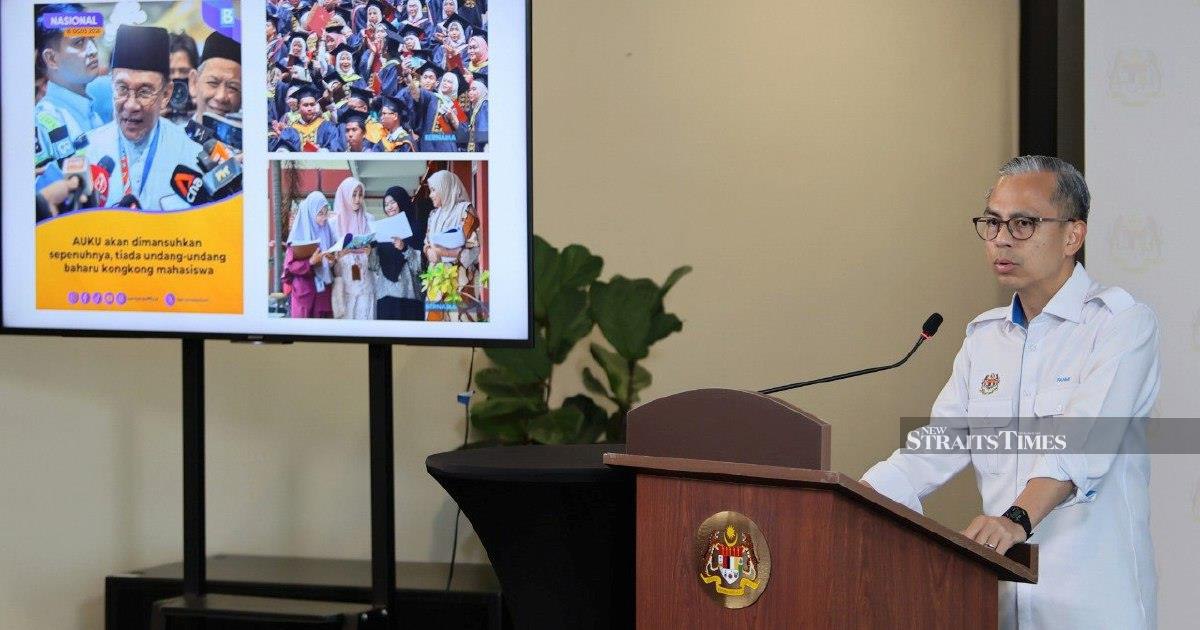
The Malaysian government has made no formal attempt to deliberate on Prime Minister Datuk Seri Anwar Ibrahim's recent comments concerning Taiwan, according to government spokesman Datuk Seri Fahmi Fadzil, a statement that offers insight into how the administration handles sensitive geopolitical flashpoints.
Fahmi's clarification came in response to ongoing questions about whether cabinet-level discussions had taken place following Anwar's remarks, which drew sharp condemnation from Taipei. The spokesman's confirmation that no such discussion occurred suggests the government may have chosen to treat the matter as settled or not requiring collective ministerial examination.
The decision to forgo cabinet debate on the issue reflects broader patterns in Malaysia's diplomatic approach to cross-strait relations. As a nation maintaining diplomatic ties with China while operating within a region where Taiwan remains a contentious and strategically significant actor, Malaysia must navigate these waters with considerable care. By sidestepping formal cabinet deliberation, the government may be signalling that it views the remarks as a individual statement rather than a systemic policy position warranting institutional recalibration.
Taiwan's strong reaction to Anwar's comments underscores the sensitivity surrounding public statements by senior Malaysian officials on the island's political status. For decades, Malaysia has adhered to the One China policy, recognising the People's Republic of China while maintaining unofficial but substantive economic and cultural ties with Taiwan. Any perceived departure from this delicate equilibrium can provoke diplomatic pushback from Taipei, which monitors statements by leaders across Southeast Asia for nuance and implied shifts in recognition.
The absence of cabinet discussion may also indicate confidence within the government that the matter requires no policy correction or clarification. Alternatively, it could suggest an implicit understanding that certain pronouncements, once made, do not merit formal institutional review if they are deemed consistent with existing official positions. This approach allows the government to maintain flexibility while avoiding the appearance of reactive or defensive policymaking.
Fahmi's statement carries implications for how Malaysia manages ministerial communications on geopolitical issues. In an era where statements by senior leaders are instantly transmitted globally and scrutinised by foreign governments, the decision not to formally discuss such remarks at cabinet level may signal either confidence in the initial messaging or a preference for compartmentalising sensitive issues away from collective ministerial forums.
For Southeast Asian observers and Malaysia-watchers internationally, the non-discussion of the issue suggests the government is prepared to absorb Taipei's criticism without seeking internal consensus-building or damage-control measures at the highest institutional level. This posture can be interpreted as reflecting either strong backing for Anwar's original position or an assessment that further deliberation would be unproductive.
The broader context matters here. Malaysia's relationship with Taiwan generates ongoing tension between its official One China policy and its practical economic interests. Taiwan ranks among Malaysia's top trading partners, with significant investments flowing in both directions, particularly in semiconductor manufacturing and technology sectors. Any statement that appears to threaten these relationships risks creating friction between different parts of the Malaysian government—the foreign ministry mindful of Beijing's sensitivities, the trade ministry concerned with economic ties, and the Prime Minister's Office balancing both considerations.
Fahmi's disclosure also reflects Malaysia's communication strategy under Anwar's administration. By having the government spokesman explicitly deny that cabinet deliberation occurred, the government pre-empts speculation and provides clarity to diplomatic counterparts. Taipei and Beijing alike can now assess whether the remarks represented a momentary statement requiring no policy consequence or a reflection of evolving Malaysian positioning. This transparency, ironically, may reduce rather than increase diplomatic friction by removing ambiguity.
For regional stability, Malaysia's approach underscores how individual statements by national leaders can be compartmentalised from institutional policymaking in a way that limits their systemic impact. Yet it also highlights the challenge facing Southeast Asian governments: balancing diplomatic relations with all parties to the Taiwan issue while avoiding either Beijing or Taipei interpreting significant statements as harbingers of policy shift.
Moving forward, Fahmi's confirmation likely means Malaysian officials will face closer scrutiny of public statements on Taiwan. The government has signalled, through its inaction, that not every remark warrants formal cabinet engagement, but this threshold remains undefined. That ambiguity itself may shape how Malaysian ministers approach cross-strait commentary going forward, conscious that their words are monitored in both Beijing and Taipei even if Kuala Lumpur initially chooses not to collectively discuss them.

