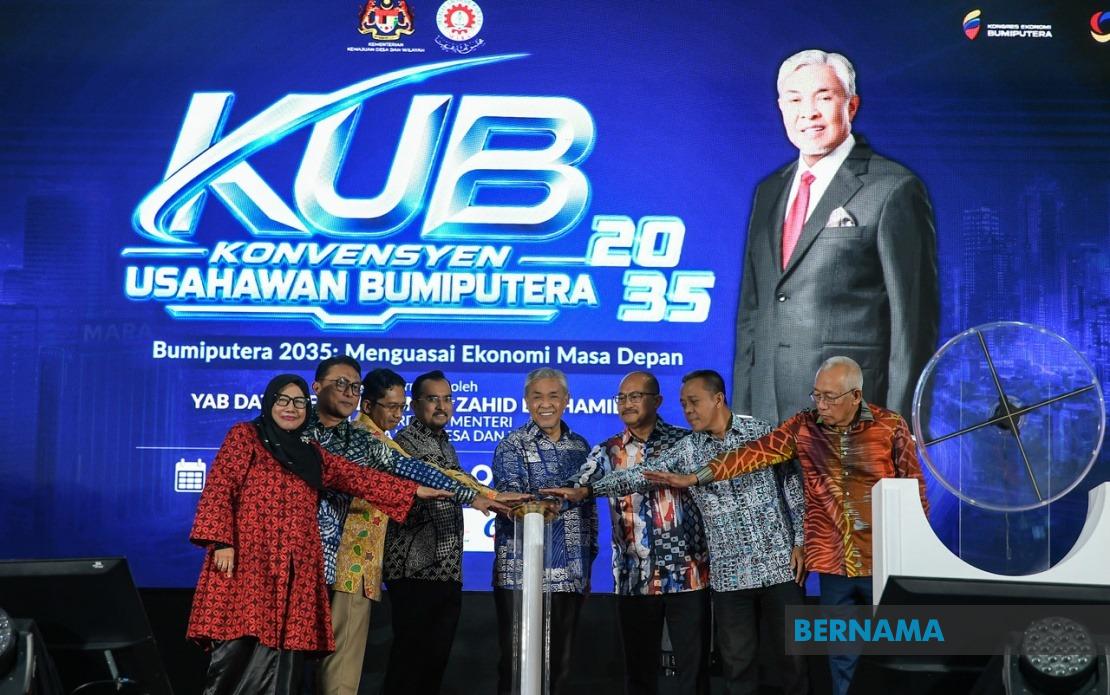
Deputy Prime Minister Datuk Seri Dr Ahmad Zahid Hamidi has called for a fundamental reorientation of Bumiputera entrepreneurship in Malaysia, arguing that the nation has moved beyond the era of mere economic participation and must now focus on building substantive ownership and market control. Speaking at the Bumiputera Entrepreneurs Convention (KUB) 2035 Declaration in Alor Setar, Ahmad Zahid articulated a vision where indigenous business owners graduate from peripheral roles within supply chains to becoming dominant players capable of steering entire sectors. His intervention signals a recognition within government circles that decades of affirmative action policies have created a participation layer without necessarily establishing the depth of entrepreneurial capability needed for long-term competitiveness.
The Deputy Prime Minister emphasized that while government initiatives would persist in providing opportunities and expanding market access, the impetus for transformation must ultimately rest with entrepreneurs themselves. Ahmad Zahid stressed that Bumiputera business owners must demonstrate boldness in their expansion strategies, willingness to compete on equal terms with established players, and commitment to generating genuine economic value rather than simply extracting rents from protected positions. This formulation represents a subtle but significant shift from traditional rhetoric that emphasizes entitlements toward language emphasizing earned advancement and market-tested viability. The underlying message reflects mounting pressure on policymakers to demonstrate that Bumiputera support mechanisms create sustainable businesses rather than perpetual dependents on government favour.
Central to Ahmad Zahid's proposal is the restructuring of how Bumiputera entrepreneurship receives institutional support. He identified three critical transformations required within the ecosystem by 2035. First, the current fragmented support architecture must be consolidated into an integrated framework where financing, skills development, and market linkages operate in coordination rather than isolation. Currently, entrepreneurs often navigate a labyrinth of separate government agencies, development institutions, and private sector programs, each operating with distinct criteria and timelines. This fragmentation imposes significant transaction costs, particularly on smaller operators lacking dedicated resource management capacity. By integrating these support channels, the government aims to reduce friction and enable entrepreneurs to access comprehensive assistance through unified entry points.
The second transformation involves reconceptualizing the fundamental objective of entrepreneurship development. Rather than focusing on the production of numerous small entrepreneurs, Ahmad Zahid advocated shifting toward cultivating existing entrepreneurs into larger-scale operators. This represents a departure from quantity-focused metrics toward quality outcomes measured by business sustainability, employment creation, and revenue generation. The distinction carries important implications for resource allocation, suggesting that development agencies should concentrate support on entrepreneurs demonstrating growth potential rather than spreading resources thinly across numerous marginal operators. This approach aligns with international best practice in small and medium enterprise development, where evidence suggests that targeted support for high-potential businesses yields superior economic outcomes.
The third pillar addresses the relationship between national economic expansion and local enterprise strengthening. Ahmad Zahid advocated ensuring that macroeconomic growth benefits flow substantially to domestic Bumiputera companies rather than concentrating in foreign or established conglomerate hands. This concern reflects broader anxiety within policy circles about wealth concentration and the perception that larger businesses capture disproportionate benefits from economic expansion. By intentionally linking national growth strategies to local business development, policymakers seek to distribute prosperity more equitably across the entrepreneurial ecosystem. The approach also addresses competitiveness concerns, as businesses rooted in local communities and responsive to domestic needs may prove more resilient than purely extractive or rent-seeking operations.
The structural fragmentation Ahmad Zahid identified represents a genuine impediment to entrepreneurial development. Financing institutions operate under different lending criteria than training organizations, market access programs prioritize different business categories, and regulatory agencies impose overlapping compliance requirements. An entrepreneur seeking to launch or expand operations must typically interact with multiple government agencies, development banks, and training providers, each interaction involving separate applications, assessments, and approval processes. This inefficiency particularly disadvantages smaller operators lacking administrative sophistication to navigate complex bureaucratic ecosystems. Integration would theoretically enable coordinated support where financial assessments consider training needs, market access programs align with financing availability, and regulatory requirements reflect developmental rather than purely compliance objectives.
The strategic emphasis on ownership and control reflects recognition that participation without ownership creates economically marginal positions. Enterprises operating as contract manufacturers, distributors of imported products, or service providers on terms dictated by foreign principals accumulate lower value and remain vulnerable to competitive displacement. Ownership of productive assets, intellectual property, brand equity, and market relationships creates defensible competitive advantages and enables value capture. By encouraging Bumiputera entrepreneurs toward ownership-based models, Ahmad Zahid's vision aims to establish enduring businesses rather than temporary positions within competitive hierarchies. This distinction carries implications for wealth accumulation and intergenerational business continuity, as ownership-based enterprises can be inherited and expanded across generations, whereas participation-based positions typically expire when relationships or contracts terminate.
The scaling imperative reflects economic reality that most small businesses never achieve significant employment-generating capacity or export capability. Businesses remaining below critical scale thresholds typically cannot invest in research and development, professional management systems, or technological capability. They compete primarily on price, remaining vulnerable to larger competitors with superior cost structures. Scaling enables businesses to achieve efficiency, invest in capability development, and potentially pursue export markets or premium positioning. Government policy increasingly focuses on helping promising enterprises cross these thresholds, recognizing that numerous viable small businesses contribute less to employment and export objectives than fewer large enterprises operating at optimal scale. The KUB 2035 Declaration presumably incorporates mechanisms for identifying and supporting scaling-capable entrepreneurs.
The timing of Ahmad Zahid's intervention reflects broader concerns about Bumiputera economic participation trends. Despite decades of affirmative action policies, Bumiputera business ownership concentration remains relatively modest by international standards, and many enterprises remain small-scale or dependent on reserved market segments. Policy instruments including vendor development programs, reserved contracts, and subsidized financing have created extensive participation but limited dominant ownership positions. Additionally, demographic changes, with younger Bumiputera increasingly educated and internationally exposed, create expectations for substantive wealth-building opportunities rather than merely participation in state-protected schemes. Ahmad Zahid's emphasis on ownership and scaling responds to these emerging aspirations.
The Rural and Regional Development Minister's statements also carry implications for competition policy and reserved market segments. If genuine ownership and scaling represent policy objectives, government may need to reconsider protective mechanisms that insulate Bumiputera businesses from competitive pressure. Protected markets enable participation but typically prevent the capability development and competitive strengthening required for scaled operation in open environments. This tension between protection and capability building remains largely unresolved in Malaysian policy discourse. Resolving it likely requires phasing protected market access conditional on business performance metrics, creating incentives for genuine capability development rather than rent extraction.
The Bumiputera Entrepreneurs Convention 2035 Declaration presumably articulates specific mechanisms for achieving Ahmad Zahid's vision. These likely include integrated financing instruments combining accessible credit terms with mandatory capability development, unified market access mechanisms coordinating government procurement and private sector linkages, and performance-based incentive structures rewarding scaling and innovation. Implementation will require coordination across multiple government agencies, development institutions, and private sector participants, necessitating governance arrangements capable of resolving inevitable conflicts between protecting smaller enterprises and rewarding ambitious scaling. Success will ultimately depend on whether these institutional arrangements genuinely reduce friction for entrepreneurs or simply add bureaucratic complexity to existing support systems.
For Malaysian entrepreneurs generally, Ahmad Zahid's pronouncements signal potential shifts in how development support allocates resources and designs programs. The emphasis on integration and scaling suggests future support mechanisms will prioritize promising businesses and may reduce support for marginal operators. Entrepreneurs seeking to access government programs should increasingly anticipate requirements to demonstrate scale ambitions and growth capability. For foreign businesses operating in Malaysia, the renewed focus on Bumiputera ownership and control may drive policy actions expanding reserved market segments or ownership requirements, particularly in strategic sectors. The 2035 target provides timeline context, suggesting these policy transitions will gradually unfold across the coming decade rather than through sudden institutional disruption.

