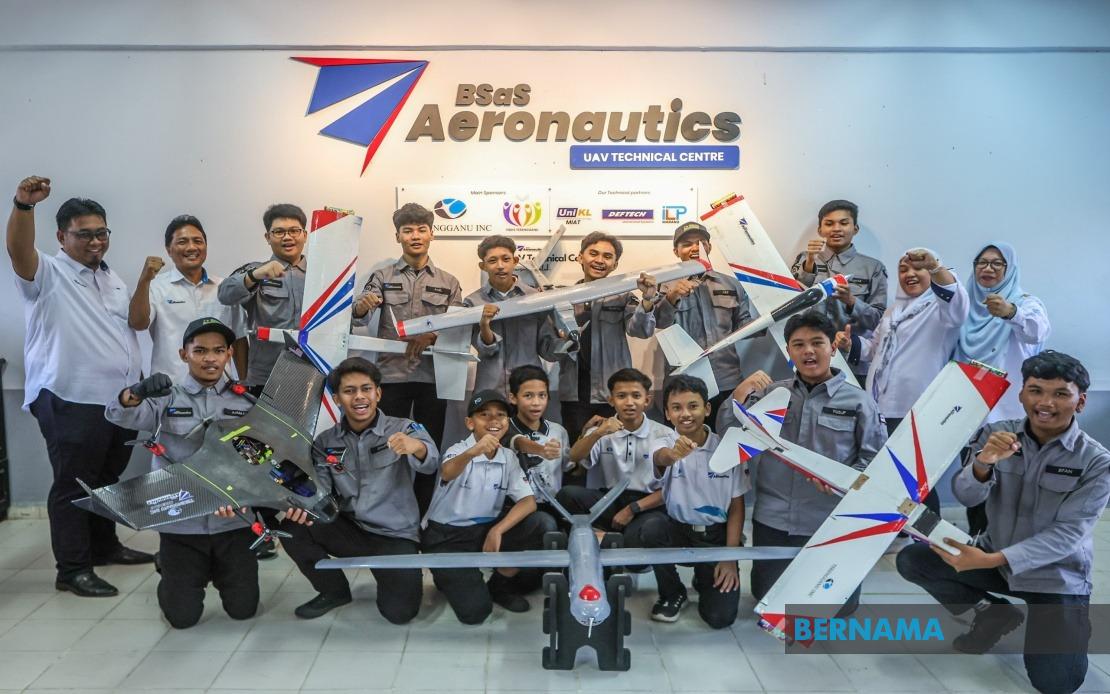
A secondary school in Terengganu's Marang district has quietly become a breeding ground for the country's next generation of aviation engineers, with 35 students now boasting hands-on experience designing and constructing operational unmanned aerial vehicles. The initiative represents a significant shift in how Malaysian schools approach technical education, moving beyond theoretical classroom learning to practical engineering that rivals professional standards. What began as one teacher's passion project has blossomed into a structured, company-sponsored programme that demonstrates the viability of nurturing STEM talent at the secondary level.
Badrul Hisyam Zakaria, an English teacher at SMK Bukit Sawa who coordinates the TI-BSAS UAV In School programme, oversees a curriculum that launched in 2023 with backing from Terengganu Incorporated and other corporate partners. Under his guidance and that of two colleague educators, students have assembled more than five fully operational UAVs, each representing an investment of between RM6,000 and RM10,000. The vehicles are constructed using industrial-grade techniques and materials, scaled appropriately for an educational environment but maintaining the rigour and specifications expected in the aerospace sector. This approach ensures that students gain genuine insight into professional aircraft development rather than assembling kit-based models.
The technical sophistication of the student-built systems reflects serious engineering ambition. Current generations of the school's UAVs are equipped with Global Positioning System technology that enables autonomous target tracking and navigation, allowing the aircraft to operate with minimal human intervention once programmed. The programme is now advancing to a more complex level, with instructors and students collaborating on next-generation systems that incorporate artificial intelligence capable of visual target recognition. This progression from GPS-dependent systems to AI-enhanced detection represents an evolution in complexity that mirrors actual industry development patterns, exposing students to the cutting edge of drone technology before they complete their secondary education.
The programme's credibility was validated spectacularly when SMK Bukit Sawa took the championship title in the UAV Avionics Integration Challenge for secondary schools at the MyAERO Challenge 2026 competition, held at MAEPS in Serdang, Selangor, last June. This national recognition positioned the school among Malaysia's leaders in aviation education and provided tangible evidence that the combination of teacher passion, corporate sponsorship, and structured curriculum could produce world-class results. The victory carries particular weight because it demonstrates that schools outside major urban centres can achieve excellence in high-tech fields, potentially inspiring similar initiatives across Terengganu and beyond.
Perhaps more tellingly, the long-term impact is already evident in the career trajectories of former participants. Two alumni from SMK Bukit Sawa who engaged with the UAV programme are now enrolled in aircraft engineering programmes at Universiti Kuala Lumpur, while three others have advanced to science matriculation courses. These outcomes suggest that exposure to practical aviation projects during secondary education significantly influences university enrolment and career direction. For Malaysian educators and policymakers, the data point to a powerful lesson: providing students with genuine engineering challenges and industry-grade tools can effectively redirect talent toward critical shortage areas in aerospace and aviation.
Badrul Hisyam's vision for the programme extends well beyond the school gates. He frames the TI-BSAS initiative as a longitudinal project designed to track student development from secondary school through university and into professional careers. The coordinator anticipates that within three to four years, the first cohort of former SMK Bukit Sawa students will complete university aviation engineering degrees and enter the workforce, potentially establishing a pipeline of locally trained professionals in UAV technology and aircraft design. This timeline-oriented approach acknowledges that transforming education into career outcomes requires sustained monitoring and support, not merely one-off interventions.
The programme addresses a national strategic objective: reducing Malaysia's dependence on foreign UAV technology and expertise. By developing local capacity to design, build, and operate unmanned systems, the initiative contributes to broader ambitions for technological self-sufficiency in defence and commercial sectors. The students are not merely learning to assemble imported components but developing understanding of systems integration, materials science, and aerodynamic principles that form the foundation for domestic industry capability. This perspective elevates the school programme beyond vocational training into the realm of national competitiveness strategy.
Corporate investment has been essential to the programme's sustainability. Terengganu Incorporated, the state development corporation, has committed RM75,000 in total support since 2023, channelling funding through corporate social responsibility mechanisms. The company initially invested RM45,000 to launch the programme in 2023, and has now provided an additional RM30,000 in 2026 to sustain activities and enable technological advancement. This multi-year funding approach allows educators to plan curriculum development confidently and procure equipment without uncertainty, creating stability that episodic grants cannot provide. For Terengganu Inc, the investment aligns corporate objectives with state development priorities and delivers measurable social impact.
The emphasis on B40 group accessibility reflects deliberate equity considerations embedded in the programme design. By providing technological skill development to economically disadvantaged students in Terengganu, the initiative addresses both regional disparities and income-based opportunity gaps. Students who might otherwise lack exposure to cutting-edge technology or aerospace career pathways gain early experience in high-demand fields. This targeted approach to inclusive excellence is increasingly recognised internationally as essential for both social mobility and economic competitiveness, as talent is distributed across income levels but opportunity historically has not been.
The scale of the student cohort involved—35 students working on UAV development—suggests the programme has moved beyond novelty status to become an established component of the school's curriculum and identity. This cohort size enables meaningful peer learning dynamics and provides sufficient human resources for complex projects that require multiple specialisations. Whether students contribute to aerodynamics, electronics, software, structural design, or testing, each finds a role aligned with developing interests and aptitudes. The collaborative nature of large engineering projects teaches students project management, communication, and teamwork skills that extend beyond technical competence.
For Malaysian regional readers, the SMK Bukit Sawa experience offers several implications. It demonstrates that quality technical education need not be confined to elite institutions or urban centres; sustained partnerships between schools, state agencies, and corporations can generate excellence anywhere. The programme model—combining passionate educators, structured curriculum, industry-standard equipment, corporate sponsorship, and longitudinal student tracking—provides a replicable framework for other states and school districts. As Southeast Asian nations compete globally for technical talent and seek to develop domestic technology sectors, this Terengganu initiative exemplifies how secondary education can contribute meaningfully to both individual student futures and national strategic objectives. The homemade UAVs soaring above Marang represent more than student achievement; they symbolise a reimagining of what Malaysian schools can accomplish when provided appropriate support and vision.

