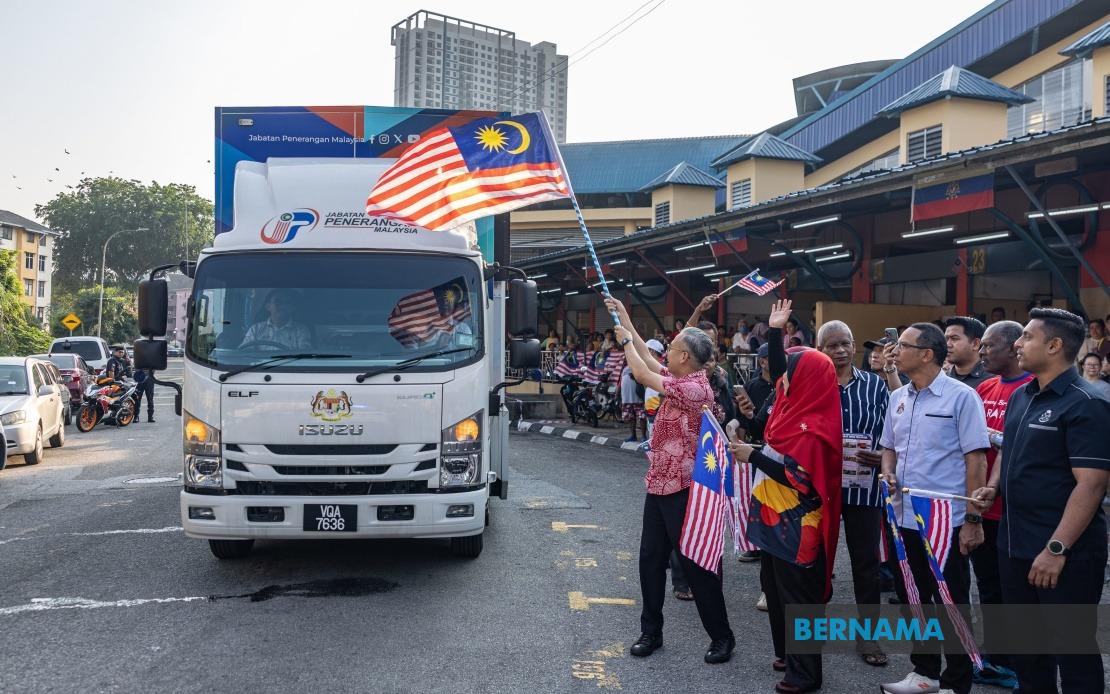
The MADANI government's upcoming Budget 2027 will place substantial weight on tackling the affordability crisis that continues to squeeze Malaysian household finances, according to Communications Minister and government spokesman Datuk Seri Fahmi Fadzil. Speaking after an event in Kuala Lumpur, Fahmi signalled that policymakers recognise the mounting pressures facing ordinary Malaysians and intend to craft a more holistic approach to managing living costs in the coming fiscal year.
The timing of this emphasis reflects broader economic concerns that extend beyond Malaysia's borders. Fahmi acknowledged that the government's budget architects must account for an increasingly volatile international landscape, where geopolitical tensions remain unresolved and create unpredictable ripple effects through global supply chains and commodity markets. This sobering reality shapes how the Finance Ministry will calibrate spending and revenue decisions, forcing planners to build greater flexibility into their assumptions about economic conditions ahead.
Crude oil prices will feature prominently among the external benchmarks guiding Budget 2027's construction, Fahmi indicated. Malaysia's economy remains significantly influenced by petroleum revenues and energy costs, making oil market movements a critical variable in fiscal planning. Should global tensions escalate or supply disruptions occur, crude prices could spike unexpectedly, with cascading consequences for domestic fuel costs, transportation expenses, and ultimately the price of goods and services that ordinary Malaysians depend upon daily. By explicitly naming this factor, Fahmi underscored how Budget 2027 cannot be drafted in isolation from world events.
The government intends to prioritise initiatives that can deliver tangible relief to communities within compressed timeframes, reflecting impatience with lengthy bureaucratic project cycles. This signals a strategic pivot toward quick-win solutions that address immediate public grievances, positioning the administration as responsive to pressing needs rather than fixated on long-term infrastructure gambits that take years to yield visible results. Such an approach carries political value during challenging economic periods when voter patience with delayed gratification wears thin.
Simultaneously, Budget 2027 will maintain a laser focus on investment attraction, both from Malaysian sources and international investors seeking growth opportunities in the region. This dual emphasis—addressing immediate cost pressures whilst simultaneously courting fresh capital inflows—reflects a calculated bet that economic expansion can help ease affordability strains over time. Policymakers evidently believe that without new investment and job creation, even well-intentioned cost-of-living measures risk becoming temporary band-aids on structural economic problems.
The budget framework must also support implementation of the 13th Malaysia Plan, the government's medium-term strategic roadmap. This creates competing demands on fiscal resources, forcing difficult choices between immediate relief measures and longer-term development commitments. Budget 2027 will need to balance urgent public demands for help with bills and groceries against investments in future competitiveness and national development objectives.
Within the Communications Ministry's portfolio, internet access expansion into remote and underserved areas represents a flagship priority for the upcoming budget cycle. Digital divide remains a persistent challenge across Malaysia, particularly in East Malaysia and rural peninsular regions where broadband infrastructure remains inadequate. By earmarking resources for connectivity improvements, the government addresses both an equity concern and an economic imperative, since modern business activity increasingly depends on reliable digital access. Communities lacking such infrastructure face systemic disadvantages in participating fully in the digital economy.
Media sustainability has emerged as another concern occupying Communications Ministry attention during Budget 2027 preparations. Malaysia's news industry faces mounting financial pressures as advertising revenue migrates toward digital platforms and audience fragmentation accelerates. Government support for traditional and emerging media outlets carries both practical and democratic significance, ensuring diverse news sources can continue operating and fulfilling their watchdog function. This issue likely involves discussions about subsidies, tax incentives, or regulatory adjustments designed to stabilise the sector.
Incentive schemes targeting international entertainment and film production represent a focused investment strategy intended to attract high-value economic activity to Malaysia. The proposed CIME (Concerts and Events in Malaysia Incentive) and FIMI (Filming in Malaysia Incentive) programmes exemplify this approach. By offering financial inducements to global entertainment companies, Malaysia positions itself as a competitive location for international productions, generating employment, foreign exchange earnings, and tourism spillovers. These initiatives acknowledge that the modern economy increasingly revolves around creative industries and experiential activities that command premium returns.
Communications Ministry discussions with the Finance Ministry regarding these incentive programmes suggest ongoing conversations about budgetary allocations and programme design. Such interdepartmental coordination reflects the reality that Budget 2027 emerges from complex negotiations among competing ministry priorities and spending philosophies. What eventually appears in the final budget document represents compromises struck between different agencies, each advocating for resources aligned with their mandates.
For Malaysian households grappling with inflation-eroded purchasing power, Budget 2027's promised emphasis on cost-of-living issues carries both promise and uncertainty. The government's ability to meaningfully ease affordability pressures depends not only on budgetary measures but also on broader economic conditions beyond policymakers' direct control. If global oil prices spike or geopolitical tensions accelerate, even well-intentioned government spending may struggle to offset external shocks. Conversely, if international conditions stabilise and commodity prices moderate, government initiatives could prove sufficient to provide material relief and restore public confidence in MADANI's economic stewardship.

