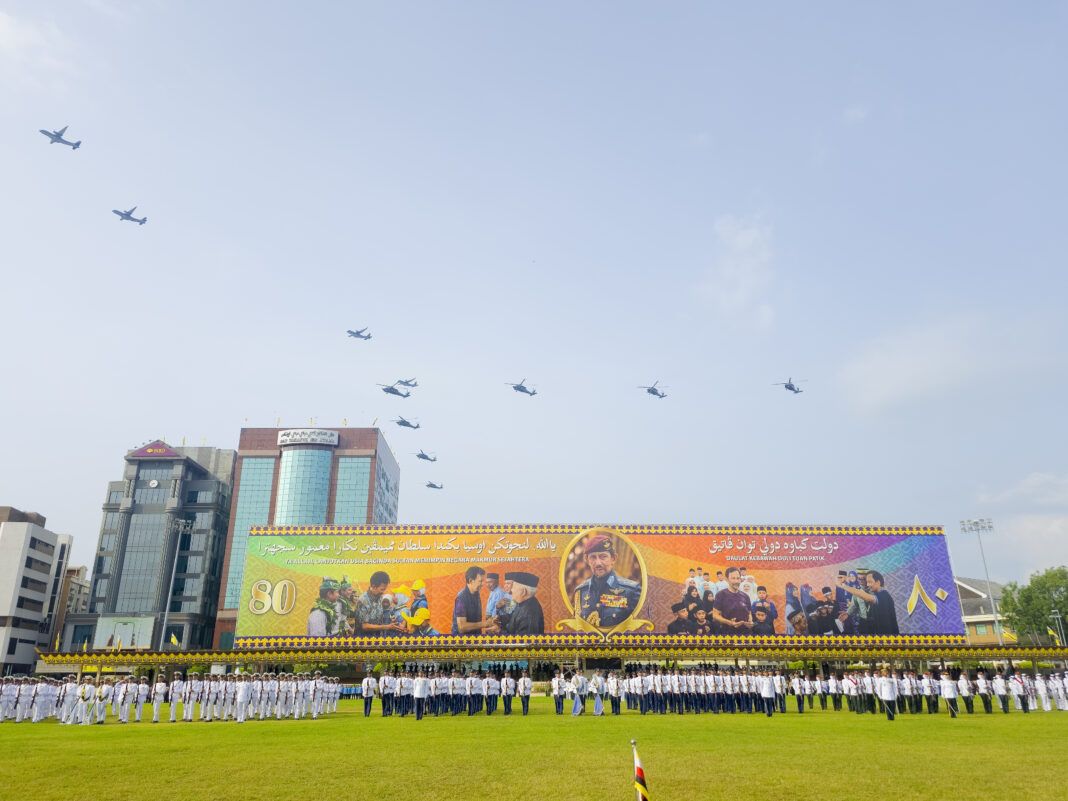
Brunei's preparations for one of its most significant national commemorations have reached their critical final phase, with organisers conducting a comprehensive full dress rehearsal for the ceremonial guard of honour parade that will honour His Majesty Sultan Hassanal Bolkiah, Sultan and Yang Di-Pertuan of Brunei Darussalam's milestone 80th birthday. The meticulous rehearsal took place at Taman Haji Sir Muda Omar 'Ali Saifuddien on Saturday, July 11, bringing together the kingdom's most senior ceremonial and government officials to ensure every element of the elaborate state spectacle meets the exacting standards befitting the occasion.
The rehearsal reflected the significance Brunei places on ceremonial observance and national identity. Chief of Adat Istiadat Negara Yang Amat Mulia Pengiran Indera Setia Diraja Sahibul Karib Pengiran Anak Idris Pengiran Maharaja Lela Pengiran Muda Abdul Kahar presided over proceedings in his capacity as both custodian of national protocol and as a co-adviser for the National Committee overseeing the 2026 commemoration. His involvement underscores how Brunei integrates traditional ceremonial authority with modern state administration, ensuring that historic protocols inform contemporary celebrations.
The coordination required to mount such an event showcases the breadth of Brunei's governance structure. Five cabinet-level officials attended the rehearsal in their roles as co-chairs of the National Committee for His Majesty's 80th Birthday Celebration. Datuk Seri Setia Awang Ahmaddin Abdul Rahman, who coordinates social policies and manpower alongside his home affairs portfolio, worked alongside Pehin Datu Lailaraja Major General (Rtd) Datuk Paduka Seri Awang Halbi Mohd Yussof, whose responsibilities span national security and defence matters. Their presence, along with that of ministers overseeing public service governance, health, and culture respectively, indicates that the birthday observance transcends ceremonial symbolism to encompass broader national initiatives.
For Malaysia and the wider Southeast Asian region, Brunei's elaborate approach to royal commemoration offers insight into how the sultanate maintains monarchical traditions within a contemporary governance framework. Unlike some countries where such celebrations might be scaled back or modernised beyond recognition, Brunei deliberately invests substantial official attention in state ceremony. This commitment reflects both the central role of the Sultan in Brunei's political system and the nation's conscious preservation of institutional continuity and cultural identity in an increasingly globalised era.
The 2026 birthday celebration comes at a particularly poignant moment in Brunei's contemporary history. Sultan Hassanal Bolkiah has reigned since 1968, making him one of Asia's longest-serving monarchs. His leadership has witnessed Brunei's transformation from a British protectorate to an independent nation, its emergence as a major liquefied natural gas exporter, and its navigation of complex geopolitical challenges across Southeast Asia. The 80th birthday milestone thus represents not merely an individual's personal anniversary but a national reflection on decades of consistent leadership.
The specific choice of venue for both rehearsal and the main ceremony carries symbolic weight. Taman Haji Sir Muda Omar 'Ali Saifuddien, named after one of Brunei's most revered historical figures, provides a setting steeped in national significance. Using this location for the ceremonial guard of honour parade connects the contemporary celebration to Brunei's historical continuity and celebrates the nation's cultural heritage alongside its reigning monarch. The park itself stands as a testament to Brunei's development and serves as a gathering place for important national occasions.
The Wednesday morning timing for the main ceremony reflects practical considerations alongside ceremonial tradition. Morning state ceremonies allow for optimal conditions and maximum visibility, while the midweek scheduling demonstrates the national importance of the event—this is not a peripheral observance but rather a centrepiece of Brunei's official calendar. The decision to hold such a significant event in the morning hours suggests the organisers anticipate substantial attendance and wish to accommodate the widest possible public participation.
From a broader Southeast Asian perspective, Brunei's commitment to elaborate ceremonial observation distinguishes its approach to governance and national identity. In an era when some nations have substantially streamlined state ceremonies or relocated them to digital platforms, Brunei's investment in traditional forms of pageantry speaks to the sultanate's deliberate choice to maintain continuity with its past. This reflects not nostalgia but rather a calculated positioning of the monarchy as an anchor of national stability and cultural authenticity.
The involvement of multiple cabinet ministers as co-chairs of the organising committee indicates that preparations extend far beyond mere ceremonial choreography. The National Committee structure suggests that various government agencies—from health services to cultural institutions—have been mobilised to ensure the celebration encompasses broader national objectives. This integration of different governmental spheres around a single focal point demonstrates how Southeast Asian monarchies can leverage ceremonial occasions to reinforce governmental cohesion and project unified national identity.
The meticulous nature of the full dress rehearsal carried particular importance. Such rehearsals do far more than refine logistical details; they establish rhythms and protocols that will govern the actual ceremony. Every movement of the ceremonial guard, every transition, and every timing element receives scrutiny and adjustment. This methodical approach reflects the formal traditions that characterise state ceremony across the region and Brunei's particular commitment to executing such occasions with precision.
Looking ahead to 2026, this rehearsal establishes the foundation for what promises to be one of Brunei's most significant state occasions in recent memory. The ceremony will occur within Brunei's broader context of seeking to maintain economic relevance as a hydrocarbon producer while strengthening regional diplomatic ties and preserving distinctive cultural identity. The birthday celebration offers an opportunity for the sultanate to reaffirm continuity in leadership and demonstrate the enduring stability that has characterised its development trajectory.
For Malaysian observers, Brunei's elaborate preparation process offers comparative perspective on how neighbouring sultanates approach royal commemoration and state ceremony. Both nations share monarchical systems and cultural traditions, yet each charts its own course regarding ceremonial scale and official investment. The rehearsal and forthcoming ceremony underscore how Southeast Asian nations continue to regard such occasions as fundamental to national life, using them not merely to honour individuals but to articulate and reinforce collective identity and values.

