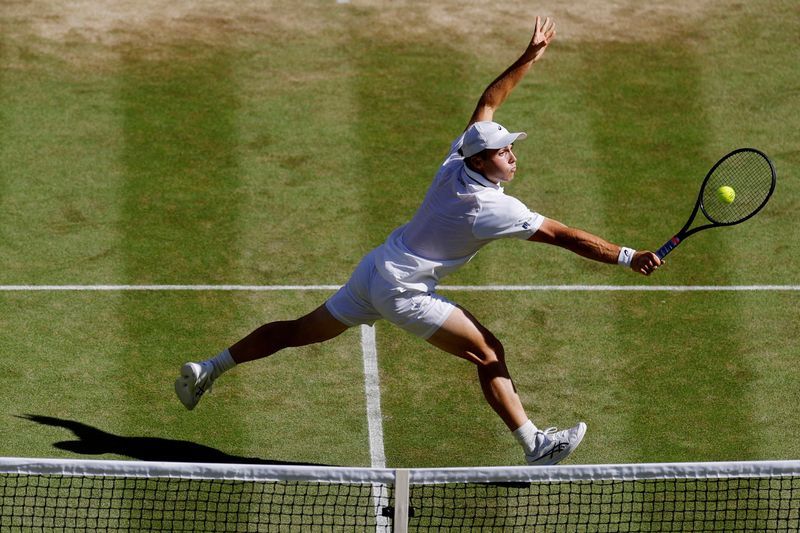
Arthur Fery has emerged as an improbable British beacon at Wimbledon, advancing to the tournament's last eight after a sequence of nail-biting victories that have captivated both the All England Club and the wider British sporting public. The France-born player, who celebrates his 24th birthday on the day of the men's singles final, entered the Championships as a wildcard but has since captured the nation's affections with his spirited performances under pressure.
Fery's journey through the early rounds has been marked by extraordinary resilience and mental fortitude. His progression has come entirely via five-set thrillers, showcasing a capacity to perform when the stakes are highest. Making his Centre Court debut on Monday, the London-raised competitor defeated fellow wildcard Grigor Dimitrov in a gripping encounter that stretched to 7-5 3-6 4-6 6-4 7-6(7), securing his place in the quarter-finals against world number 10 Flavio Cobolli, whom he had previously conquered at the Australian Open earlier this year.
The Dimitrov victory proved particularly dramatic given the context surrounding it. The Bulgarian veteran, a former world number three now 35 years old, had dominated stretches of the match and appeared poised for victory when leading 4-3 with a break in the fourth set. Yet Fery summoned an extraordinary comeback, ultimately prevailing in front of Roger Federer himself, who observed the encounter from the Royal Box. The roar from the crowd when Fery claimed match point reverberated with an intensity rarely heard at the sacred venue, reflecting both the partisan support and the sheer dramatic tension of the occasion.
Fery's ascent becomes more remarkable when examined against the broader context of British performances at this year's Championships. Of the 19 British players who contested the men's singles draw, 15 were eliminated in the opening round, leaving Fery to carry the home nation's hopes almost entirely on his shoulders. This remarkable disparity underscores how unexpectedly far the wildcard has progressed, transforming what could have been a disappointing tournament for British tennis into a compelling narrative of individual determination and tactical maturity.
His third-round victory over Belgium's Zizou Bergs on Saturday further illustrated his capacity to overcome adversity. That encounter saw Fery navigate back from a two-set deficit while simultaneously managing physical complications, including a succession of nosebleeds that threatened his continuation in the match. Despite trailing and facing a double break down in the fourth set, he mustered the focus to claim victory in what became the longest match contested throughout the tournament to that point.
Fery's own perspective on his achievements remains measured yet appreciative of the historic significance. Speaking after his Dimitrov victory, he acknowledged the broader sporting context of the day, noting that his match coincided with England's World Cup victory over Mexico in the last sixteen, creating an atmosphere of genuine national sporting celebration that transcended individual competitions. This layering of emotional investment—combining traditional Wimbledon drama with concurrent World Cup excitement—created an almost unique atmosphere on the grounds.
The Stanford University alumni began this tournament ranked 114th globally, yet his current trajectory suggests he will soon occupy a significantly elevated position in the world rankings. Already inside the top 70 and continuing to accumulate ranking points with each successive round, Fery's remarkable week has fundamentally altered his professional standing and opened doors that seemed distant when he arrived at the All England Club.
Fery's credentials, however, have not gone entirely unnoticed by his fellow professionals. American sixth seed Taylor Fritz, who trained alongside Fery in the lead-up to the 2024 World Tour Finals, provided perspective on the British player's genuine quality. Fritz described being systematically outplayed during their practice sessions, noting Fery's exceptional serve and forehand stroke, attributes that appeared particularly lethal when deployed from the baseline. Fritz's endorsement carries considerable weight, particularly given that he subsequently reached the Turin finals and maintained strong form throughout the season.
The broader implications of Fery's run extend beyond mere entertainment value for British sports enthusiasts. His success represents validation of the competitive depth emerging within the sport's next generation of players, individuals who may lack the household recognition of established stars yet possess sufficient skill and mental resilience to compete effectively at the sport's highest level. For Malaysian and Southeast Asian tennis observers, Fery's trajectory illustrates how wildcards and unseeded players can still impact major tournaments, a lesson relevant to emerging talents across the region.
Fery's potential quarter-final meeting with Cobolli will test whether his form represents genuine elevation or an extraordinary hot streak. The Italian opponent presents considerable technical challenges, yet Fery's previous victory over Cobolli and his demonstrated ability to perform under extreme pressure suggest the match remains genuinely competitive. Should Fery progress further, questions about his capacity to maintain this extraordinary standard while dealing with increasingly experienced opponents will become increasingly pertinent.
The romantic narrative of Fery's run—the France-born player raised in London, wielding a British wildcard, suddenly thrust into international prominence through sheer determination—has resonated powerfully with Wimbledon audiences. Whether he ultimately contends for the title or his remarkable journey concludes in the quarter-finals, Fery has already transcended the typical wildcard story to become one of the tournament's most compelling narratives.

