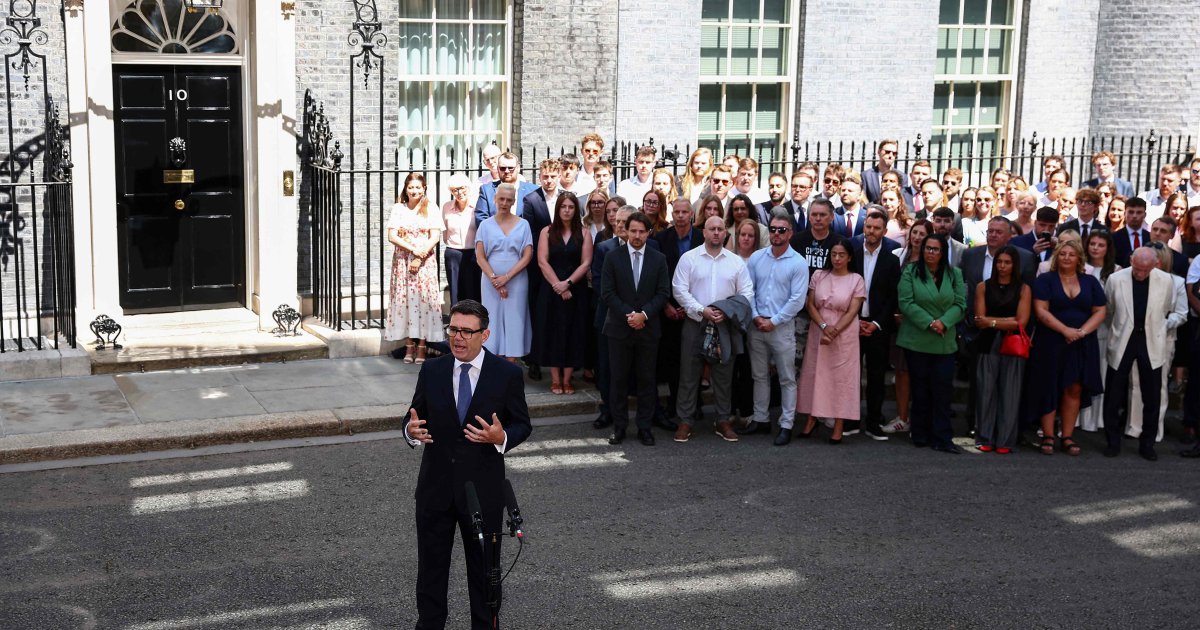
The installation of Andy Burnham as Britain's seventh prime minister since early 2016 has crystallised deep public disillusionment with an institution many voters now view as chaotic and unreliable. As the nation formally transitioned to Burnham's leadership on Monday, citizens across the country expressed exasperation at what has become a dizzying revolving door of leadership, each tenure often marked by controversy, resignation, or electoral repudiation.
Claire Walker's resigned "not another one" captures the sentiment pervading British society—a weariness born of relentless political turbulence that has dominated the national conversation for over a decade. The succession of seven different prime ministers in such a compressed timeframe represents an extraordinary level of governmental instability, particularly for a mature democracy with established constitutional traditions. This phenomenon stands as a sharp departure from historical precedent, when prime ministerial tenures typically spanned multiple years and sometimes decades.
The underlying causes of this churn reflect fundamental fractures within British politics. The 2016 Brexit referendum exposed deep societal divisions that have yet to heal, creating fault lines within both major political parties and rendering governing coalitions fragile. Each prime minister who took office promising to resolve the Brexit question or chart a new post-referendum course ultimately encountered parliamentary deadlock, factional rebellion, or public backlash that ultimately proved insurmountable.
The pace of change has been particularly destabilising for policy continuity and institutional confidence. With barely sufficient time to implement coherent legislative agendas, successive administrations have struggled to address pressing challenges including economic management, healthcare reform, and international relations. Public perception of governmental competence has deteriorated correspondingly, as voters observe repeated cycles of promise, stagnation, and failure.
For Malaysian observers, Britain's predicament offers cautionary lessons about the fragility of parliamentary democracy when underlying political consensus fractures. While Malaysia has experienced changes in government, the institutional mechanisms—including a strong civil service and established constitutional frameworks—have generally maintained continuity despite transitions. Britain's experience suggests that even wealthy nations with centuries-old parliamentary traditions can experience acute governance crises when fundamental political divisions go unresolved and manageable disagreement escalates into existential conflict.
Burnham's ascension represents neither a clean break nor a dramatic solution to these entrenched problems, but rather the latest adjustment in an ongoing pattern of leadership rotation. His appointment signals that British voters continue seeking alternatives, yet each successive change reinforces the underlying reality that no single leader has successfully united the fractured polity behind a coherent vision.
The electoral consequences of this instability have reverberated through British politics. Voter confidence in democratic institutions has measurably declined, with approval ratings for government often hovering at historically low levels. Turnout in recent electoral contests has fluctuated, reflecting both disengagement and the strategic calculations of voters seeking to punish or reward particular parties based on recent performance.
International standing has also suffered from this domestic turbulence. Britain's position as a stable democratic power has been questioned by international observers, and persistent policy reversals have complicated foreign relations and trade negotiations. Nations conducting long-term diplomatic and commercial planning with Britain face uncertainty about governmental commitments and policy direction.
For Southeast Asian nations, including Malaysia, Britain remains an important partner in regional security, trade, and educational exchange. However, the political instability at Westminster inevitably impacts reliability of partnerships and the capacity of the British government to maintain consistent engagement with regional priorities. The contrast between Britain's volatility and the more stable governance patterns in many Southeast Asian countries underscores how institutional strength and policy consistency contribute to international standing.
Burnham's task extends beyond conventional prime ministerial duties—he must somehow reconstruct public confidence in governmental institutions that have been eroded by years of instability and perceived ineffectiveness. Whether his tenure represents a turning point or merely another chapter in ongoing political turbulence remains uncertain, but the accumulated weight of public frustration suggests that structural reforms addressing parliamentary dysfunction and political polarisation may become increasingly unavoidable.
The exhaustion evident in voter sentiment reflects more than mere tiredness with political news cycles. It represents a deeper anxiety about whether democratic institutions can effectively respond to contemporary challenges when fractured by intractable disagreements. As Britain confronts this moment, other established democracies—including those in the Asia-Pacific region—will be watching whether parliamentary traditions can accommodate and resolve profound political division, or whether institutional strain ultimately demands fundamental constitutional adjustment.

