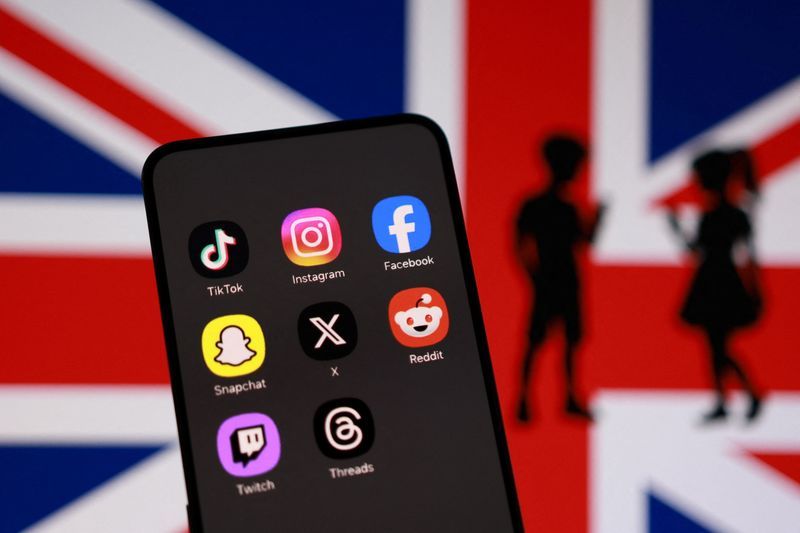
Britain's government has announced plans to impose default overnight curfews on social media platforms for teenagers aged 16 and 17, restricting access between midnight and 6 a.m. unless users manually adjust their settings. The initiative represents a significant escalation in the government's approach to digital safety for young people, coming just weeks after officials unveiled proposals to ban social media use entirely for those under 16. The dual approach signals mounting governmental concern about the impact of unchecked social media consumption on adolescent development and wellbeing.
Under the proposed framework, users in the affected age group would find themselves automatically locked out of major platforms during the overnight hours. The regulations would also deactivate addictive features—such as infinite scroll and algorithmic recommendations—by default, requiring conscious action from teenagers to re-enable these engagement tools. This represents a philosophical shift toward making harmful defaults opt-in rather than opt-out, placing responsibility initially with platform designers rather than individual users to resist compulsive behaviour.
Technology minister Liz Kendall framed the measures as essential tools for protecting adolescent development, arguing that adequate sleep, academic focus, and offline family time have become casualties of unrestricted social media access. The government contends that teenagers frequently sacrifice sleep and mental wellbeing due to the deliberately addictive design of social platforms, which employ sophisticated algorithms specifically engineered to maximise engagement and time-on-platform metrics. By establishing these protective defaults, policymakers argue they create space for healthier life patterns during critical developmental years.
Crucially, the government plans to make implementation legally mandatory for technology companies rather than voluntary. Online safety minister Kanishka Narayan made clear that this is not a request but a requirement, declaring that regulators would compel tech firms to implement the curfews. He further signalled that companies failing to conduct robust age verification would face severe regulatory consequences. This enforcement language reflects frustration with past patterns where social platforms have resisted or delayed safety measures, viewing them as obstacles to revenue generation rather than legitimate protective mechanisms.
The proposed regulations will enter parliamentary consideration by the end of the calendar year, with actual enforcement anticipated to begin in spring 2027. This timeline allows for legislative debate, potential industry consultation, and technical implementation periods—though it also provides considerable runway for technology companies to lobby against provisions that might reduce user engagement metrics. The delayed implementation window creates uncertainty about whether commitments announced today will survive the complex political and commercial pressures that typically emerge during detailed policy-making.
Industry responses have been notably muted. Meta, TikTok's parent company ByteDance, and Google—the three most significant platforms likely to be affected—declined to comment immediately on the proposals. Their silence may reflect internal deliberation about compliance costs, technical feasibility, or the potential for legal challenges. Alternatively, it could indicate strategic positioning ahead of formal consultation periods. What is notable is the absence of public resistance or counter-arguments to the basic premise that overnight curfews might benefit teenage users.
Not all observers support the approach. Opposition Conservative Party education policy chief Laura Trott has criticised the framework as ineffectual, arguing that curfews users can easily disable amount to regulatory theatre rather than meaningful protection. Her critique highlights a fundamental tension in digital regulation: technical requirements prove only as effective as users' motivation to comply, and teenagers determined to access social media can readily circumvent default settings. This raises questions about whether the regulatory approach addresses underlying drivers of problematic social media use or merely creates compliance burdens without substantive behavioural change.
The curfew proposal emerges against a broader international backdrop of digital regulation. Australia famously became the first country to legislate an outright social media ban for children, yet implementation has proven complicated. Investigation of Australia's approach revealed that platforms struggle fundamentally with age verification itself—the prerequisite step for any age-based restrictions. If technology companies cannot reliably identify which users fall into protected age categories, even well-intentioned regulations become technically unenforceable. This precedent suggests that Britain's proposed curfews face similar practical obstacles that regulations alone cannot resolve.
Further complicating the landscape, both Google and TikTok have recently settled lawsuits brought by individuals claiming that platform designs damaged their mental health. These legal outcomes acknowledge, at least implicitly, that social media business models create demonstrable harms for young users. The settlements suggest growing legal liability for technology companies that fail to implement protective measures, potentially making regulatory curfews attractive as a way to demonstrate duty of care and reduce exposure to civil litigation. From this perspective, mandatory default curfews serve company interests by establishing a legal safe harbour.
For Malaysia and Southeast Asia, these developments carry significant implications. As digital markets continue expanding across the region, questions about age-appropriate platform governance remain contested. Malaysian policymakers monitoring the British experiment may find evidence either supporting or cautioning against similar approaches. The regulatory framework also affects Southeast Asian technology companies and content creators who depend on platform algorithms and audience engagement metrics. If major global platforms implement curfews in Britain, regulatory consistency pressures may push toward similar requirements in other jurisdictions.
The British initiative highlights persistent tensions between protecting vulnerable users and preserving commercial interests in digital platforms. Default settings that favour protection represent a regulatory statement that profit maximisation cannot be the sole design principle for systems accessible to adolescents. Whether implementation proves technically feasible, whether users actually comply with defaults rather than disable them, and whether the approach meaningfully improves teenage mental health and sleep patterns remain open questions. The coming years will test whether regulation can meaningfully reshape how technology companies balance adolescent welfare against engagement metrics.

