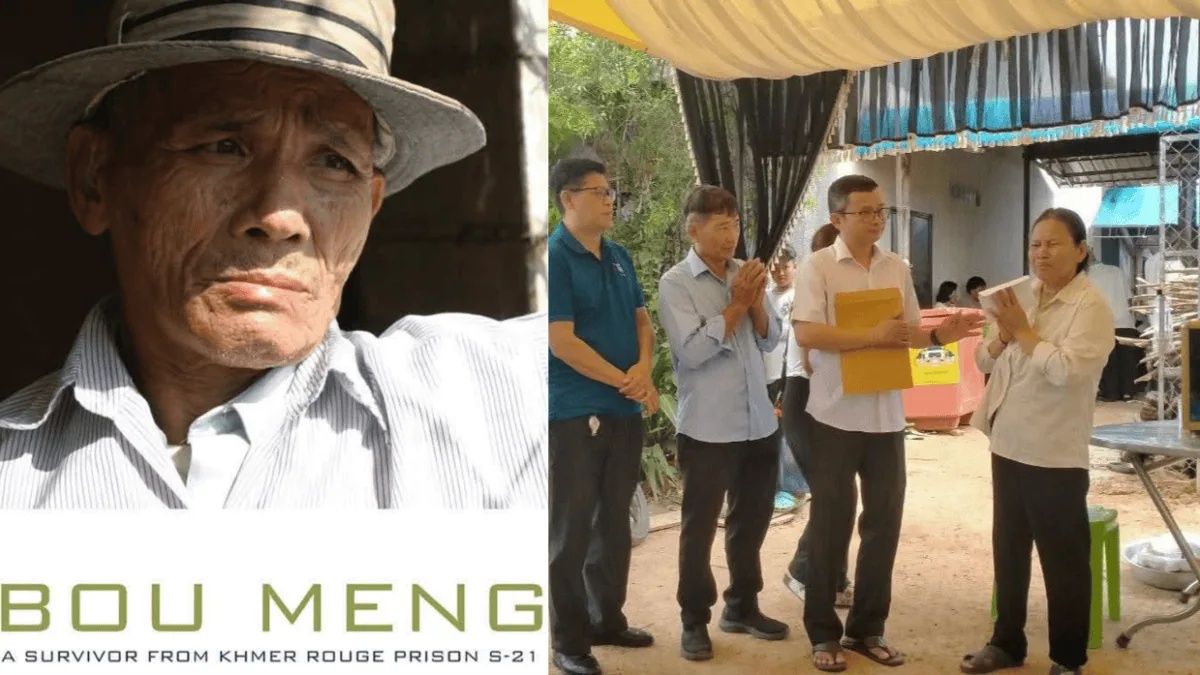
Bou Meng, a living symbol of resilience and historical witness to one of the twentieth century's darkest atrocities, has died at the age of 85. The Tuol Sleng Museum announced his passing on Friday, August 14, 2026, at 11pm, marking the loss of one of only seven individuals known to have survived the Khmer Rouge's notorious S-21 detention facility. His death represents the fading of firsthand testimony from those who endured the regime's systematic brutality, as Cambodia's ageing survivor population continues to diminish.
Bou Meng's story encapsulates both the horror and the fragile thread of chance that determined life and death within the Khmer Rouge's machinery of terror. In 1977, he and his wife were both imprisoned at S-21, while their children were forcibly separated and sent to a children's camp. The family was torn apart by a regime that viewed bloodlines as ideologically contaminated. He never saw his wife or children again—a personal tragedy multiplied across hundreds of thousands of Cambodian families. The emotional weight of this permanent separation, carried for nearly five decades, formed the backdrop to Meng's survival and his subsequent efforts to document what happened within those prison walls.
What distinguished Bou Meng from the vast majority of S-21's estimated 17,000 victims was a skill that proved unexpectedly invaluable in the hands of executioners. His abilities as a painter caught the attention of his captors, who occasionally spared those with specialized talents useful to the regime. While countless others were subjected to systematic torture and executed, Meng's artistic capabilities provided a tenuous lifeline. He was put to work creating propaganda materials and portraits for the revolutionary leadership, a grim irony wherein the very apparatus of state violence relied on his creative labour to perpetuate its mythmaking.
The survival of only seven individuals out of thousands imprisoned at S-21 underscores the mechanical ruthlessness of the facility under the command of Kaing Guek Eav, better known as Comrade Duch. The prison operated as a sorting mechanism for death, where detailed confessions were extracted through torture before prisoners were transported to killing fields for execution. Duch's meticulous record-keeping and organizational efficiency made S-21 a functioning cog in the broader genocidal machinery. The Khmer Rouge Tribunal, formally the Extraordinary Chambers in the Courts of Cambodia (ECCC), was established decades later to prosecute the regime's architects and senior commanders—a belated but significant attempt at transitional justice.
Bou Meng's decision to testify against Duch at the ECCC represented a profound personal act of courage and a crucial contribution to historical accountability. Survivor testimony carries a weight that documentary evidence alone cannot match; it places human faces and voices against abstract statistics and historical records. Meng's account of conditions, torture methods, and the systematic nature of killings provided the tribunal with eyewitness corroboration of the crimes. His participation in the judicial process helped construct a historical record that transcends propaganda or denial, establishing an official, internationally recognized account of what transpired. Duch was ultimately convicted and sentenced to life imprisonment, with Meng's testimony forming part of the evidentiary foundation for that conviction.
Beyond his formal role in the judiciary, Meng transformed his survival into a lifelong pedagogical mission. In recent years, he devoted substantial effort to welcoming visitors to the Tuol Sleng Museum and recounting his experiences, understanding that education represents a primary defence against historical repetition. The museum, housed in the former S-21 compound, has become a site of pilgrimage for those seeking to comprehend the Khmer Rouge period and its implications for human rights and state violence. Meng's presence there, explaining torture methods, showing visitors the cells where he was held, and speaking of the faces of fellow prisoners, transformed abstract horror into tangible, human-scaled tragedy.
The loss of Bou Meng carries particular significance for Southeast Asia and the broader global project of confronting genocide. Cambodia's Khmer Rouge period killed an estimated 1.7 to 2.2 million people between 1975 and 1979—roughly one-quarter of the country's population. The ECCC process, while controversial and incomplete, has served as a model for post-conflict justice mechanisms in other contexts. As surviving witnesses pass away, the direct transmission of knowledge and memory faces irreversible interruption. The challenge of maintaining historical consciousness without firsthand testimony becomes increasingly acute for younger generations of Cambodians and for international audiences unfamiliar with this period.
Meng's legacy extends beyond Cambodia's borders. His willingness to testify decades after trauma, despite the psychological and social costs of reliving torture and loss, exemplifies principles of dignity and accountability that resonate across post-conflict societies throughout Asia and beyond. Other nations grappling with historical injustices—whether in Myanmar, the Philippines, East Timor, or elsewhere in the region—have looked to Cambodia's transitional justice mechanisms for lessons and precedents. Bou Meng's participation in this process contributed to an evolving international framework for how societies might address state violence and honor victims.
The Tuol Sleng Museum and broader Cambodian civil society have emphasized that Meng's passing represents an irreplaceable loss not merely of an individual, but of a crucial archival function. Living memory, with all its texture, emotion, and contextual nuance, cannot be fully replicated through documents, photographs, or recordings. While video testimony and written accounts of Meng's experiences will persist, the loss of his physical presence and his ability to respond to questions from visitors reflects a broader intergenerational shift in how Cambodia's genocide is understood and transmitted. Future generations will access the Khmer Rouge period primarily through mediated sources rather than direct conversation with survivors.
Cambodia continues to grapple with the long shadow of the Khmer Rouge period. Institutional memory remains contested, with competing narratives about accountability, healing, and national identity. The passing of figures like Bou Meng underscores the urgency of documenting survivor testimonies, supporting institutional preservation efforts, and ensuring that younger Cambodians maintain engagement with this foundational historical moment. The Tuol Sleng Museum will likely enhance its archival and educational functions in response to the increasing rarity of living witnesses. For visitors and students, Meng's death serves as a reminder of history's fragility and the finite window for learning directly from those who lived through catastrophe.

