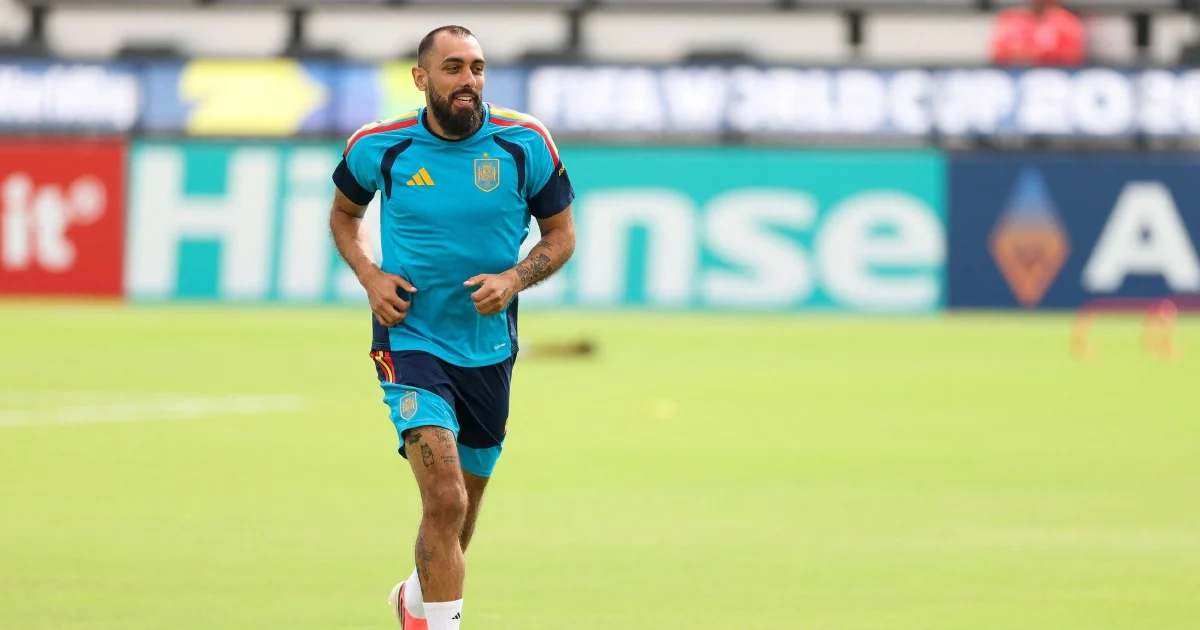
Borja Iglesias has emerged as one of football's most outspoken athletes, a distinction that sets him apart in a sport traditionally hostile to players who venture beyond the pitch into contentious social debates. The Spanish striker, who featured in his nation's World Cup campaign, displays an uncompromising willingness to address issues ranging from the Gaza conflict to homophobia within the sport—conversations many of his peers deliberately avoid. His candid approach has earned him an unusual moniker within the football community: "the alien of football," a label that simultaneously acknowledges his rare forthrightness and underscores how unconventional such transparency remains at the highest levels of professional sport.
The 31-year-old's approach to self-expression extends beyond verbal commentary. Iglesias regularly paints his nails, a personal aesthetic choice that challenges unspoken masculine conventions deeply embedded in football culture. This visible form of individuality serves as a daily statement about accepting diversity in spaces traditionally governed by rigid behavioural expectations. For many observers across Southeast Asia and beyond, where football fanaticism frequently intersects with conservative social attitudes, Iglesias represents a figure actively pushing against the sport's complicity in perpetuating narrow definitions of masculinity. His willingness to present himself authentically, regardless of potential criticism, demonstrates a courage that extends from personal presentation into his public advocacy.
Within the context of professional football's global landscape, Iglesias's interventions on political and social matters are particularly significant. Players commanding international platforms rarely deploy their visibility to critique geopolitical conflicts or systemic inequalities, fearing financial consequences, sponsorship withdrawal, or club management pressure. Yet Iglesias has repeatedly broken this unwritten code of silence. His commentary on Gaza represents a departure from the sanitised, politically neutral persona that governing bodies like FIFA implicitly demand from athletes. By speaking candidly about a deeply polarised international issue, he positions himself outside the protective bubble that professional football typically provides to its elite performers.
The striker's advocacy regarding homophobia carries particular weight in European football specifically and global sport generally. Football remains a domain where homophobic chanting, discriminatory language, and exclusion of LGBTQ+ athletes persist across numerous countries and leagues. Players like Iglesias who explicitly denounce such attitudes contribute meaningfully to shifting the sport's cultural baseline, even as they risk social ostracisation or targeted campaigns by conservative supporters. His willingness to centre this issue reflects understanding that athletic spaces profoundly shape broader social norms, particularly among younger audiences who idolise footballers.
The "alien of football" designation captures something revealing about contemporary sports culture. Rather than framing Iglesias as heroic or simply courageous, the epithet suggests that authenticity itself appears fundamentally strange within football's ecosystem. This framing reveals the sport's pathology—that straightforward moral clarity on social issues registers as alien rather than obvious. For Malaysian readers navigating football's significance as both entertainment and cultural touchstone, Iglesias's example illuminates how globalised professional sport often imports not just commercial structures but also moral compromises that diminish athletes' humanity and accountability.
Iglesias's trajectory also reflects generational shifts within European football. Younger players, particularly those who came of age during periods of heightened social activism and digital interconnectedness, increasingly resist the historical pattern of enforced political silence. This generational difference will likely intensify debates about athletes' responsibilities in publicising social concerns. While established institutions like FIFA continue emphasising "football is for everyone," the organisation simultaneously penalises teams and players for political expression, revealing the inherent contradictions within sport's governance structures.
The consequences Iglesias faces for his outspokenness remain largely unquantified but almost certainly significant. Social media backlash from conservative supporters, potential complications in contract negotiations, and the psychological toll of standing isolated within one's profession represent real costs. Spanish media attention to his statements varies considerably, with traditional outlets sometimes downplaying his activism while digital platforms and international media engage more seriously with his perspectives. This uneven coverage itself demonstrates how institutional structures within football continue marginalising athletes who prioritise moral clarity over commercial palatability.
For Southeast Asian football enthusiasts, Iglesias presents a compelling counternarrative to the dominant ethos of celebrity athletes as apolitical brands. Many professional players across Asian leagues face intense social pressure to remain politically neutral, reflecting broader regional attitudes toward public political expression. Iglesias's model demonstrates that international footballers retain agency and can exercise it despite systemic pressures. His example suggests possibilities for athletes throughout Asia who increasingly grapple with social questions but encounter cultural expectations demanding silence.
Looking forward, Iglesias's career trajectory will likely illuminate whether football's power structures can genuinely accommodate athletes who refuse sanitisation. If he continues both performing at elite levels and speaking publicly on contentious issues, he will have demonstrated that professional viability and moral authenticity need not be mutually exclusive. Conversely, if institutional pressure marginalises him, his fate will reaffirm football's deeper commitment to commercial stability over principled stands. For now, Iglesias remains that anomalous figure: a world-class athlete insisting that footballers' responsibilities extend beyond tactical execution into the realm of social accountability.

