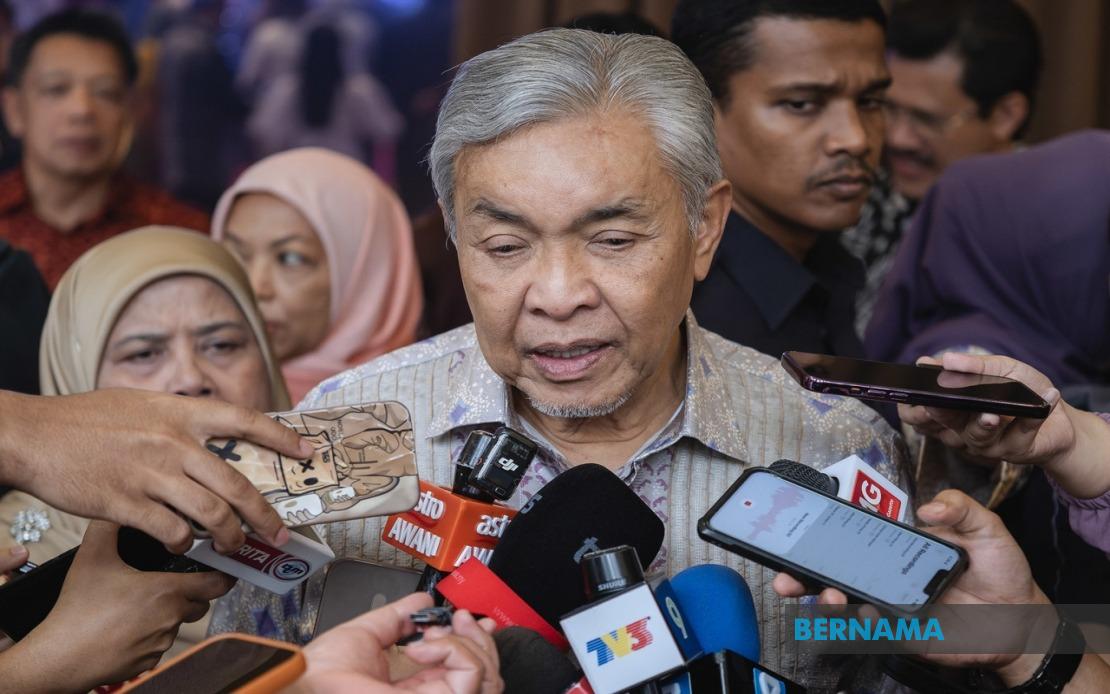
Barisan Nasional has pledged to steer clear of matters relating to the Negeri Sembilan royal institution and the state's Council of Justice and Laws (DKU) as it prepares for the upcoming state election, Deputy Prime Minister Datuk Seri Dr Ahmad Zahid Hamidi declared on June 29. The commitment signals the coalition's determination to maintain clear boundaries between its electoral campaign machinery and the constitutional functions of the state's monarchy and judicial bodies.
Ahmad Zahid, who leads UMNO as party president, outlined the position following discussions with Negeri Sembilan's party hierarchy regarding electoral preparations. His remarks emphasised that BN views non-interference in royal and legal matters as a foundational principle that must guide the coalition's conduct during the campaign period. The statement carries particular significance given historical instances in Malaysian politics where electoral campaigns have intersected with constitutional controversies, a dynamic the coalition appears determined to avoid this time around.
The Deputy Prime Minister's explicit declaration reflects broader concerns within Malaysian politics about maintaining institutional independence during heated electoral periods. By publicly committing BN to a hands-off approach, Ahmad Zahid has essentially created a political ceiling against party members who might otherwise seek to leverage royal or legal matters for campaign advantage. This self-imposed restraint demonstrates recognition that aggressive involvement in such sensitive domains could backfire, undermining institutional respect and inviting public backlash, particularly among voters who value constitutional propriety.
Ahmad Zahid identified party unity across all organisational tiers as BN's principal strategic focus heading into the contest. The emphasis on internal cohesion underscores recognition that electoral success depends fundamentally on mobilising members effectively rather than pursuing external controversies. In Negeri Sembilan, where 36 state seats will be contested, maintaining disciplined messaging and coordinated campaign efforts could prove decisive, especially if opposition parties attempt to fragment the BN vote.
The electoral landscape for Negeri Sembilan differs markedly from the previous state election held in 2018. During that fifteenth general election, BN operated in partnership with Pakatan Harapan component parties, a collaborative arrangement born of post-2018 federal political realignments. This time, however, BN contests independently without the support of PH parties, fundamentally reshaping the competitive dynamic. The coalition must therefore consolidate its traditional voter base more intensively while potentially competing directly for votes in constituencies where PH components previously stood aside.
This shift towards outright competition rather than cooperation carries implications for BN's organisational requirements. Without coalition partners to share the campaign burden across constituencies, the coalition depends more heavily on internal discipline and resource concentration. Ahmad Zahid's insistence on leadership unity at all levels reflects this operational reality. Fragmentation among BN members, or public disagreements between party factions over strategy, could exploit opportunities for opposition parties to make gains they might otherwise struggle to achieve.
Negeri Sembilan historically presents mixed political terrain. The state has alternated between BN and opposition control, and recent federal-level electoral patterns have proven unpredictable as Malaysian voters increasingly split their votes across federal and state contests. The August 1 polling date positions the election as a potential bellwether for how Malaysian electoral sentiment has evolved since the previous state contests and the 2022 federal elections. Results could provide insights into whether BN has successfully rehabilitated its political standing in critical constituencies or whether opposition momentum persists.
The decision to ringfence royal and legal matters from campaign activities also reflects practical political calculation. Constitutional controversies typically attract scrutiny from civil society, media, and concerned citizens who value institutional integrity regardless of partisan affiliation. Campaigns that appear to instrumentalise such matters risk activating voters motivated primarily by institutional preservation rather than partisan preference. By demonstrating restraint, BN aims to appeal to this often-decisive middle-ground constituency that votes based on institutional stability concerns alongside economic and service-delivery considerations.
Ahmad Zahid's statement effectively signals to BN members at grassroots level that certain boundaries remain non-negotiable during the campaign period. Party members operating at ground level occasionally face temptations to weaponise local controversies involving state institutions, hoping to gain advantage through inflammatory rhetoric. By establishing clear leadership guidance on this issue, Ahmad Zahid has attempted to prevent such local indiscipline from undermining the coalition's broader strategic positioning. This top-down communication serves as both directive and defensive measure.
For Malaysian observers tracking institutional governance questions, BN's explicit commitment carries broader significance beyond this single state election. The statement reinforces the principle that electoral campaigns, however intense, should not encroach upon the constitutional functions of the monarchy and the courts. This principle has periodically faced strain in Malaysian politics, particularly during periods when electoral pressures tempt politicians toward constitutional brinksmanship. By foreclosing this avenue explicitly, BN contributes to normalising the expectation that such matters remain genuinely off-limits throughout campaign seasons.
The August 1 election itself will test whether BN can translate its stated commitment into effective campaign practice. Member discipline, media messaging alignment, and candidate selection will ultimately determine whether the coalition maintains coherence around this principle. Opposition parties will likely scrutinise BN campaign conduct carefully, ready to publicise any apparent violations of this stated boundary. Success therefore requires not merely a leadership declaration but consistent enforcement of standards throughout the party machinery.
Negeri Sembilan's voters will ultimately render judgment on BN's performance across multiple dimensions including economic management, service delivery, developmental initiatives, and institutional governance. The coalition's pledge to respect royal and legal boundaries represents one element of a broader competitive contest that will encompass traditional bread-and-butter political issues. How Malaysian politics continues to evolve regarding the relationship between electoral campaigns and constitutional institutions remains an ongoing question, with state elections like Negeri Sembilan providing opportunities to observe whether principles of institutional separation gain genuine traction or face continued pressure during hard-fought campaigns.

