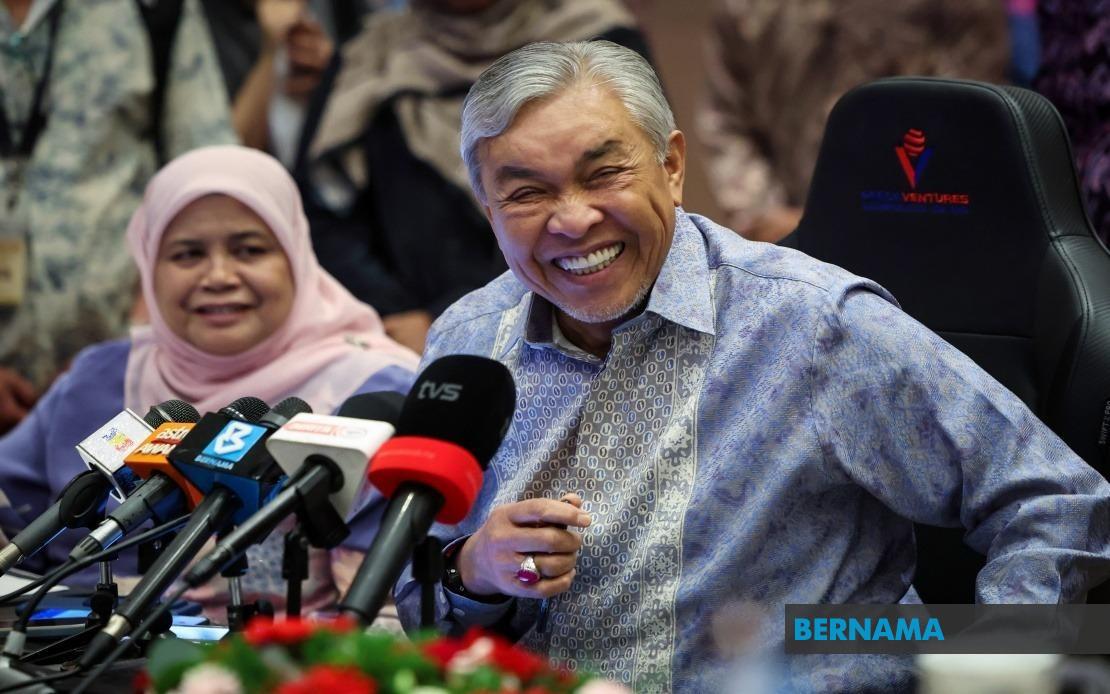
Barisan Nasional's commitment to the Unity Government will remain steadfast until the completion of the current parliamentary term, according to Deputy Prime Minister and BN chairman Datuk Seri Dr Ahmad Zahid Hamidi, who dismissed speculation about any scheme to undermine the administration of Prime Minister Datuk Seri Anwar Ibrahim. Speaking at a press conference in George Town following the 61st Coordination Meeting for Rural Development, Ahmad Zahid categorically rejected insinuations of political manoeuvres aimed at destabilising the current government.
The BN leadership's public assertion comes amid persistent rumours within political circles regarding the stability of the ruling coalition, particularly given the fractious nature of the multiethnic and multi-party alliance that emerged following the 2022 General Election. Ahmad Zahid's explicit rejection of what he termed "Bangkok Move" or "Dubai Move" references—colloquialisms used in Malaysian politics to describe covert efforts to shift political allegiances or orchestrate government changes—underscores the coalition's determination to maintain the status quo. His language was deliberately emphatic, employing the phrase "full stop" to signal finality and leaving no room for misinterpretation.
The timing of Ahmad Zahid's remarks holds significance given the ongoing Negeri Sembilan state election campaign, where BN and Perikatan Nasional (PN) are competing as separate entities despite persistent talk of closer cooperation between the two coalitions. This apparent contradiction—campaigning against PN while pledging loyalty to a national government that includes various Bersatu members—illustrates the delicate balancing act that Malaysian politics requires. Ahmad Zahid acknowledged this complexity by noting that despite opposing PN candidates in state-level contests, the national commitment to the Unity Government framework remains unshaken.
Ahmad Zahid grounded BN's continued participation in the Unity Government within the constitutional framework established by the Yang di-Pertuan Agong's decree following the 2022 elections. This framing is significant for Malaysian readers who understand that any deviation from the monarch's directive would carry substantial political and constitutional weight. By referencing the royal sanction, Ahmad Zahid positioned BN's commitment not merely as a political choice but as a constitutional obligation, thereby elevating the matter beyond ordinary coalition politics.
The deputy prime minister's insistence on remaining "united for the sake of political stability" reflects broader anxieties within the government about its fragility. The Unity Government, comprising BN, Pakatan Harapan, and various Bersatu MPs alongside independent support, operates with a relatively narrow majority in Parliament. Any significant defection or policy disagreement could potentially trigger a confidence crisis. Ahmad Zahid's repeated assurances appear designed to reassure both internal stakeholders and the Malaysian public that internal fractures will not compromise governmental continuity.
Operating in the shadow of these statements is the troubling incident involving the Barisan Nasional Polling District Centre in Klawang, which suspended operations in protest over the decision not to field a candidate for one of the state seats in the Negeri Sembilan election. The centre's closure reflected grassroots frustration with BN's strategic calculations, suggesting that rank-and-file party members do not always accept top-level decisions with equanimity. Ahmad Zahid's acknowledgment of this issue and his confidence that resolution would occur within nine days of the polling date indicated an awareness that internal discontent, if left unaddressed, could cascade into larger problems.
The three-cornered contest in Klawang—pitting Pakatan Harapan's Bakri Sawir against PN's Danni Rais and Bersatu's Muhammad Adib Musa—exemplifies the fragmentation within Malaysian politics post-2022. The decision to deploy different vehicles within the same Negeri Sembilan contest reflects calculations about candidate selection and electoral strategy that do not always align neatly with national coalition obligations. For Malaysian observers, these contradictions highlight the complexity of managing a government that must satisfy multiple constituencies with divergent interests and ambitions.
Regarding speculation about a proposed "Perikatan Barisan Nasional" alliance, Ahmad Zahid took pains to clarify that no formal discussions had occurred between BN and PN despite suggestions that such an arrangement might strengthen both coalitions politically. He characterised the proposal as campaign rhetoric rather than substantive negotiations, indicating that while senior figures might publicly explore such possibilities, the actual machinery of political negotiation had not yet engaged. This distinction between loose talk and formal engagement holds importance for understanding the current political landscape, where aspirational statements often exceed concrete commitments.
The personal dynamic between Ahmad Zahid and Prime Minister Anwar Ibrahim received attention in the deputy prime minister's light-hearted response to a pantun shared by the Prime Minister the preceding day. Anwar's verse had emphasised the importance of unity and discipline in both friendship and political cooperation, and Ahmad Zahid's reciprocal recitation of his own pantun suggested that despite their leadership of competing parties within the coalition, their working relationship retained elements of mutual respect and humour. This cultural exchange, typically Malaysian in character, conveyed an important message about the personal relationships underlying the broader political structure.
For Southeast Asian and Malaysian observers, Ahmad Zahid's statements represent an attempt to stabilise perceptions regarding the government's continuity and coherence. The repeated affirmations of commitment serve multiple audiences simultaneously: they reassure international investors and trading partners concerned about political uncertainty, they signal to parliamentary backbenchers that leadership remains confident, and they attempt to manage expectations among BN's own membership regarding the party's strategic direction. The emphasis on political stability reflects an understanding that Malaysia's economic performance and international standing depend partly on predictable governance.
The broader context for these remarks encompasses growing speculation about Malaysian politics' future trajectory, particularly regarding whether the current coalition arrangement can survive until 2028. Ahmad Zahid's categorical rejection of destabilisation attempts, while necessary, cannot entirely dispel underlying tensions about power-sharing, resource allocation, and policy direction within the government. His assertion that "people say what they want" but BN will "remain united" acknowledges public scepticism while attempting to project confidence through sheer force of assertion.
Looking forward, Ahmad Zahid's statement establishes a clear benchmark against which BN's future actions will be measured. Any subsequent movement toward closer cooperation with PN, any significant policy divergence with coalition partners, or any weakening of support for Anwar Ibrahim's administration could be invoked as evidence contradicting today's categorical assurances. The deputy prime minister has essentially staked his own credibility on maintaining the current arrangement, thereby raising the political cost of any future realignment. For Malaysian political observers, this represents both a stabilising commitment and a hostage to fortune.

