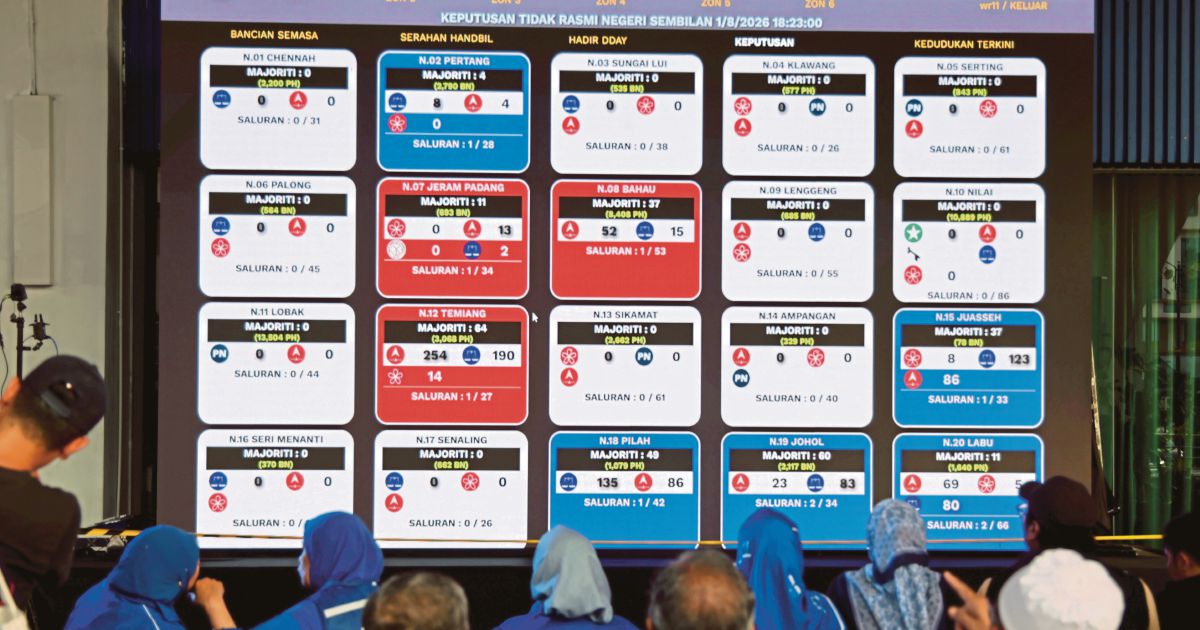
Barisan Nasional and Perikatan Nasional appear to have secured sufficient legislative support to govern Negri Sembilan, according to Umno deputy president Datuk Dr Asyraf Wajdi Dusuki. The coalition has claimed victory with 23 seats from the state assembly, a figure that would grant them the numerical strength needed to command the chamber and form government without additional backing.
The assertion comes from Asyraf Wajdi, a prominent Umno figure who has been instrumental in navigating the party's coalition arrangements across multiple states. His declaration carries weight within party circles, though the claim remains unofficial pending formal confirmation through constitutional procedures. The 23-seat figure represents a critical threshold for Negri Sembilan, where the state assembly comprises a full complement of seats that determines governmental control.
For Malaysian political watchers, the successful coordination between BN and PN in Negri Sembilan reflects a broader pattern of cooperation between these two coalitions that has reshaped state-level politics across the country. This alliance has proven capable of delivering electoral victories in several state elections, demonstrating that despite their historical opposition at the federal level, both coalitions can find common ground when circumstances align at the state level.
The Negri Sembilan outcome carries particular significance for BN, as the coalition seeks to rebuild its political standing following its loss of federal control in 2018. State-level victories serve as both symbolic and strategic wins, providing platforms for party leaders and revenue streams through state resources. For Perikatan Nasional, the partnership underscores its capacity to influence governance beyond its core strongholds in the northern and eastern regions.
The composition of the winning 23 seats would reveal which parties dominate the arrangement. Traditionally, Umno brings substantial organisational capacity and grassroots networks to such coalitions, while PKR's partnership with BN or PN varies depending on circumstances. The specific seat distribution would determine which party holds the Chief Minister position and key state portfolios, matters of considerable importance for party prestige and influence within the coalition structure.
Negri Sembilan has witnessed notable political shifts in recent election cycles. The state's electorate has demonstrated willingness to split its support between different coalitions, and previous elections showed competitive contests across multiple constituencies. A 23-seat claim suggests the BN-PN combination has made inroads that previous independent efforts by either coalition alone might not have achieved, indicating effective collaboration in seat allocation and campaign coordination.
The governance implications extend beyond simple mathematics. A 23-seat majority in Negri Sembilan provides the coalition with flexibility in legislative matters but also requires internal discipline to maintain cohesion. Defections or absences during crucial votes could jeopardise government stability, a risk that has affected several state administrations. Both BN and PN would need to ensure their elected representatives maintain party unity throughout the government's tenure.
For Malaysian federal politics, state-level outcomes feed into broader calculations about coalition viability and electoral trajectories. Success in Negri Sembilan contributes to the narrative around either BN's recovery or PN's expansion of influence. These state-level dynamics eventually influence federal-level considerations, as parties assess their relative strength and positioning ahead of the next general election.
The Negri Sembilan result also matters for internal party politics within both coalitions. Strong performances validate current leadership decisions regarding alliance strategies, while disappointing showings prompt recalibration. Asyraf Wajdi's confidence in publicising this outcome reflects Umno's satisfaction with the arrangement, though potential tensions could emerge during the distribution of ministerial appointments and state development allocations between coalition partners.
Governance challenges await the incoming administration. Negri Sembilan faces typical state-level issues including infrastructure development, education quality, and economic diversification. The coalition government's ability to address these matters effectively while maintaining internal cohesion will determine its political longevity and public support. Economic performance particularly matters for states seeking to attract investment and provide employment to constituents.
The institutional process ahead remains important despite Asyraf Wajdi's announcement. Formal recognition through the Yang di-Pertuan Agong or Sultan's appointment of a Chief Minister, followed by formal assembly procedures confirming government formation, will provide official validation. These constitutional steps are essential for legitimising the government and establishing its legal authority to exercise state powers.

