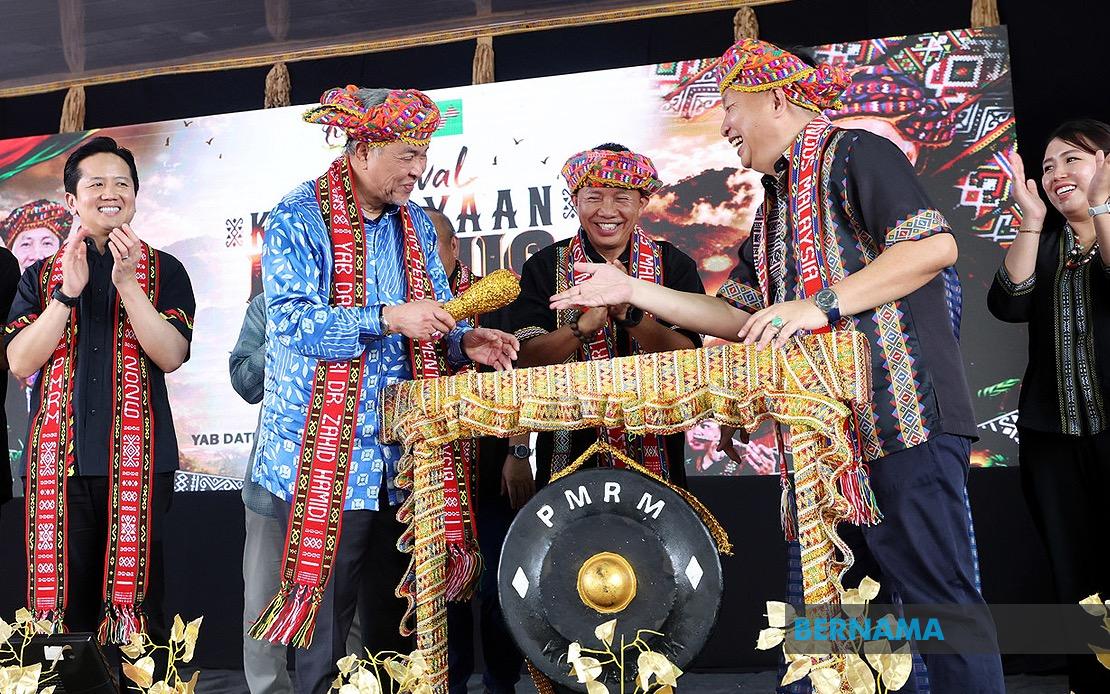
Barisan Nasional has signalled its continued openness to dialogue on seat allocation for the forthcoming Melaka state election, with BN chairman Datuk Seri Ahmad Zahid Hamidi emphasizing that discussions must be grounded in transparency and genuine commitment from all participants. Speaking at the Rungus Cultural Festival in Kudat on August 8, the Deputy Prime Minister articulated a measured stance that acknowledges the coalition's flexibility while preserving core principles around party autonomy and electoral respect.
At the heart of BN's position lies a fundamental assertion: constituencies already secured by any party through election results warrant protection from arbitrary reassignment. Ahmad Zahid made clear that the coalition's framework does not contemplate simply transferring hard-won seats between partners without reciprocal consideration. This principle, he explained, forms the foundation upon which all further negotiations must build. The rationale reflects longstanding tensions within Malaysian coalition politics, where seat allocation has historically been a source of friction between larger and smaller component parties.
Where flexibility emerges is in the possibility of seat swaps or exchanges—arrangements whereby two parties agree to trade constituencies in a manner that leaves each party's total seat count unchanged. Ahmad Zahid elaborated that such exchanges could theoretically extend beyond Melaka's boundaries, encompassing seat trades that span multiple states under BN control. This broader interpretation suggests BN leadership is willing to consider creative solutions that distribute resources more equitably across coalition members and electoral cycles, provided the mathematics of the arrangement remain balanced.
The Deputy Prime Minister's metaphor about keeping the negotiation door "not too wide and not too shut completely" captures the delicate equilibrium BN seeks to maintain. In practice, this means the coalition will engage seriously with component parties on seat arrangements, but will not surrender its preference that seats already won by individual parties remain with those parties. This stance reflects BN's desire to preserve both coalition unity and the electoral integrity of its constituent parties.
Melaka Chief Minister Datuk Seri Ab Rauf Yusoh, who chairs the state BN machinery, has been instrumental in articulating these principles. His emphasis on respecting the electoral positions of winning parties establishes a baseline that BN negotiators will not cross. However, the willingness to discuss swaps indicates that component parties have space to propose creative redistribution schemes that could benefit smaller coalition members or address perceived imbalances from previous elections.
For Malaysian political observers, BN's current posture on seat negotiations carries broader significance. The coalition has faced persistent pressure from within its own ranks, with smaller parties sometimes feeling marginalized in seat allocation processes. By signalling openness to seat exchanges that maintain equilibrium, BN appears to be attempting to address grievances without fundamentally disrupting the distribution formula that has long favored larger parties like UMNO.
The Melaka context adds particular urgency to these discussions. The state has been a political battleground, with leadership changing hands between coalitions in recent years. A state election in Melaka thus carries symbolic weight for BN's broader legitimacy and electoral prospects. Ensuring that component parties feel fairly treated in seat allocation could prove crucial to coalition cohesion during the campaign and beyond.
Internally, BN must balance competing pressures. Larger parties want to maximize their seat allocations to strengthen their parliamentary representation, while smaller parties seek meaningful constituencies to justify their continued participation in the coalition. Seat swaps, if executed thoughtfully, could provide a mechanism to address some of these tensions without requiring wholesale redistribution. An exchange that shifts resources between states or electoral cycles might allow smaller parties to contest in constituencies where they have stronger organizational presence or electoral appeal.
From a Southeast Asian perspective, Malaysia's coalition dynamics warrant attention. Unlike some regional neighbours that have moved toward dominant-party systems, Malaysia has maintained a tradition of multi-party coalitions requiring constant negotiation and compromise. How BN manages its internal seat allocation disputes signals whether coalition politics in the region can adapt to changing voter preferences and demographic shifts while maintaining organizational stability.
The success of BN's negotiation framework will ultimately depend on whether component parties perceive it as genuinely fair. Ahmad Zahid's public articulation of principles provides all parties with benchmarks against which to measure proposed arrangements. If negotiations remain grounded in these transparently stated parameters, they may avoid the acrimony that has sometimes characterized previous coalition discussions. Conversely, if perception emerges that larger parties are exploiting the flexibility of the exchange mechanism to capture disproportionate advantage, confidence in the process could erode quickly.
Moving forward, the specific seat configurations proposed for Melaka will reveal whether BN's principled framework translates into workable outcomes. The coalition's credibility depends not merely on articulating principles but on demonstrating that those principles are applied consistently and fairly across all negotiations. For smaller component parties, the litmus test will be whether seat swaps genuinely provide meaningful opportunities or simply create the appearance of inclusivity while preserving existing hierarchies.

