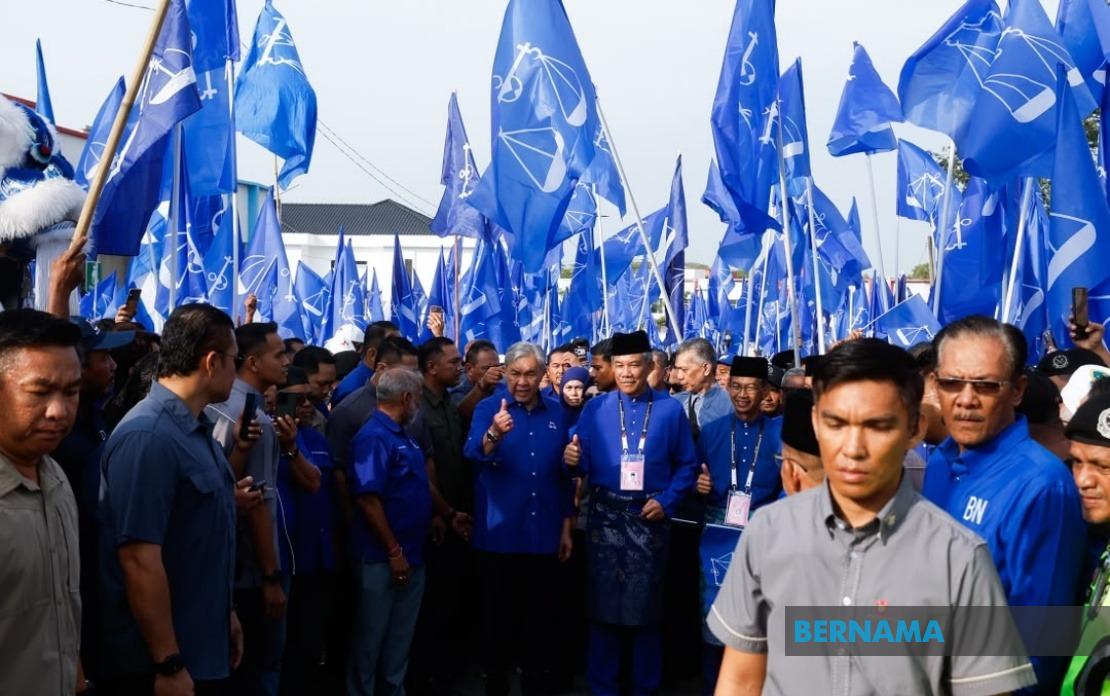
The leadership hierarchy of Barisan Nasional made a deliberate show of unity and support on Thursday as candidates filed their nomination papers for the Negeri Sembilan state election, with senior party figures personally escorting contenders to submission centres across the state. The coordinated turnout reflected the coalition's determination to maintain its political dominance in a state where it has held sway for decades, even as Malaysian politics continues to experience considerable volatility.
BN chairman and UMNO president Datuk Seri Dr Ahmad Zahid Hamidi personally accompanied his deputy Datuk Seri Mohamad Hasan to the Dewan Seri Rembau nomination centre in Rembau, where Mohamad submitted his candidacy for the Rantau state seat. The early morning arrival at 8:40 am, ahead of the official 9 am opening of all eight nomination centres across the state, underscored the symbolic weight BN was placing on the occasion. Mohamad, who has represented Rantau since 2004, is seeking to retain a seat he has held across multiple electoral cycles, making his unopposed arrival with the party's top leadership a calculated statement of continuity and institutional confidence.
The nomination period itself, while brief, reflected standard electoral procedures that have become routine in Malaysian state elections. All eight centres throughout Negeri Sembilan opened simultaneously at 9 am and conducted business for exactly one hour before closing, creating a compressed window during which candidates rushed to complete their formal registrations. This rigid scheduling has become familiar to Malaysian voters and political observers, though it inevitably creates logistical challenges for candidates and their support teams attempting to navigate multiple centres or coordinate media presence.
Beyond Rembau, the party machinery demonstrated its reach across multiple parliamentary constituencies and demographic constituencies within Negeri Sembilan. In Port Dickson, BN secretary-general Datuk Seri Dr Zambry Abd Kadir escorted Datuk Mohd Faizal Ramli to file for the Linggi state seat, while UMNO vice-president Datuk Seri Johari Ghani similarly accompanied Suhaimizan Bizar, who is contesting Gemencheh in the Tampin parliamentary area. The distribution of senior party figures across different nomination centres reflected careful political choreography designed to maximise the symbolic presence of BN leadership while covering the various battleground constituencies.
In the Jempol parliamentary constituency, UMNO secretary-general Datuk Dr Asyraf Wajdi Dusuki took responsibility for ushering three BN candidates through the nomination process. Datuk Mustapha Nagoor, Datuk Mohd Zaidy Abdul Kadir, and Chong Fui Ming, contesting the Palong, Jeram Padang, and Bahau state seats respectively, received the party's official blessing through Asyraf's presence. This three-candidate escort reflected the concentration of competitive seats within a single parliamentary division and the strategic importance BN places on retaining influence in this particular region.
The opposition presence at the nomination centres also underscored the multi-cornered contest taking shape in Negeri Sembilan. Tan Sri Abdul Hadi Awang, president of PAS, personally brought party candidate Mohd Fairuz Mohd Isa to file for the Serting state seat, indicating PAS's determination to expand its presence beyond traditional strongholds. Meanwhile, Parti Orang Asli Malaysia leadership, represented by president Rashid Ka, accompanied Dayana Dal as she submitted her nomination for Jeram Padang, demonstrating that even smaller political parties are fielding candidates and marshalling leadership support to ensure visibility during the crucial nomination phase.
The electoral timeline for this sixteenth Negeri Sembilan state election has been firmly established, with the Election Commission setting August 1 as polling day and scheduling early voting for July 28. The nearly two-week gap between nominations and the actual election provides ample time for campaigning, though Malaysian state elections typically experience compressed campaign cycles compared to federal elections. This compressed timeline places particular pressure on parties to establish momentum immediately after the nomination process.
The political context underlying this election reflects the broader instability that has characterised Malaysian state politics in recent years. The Negeri Sembilan State Legislative Assembly was formally dissolved on June 5 following approval from the Yang Dipertuan Besar of Negeri Sembilan, Tuanku Muhriz Tuanku Munawir, setting the legal machinery in motion. State-level elections in Malaysia have increasingly become important barometers of political sentiment between federal elections, with results often interpreted as referendum on incumbent federal governments or coalitions.
For BN, retaining control of Negeri Sembilan remains strategically significant despite the state's relatively modest size in national political terms. The coalition's demonstrated ability to mobilise senior leadership for nomination events signals confidence in its prospects, yet also acknowledges that no state electoral outcome can be taken for granted in contemporary Malaysian politics. The presence of multiple opposition parties, including PAS and smaller formations, indicates that the Negeri Sembilan contest will test BN's enduring grassroots organisation and appeal across various voter demographics in a state that has been largely shaped by BN governance for the past several decades.

