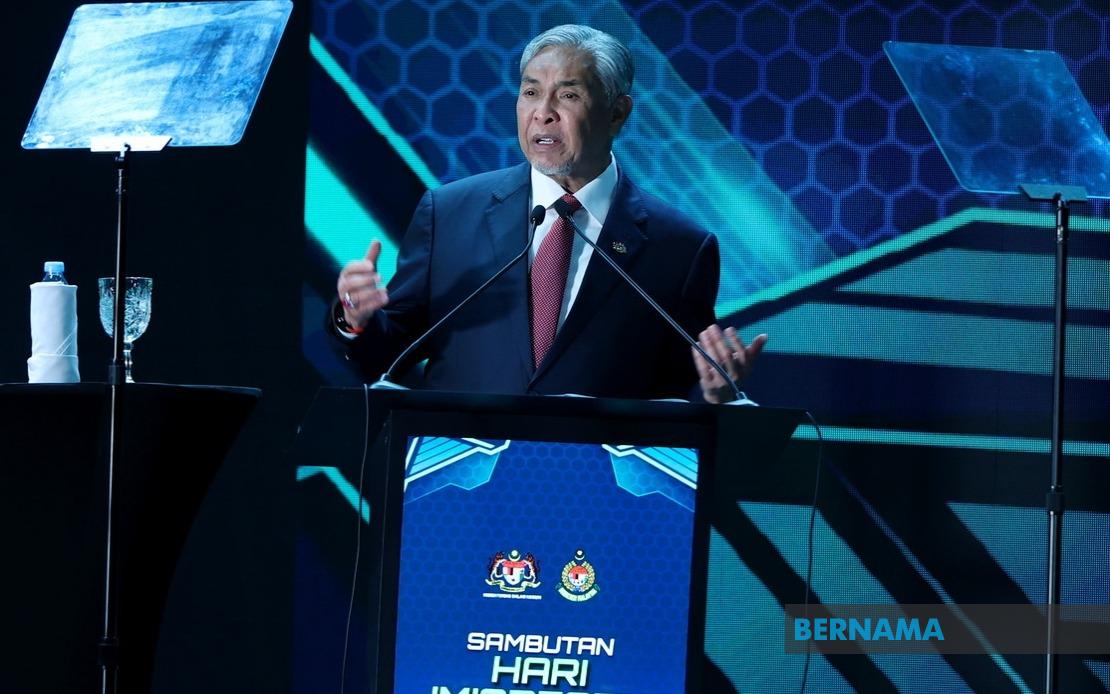
Barisan Nasional will persist as a partner in the Unity Government framework, affirming the position endorsed at UMNO's recent General Assembly, according to the coalition's chairman Datuk Seri Dr Ahmad Zahid Hamidi. Speaking at the 2026 Immigration Day celebration in Cyberjaya on July 21, the UMNO president and Deputy Prime Minister stressed that the decision reflects the party's formal stance and carries the weight of authority from the highest deliberative body within UMNO.
Ahmad Zahid's public statement serves as a reassurance to political observers who have speculated about potential shifts in Malaysia's coalition architecture. The explicit affirmation comes at a time when Malaysia's political landscape remains fluid, with various coalitions and partnerships continuously evolving. By invoking the General Assembly resolution, Ahmad Zahid has anchored BN's commitment to institutional decision-making processes rather than presenting the matter as open to negotiation or reinterpretation.
The emphasis on respecting General Assembly decisions underscores a significant principle within UMNO's internal governance structure. In Malaysian political tradition, party congresses represent the ultimate authority for strategic decisions, superseding statements from individual leaders or smaller governing bodies. Ahmad Zahid's reference to this hierarchy signals that BN's participation in the Unity Government framework reflects not merely his personal preference or tactical calculations, but rather the collective will of UMNO's membership base.
The broader context of this announcement relates to ongoing tensions within Malaysia's ruling coalition structure. The Unity Government, formed following the 2022 elections, represents an unprecedented collaboration between historically opposing blocs—UMNO-led BN and PKR-led PH—along with other parties. Maintaining this coalition has required careful management of factional interests and ideological differences. BN's public reaffirmation therefore serves a stabilising function in an inherently fragile political arrangement.
Separately, Ahmad Zahid addressed the question of ministerial accountability and Prime Minister Datuk Seri Anwar Ibrahim's prerogatives in cabinet management. He acknowledged that appointment and dismissal powers belong exclusively to the Prime Minister, reflecting Malaysia's Westminster-influenced constitutional framework. This statement gains particular significance given recent tensions over ministerial conduct during state-level political campaigns.
Anwar Ibrahim had previously issued guidance to cabinet members and government officials, cautioning them against leveraging their positions to criticise Unity Government coalition partners during state election campaigning. The Prime Minister indicated that those contravening this directive would face dismissal. Ahmad Zahid's restatement of the Prime Minister's unilateral authority over ministerial appointments effectively legitimises this expectation while avoiding direct commentary on specific incidents.
This dual affirmation—of BN's commitment to Unity Government and of the Prime Minister's executive autonomy—reflects the delicate balance required to maintain Malaysia's current coalition. For BN, demonstrating loyalty to the coalition framework proves essential to securing ministerial positions and government resources. For Anwar's administration, maintaining discipline within the cabinet becomes crucial to preventing the coalition from fragmenting under pressure from component parties pursuing competing agendas.
The timing of Ahmad Zahid's remarks warrants consideration. State elections remain a flashpoint for coalition tensions, as parties operating at the state level sometimes advance interests that conflict with federal coalition agreements. By articulating clear boundaries regarding acceptable conduct during electoral campaigns, the BN chairman and Deputy Prime Minister help establish norms that could prevent tactical conflicts from escalating into systemic coalition breakdown.
For Malaysian observers tracking political developments, these statements reveal the mechanisms through which coalitions sustain themselves despite inherent contradictions. The reliance on institutional processes—General Assembly resolutions, prime ministerial authority, cabinet protocols—provides structural scaffolding that can contain tensions that personal relationships alone might not. Ahmad Zahid's invocation of these mechanisms suggests BN leadership recognises that explicit commitment must be regularly renewed through formal channels.
The regional implications extend beyond Malaysia's domestic political equilibrium. Southeast Asian governments increasingly operate through multi-party coalitions rather than single-party dominance, making the sustainability of such arrangements a matter of interest across the region. How Malaysia manages coalition tensions offers lessons for other regional democracies navigating similar power-sharing arrangements.
Moving forward, maintaining Unity Government cohesion will depend partly on how effectively senior figures like Ahmad Zahid can signal commitment while maintaining space for BN to pursue its interests. The coalition framework requires periodic reinforcement through exactly such public statements, preventing the normalisation of defection or the perception that any partner might unilaterally exit the arrangement. Ahmad Zahid's remarks therefore function as both affirmation and warning—reassurance to coalition partners coupled with implicit caution against destabilising behaviour.

