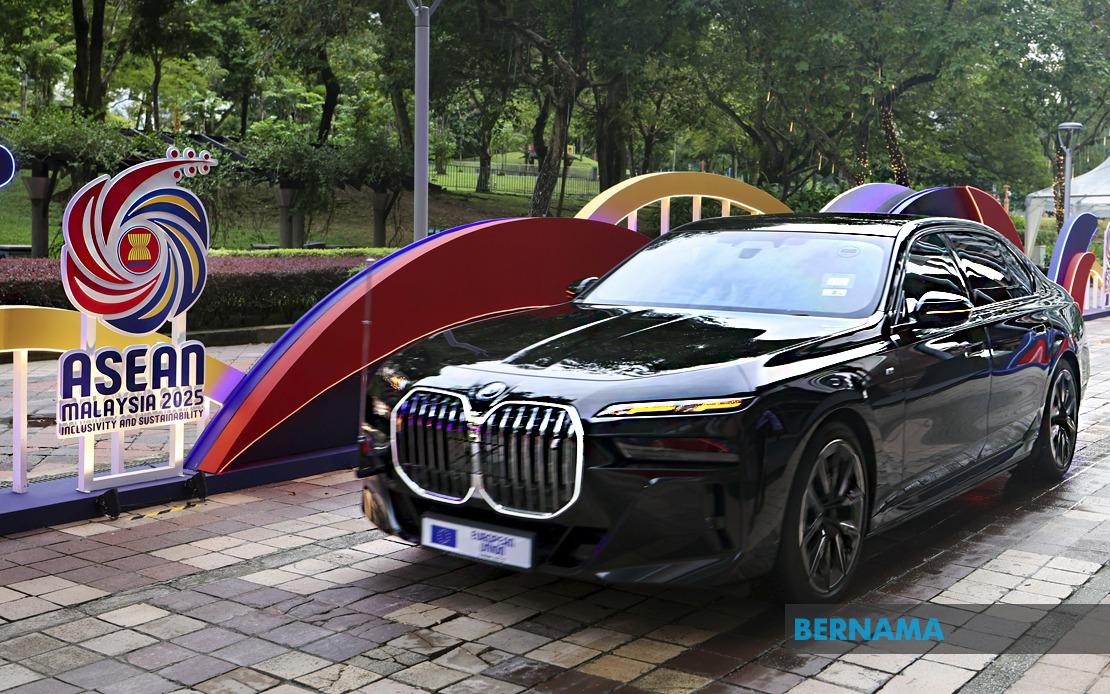
The Prime Minister's Department has moved to settle public speculation surrounding a luxury BMW vehicle recently seen accompanying Prime Minister Datuk Seri Anwar Ibrahim, confirming that the car is an existing government asset rather than a newly purchased official vehicle.
Through a statement issued via the Ceremonial and International Conference Secretariat Division (BIUPA), the department explained that the BMW falls under BIUPA's administrative supervision and forms part of Malaysia's official logistics fleet. The clarification came after social media users raised questions about the procurement and status of the vehicle, prompting the government to provide formal transparency on the matter.
According to the official announcement, the primary purpose of maintaining such a vehicle relates to Malaysia's international obligations and diplomatic requirements. When foreign heads of state and government officials—particularly those holding presidential or prime ministerial rank—visit the country, Malaysia must provide transportation that adheres to strict international security protocols and standards. This responsibility extends beyond ordinary convenience; it reflects the nation's standing in the global community and its capacity to host high-level dignitaries safely.
The specifications required for such diplomatic vehicles are considerably specialized and demanding. The BMW in question has been engineered to withstand multiple security threats that conventional automobiles cannot address. These protective features include reinforced structures capable of resisting high-caliber ballistic projectiles, protection against explosive devices, and countermeasures designed to neutralize emerging threats such as drone-based attacks. The combination of these features necessitates purpose-built vehicles that cannot be sourced from standard commercial channels.
Regarding the Prime Minister's current use of the vehicle, the department noted that this arrangement is temporary and follows recommendations from Malaysia's security apparatus. The Royal Malaysian Police assessed that the temporary deployment of this vehicle was warranted based on current security considerations and threat assessments specific to the Prime Minister's official duties and movements.
The clarification also provided practical context for why an alternative vehicle was temporarily required. The Prime Minister's designated official vehicle—which was previously gifted by the Yang di-Pertuan Agong—is currently undergoing routine maintenance procedures. This regular upkeep is necessary to ensure that Malaysia's primary vice-regal gift vehicle remains in optimal operational condition and fully capable of meeting its security and ceremonial functions. The temporary substitution was thus presented as a practical measure during scheduled servicing.
The statement's issuance reflects a broader pattern of government officials addressing public queries and misconceptions through direct communication channels. Social media platforms have increasingly become spaces where speculation regarding government assets and spending can rapidly proliferate without verified information. By releasing a detailed clarification, the department sought to provide Malaysian citizens with authoritative facts and dispel inaccuracies that might otherwise persist unchallenged in public discourse.
From a governance perspective, the matter underscores the distinction between government assets designated for specific operational purposes and routine procurement decisions. Malaysia, as a nation hosting international delegations and maintaining diplomatic protocols consistent with those of other Southeast Asian and Commonwealth nations, requires specialized vehicles that cannot be categorized as extravagant acquisitions but rather as necessary infrastructure for state functions.
The security specifications mentioned in the statement also reflect contemporary global realities. Modern threats to high-ranking officials have evolved considerably beyond historical concerns, with security agencies worldwide now incorporating ballistic protection and explosive countermeasures as baseline requirements. Malaysia's adoption of such standards for vehicles used by or made available to the Prime Minister aligns with international best practices observed in comparable nations throughout the region and beyond.
The temporary nature of the arrangement is significant, as it indicates that the deployment of the BMW is not intended as a permanent change to the Prime Minister's official transport arrangements. Once the Yang di-Pertuan Agong's gifted vehicle completes its maintenance cycle, the established protocol regarding the Prime Minister's primary official vehicle will presumably resume. This further demonstrates that the explanation offered reflects genuine operational circumstances rather than policy shifts.
For Malaysian citizens and observers, the clarification provides assurance regarding transparency in government asset management and official vehicle usage. The willingness of the Prime Minister's Department to address public questions promptly contributes to informed public understanding of how official structures function and why particular expenditures and arrangements exist. Such communication helps distinguish between legitimate government operational needs and instances of actual fiscal mismanagement, allowing citizens to form judgments based on accurate information rather than speculation.

