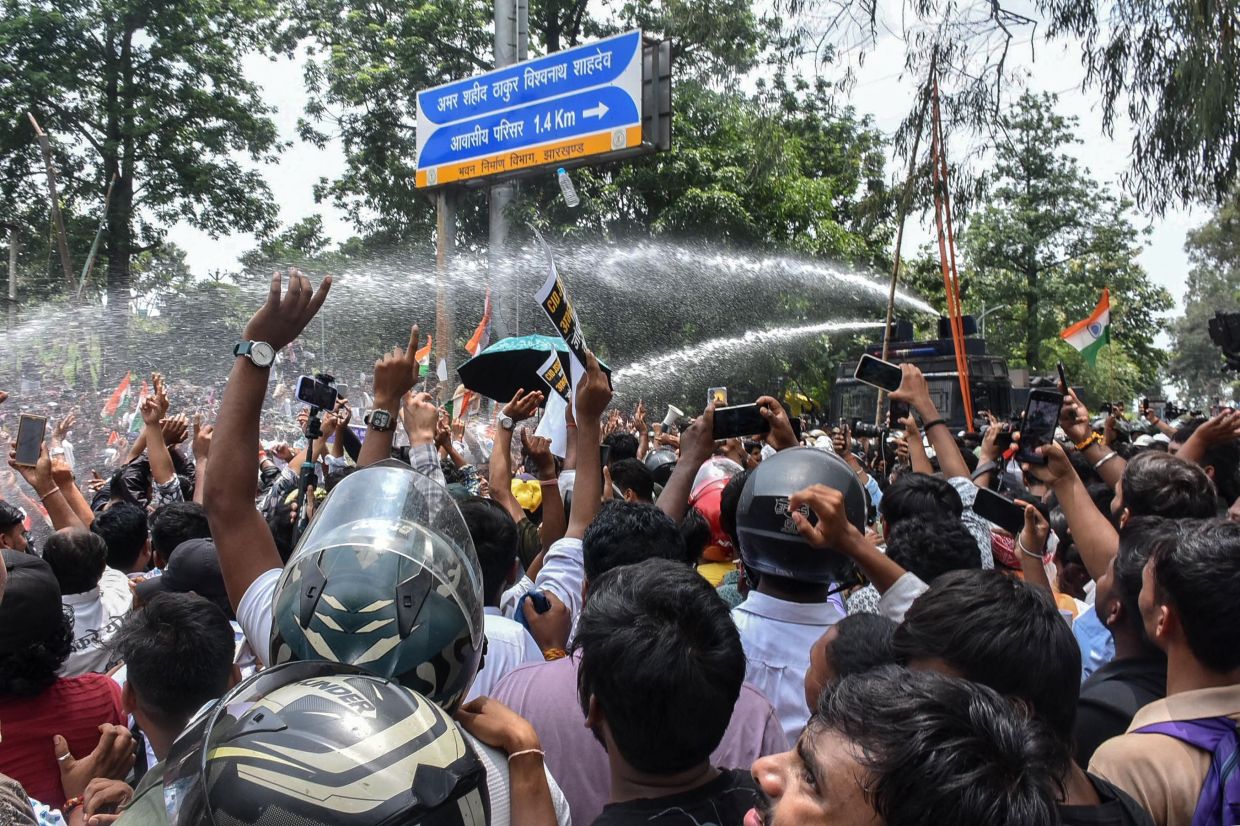
Prime Minister Narendra Modi's governing Bharatiya Janata Party has launched a pointed critique of the Cockroach Janta Party, the activist collective that mobilised students in India's capital last month, characterising its limited engagement with concurrent demonstrations elsewhere as evidence of opportunistic rather than principled activism. BJP spokesperson Keya Ghosh delivered the assault on Tuesday, suggesting the group's singular focus on New Delhi protests betrayed a narrower agenda than the movement's rhetoric implied.
The Cockroach Janta Party, which evolved from internet-based satire into a tangible political pressure group, had catalysed large-scale student unrest across New Delhi in late July over alleged irregularities in national examinations. The movement ultimately succeeded in forcing the resignation of Education Minister Dharmendra Pradhan, a significant political victory that amplified the movement's credibility and reach among India's student population. However, the group's subsequent withdrawal from active protesting, despite continuing agitation elsewhere, has invited scrutiny about whether its motivations were genuinely reform-oriented or primarily anti-government.
The parallel demonstrations have shifted to Jharkhand, a mineral-rich state in eastern India where students and job aspirants are demanding a federal inquiry into alleged corruption within state-level recruitment examinations. These protests represent a distinct challenge to local governance structures, yet have not commanded equivalent attention or physical presence from the Cockroach Janta Party's leadership and core activists, notwithstanding the group's stated support for students' fundamental rights to demonstrate peacefully. This geographical and strategic divergence has provided the BJP with ammunition to question the consistency of the movement's principles.
Ghosh's criticism specifically targeted Abhijeet Dipke, the group's founder, suggesting his absence from Jharkhand's protest sites undermined claims that the Cockroach Janta Party represented a broader commitment to educational and employment justice across India. The insinuation was clear: if the movement truly championed students' rights universally, its leadership would be equally visible and engaged regardless of which government faced pressure. The fact that demonstrations in Jharkhand are directed at a coalition government led by the Jharkhand Mukti Morcha, which includes the Indian National Congress—parties opposing Modi's BJP nationally—may explain the discrepancy, though BJP spokespeople have stopped short of stating this explicitly.
Dipke, for his part, has attempted to distinguish between the Cockroach Janta Party's relationship to the two protest movements. While he personally condemned police deployment of water cannons and batons against demonstrators in Jharkhand on Monday, framing such tactics as "cruel and inhuman," the group has characterised its role in the eastern state's agitation as supportive rather than leadership-driven. The Jharkhand protests appear genuinely indigenous, rooted in local anxieties over employment opportunities and institutional integrity, with student organisers operating largely independently of Delhi-based activist networks.
Akshay Shinde, the Cockroach Janta Party's national coordinator, has nevertheless asserted that members active during the New Delhi campaign have travelled to Jharkhand and are contributing substantively to ongoing demonstrations there. According to local media reports, these individuals are working within the movement's structures and have committed to remaining engaged until the students' demands are fully satisfied. This claim complicates the BJP's narrative of wholesale withdrawal and disinterest, though it does not entirely rebut the critique that the group's institutional engagement differs significantly between the two contexts.
The political dimensions of this dispute warrant careful analysis for observers across Southeast Asia, where student activism frequently intersects with government legitimacy and opposition strategies. India's demonstration demonstrates how activist movements can become entangled with partisan narratives, even when their stated intentions transcend electoral politics. The BJP's offensive also highlights how ruling parties globally exploit apparent inconsistencies in opposition-aligned movements to delegitimise their claims of principle.
Rahul Gandhi, the Indian National Congress leader and opposition figure in parliament, has maintained a cautious distance from both protest sites, condemning violence against demonstrators while declining to visit either location. His conspicuous absence has invited BJP accusations that opposition parties selectively support activism based on partisan benefit rather than genuine concern for student welfare. Gandhi's statement that "students have a right to peaceful protest, and only dialogue can yield solutions" asserts platitudes rather than demonstrating substantive engagement with either movement's specific grievances or demands.
The Jharkhand situation presents particular complexity because the state's coalition government, though opposed to Modi's BJP, faces legitimate criticism over examination integrity. The BJP's focus on attacking the Cockroach Janta Party rather than substantively addressing the students' underlying concerns suggests that its critique may serve primarily tactical purposes within national political competition. For Malaysian observers, this illustrates how student activism in larger democracies becomes rapidly subsumed within broader partisan conflicts, a dynamic potentially relevant to understanding activism within Malaysia's own political ecosystem.
Ultimately, the dispute reveals tensions inherent to student-led movements operating within partisan democracies. The Cockroach Janta Party's apparent strategic choices—whether consciously calculated or circumstantial—have exposed it to charges that its activism serves narrower political objectives than universal principles. Whether these criticisms prove substantive or represent merely opportunistic opposition rhetoric remains contested, though the movement's trajectory will likely influence how Indian students and activists approach future political engagement.

