Wimbledon stands as a study in contrasts. The All England Club's 149-year-old tournament meticulously preserves traditions that define British social convention, from the mandatory white dress code extending even to players' footwear, to strawberries and cream served at courtside, and carefully orchestrated appearances by members of the royal family. Yet beneath this carefully curated pageantry lies a sporting intensity that rivals any other competition on the global calendar. The gulf between aesthetic presentation and raw competitive drive has rarely been starker than when Wimbledon coincided with the FIFA World Cup, two major sporting events separated not merely by the distance between All England Club and distant football stadiums, but by fundamentally different philosophies of display versus substance.
The 149-year-old Grand Slam tournament sprawls across its iconic grass courts with roughly 675 matches across every competitive category, creating a vast stage upon which individual drama plays out in concentrated bursts. While casual observers might fixate on the spectacle—the creative headwear adorning spectators, the immaculate appearance of players, the pageantry of royal patronage—the tournament's true narrative emerges in far more intimate moments. These are the instances where professional athletes confront the gap between aspiration and achievement, where years of preparation meet the unforgiving reality of elite competition.
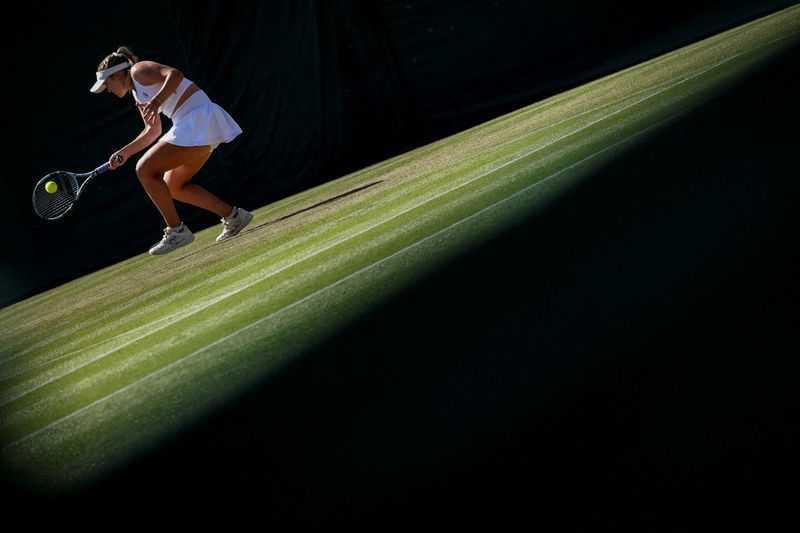
Photographers embedded throughout the tournament documented this underlying emotional landscape with particular clarity. The moment Alexandra Eala, a 21-year-old attempting to defeat Iga Swiatek, the third seed and six-time major champion, fell while executing a forehand return revealed the grinding determination required to compete at this level. Eala's gritted teeth in that captured instant symbolized far more than physical struggle—it represented the psychological resilience demanded when confronting established champions. Her battle against the odds played out in microseconds, yet encapsulated the entire competitive thesis of professional tennis.
Photographer Toby Melville had positioned himself to document Eala's anticipated celebration, but instead captured something far more revealing. As the player's fall transformed her vertical frame into a horizontal shape across the grass, Melville's lens caught what he described as one of the tournament's finest competitive moments—not a moment of triumph, but a moment of raw struggle. This chance capture illustrates how the deepest sporting truth often emerges not from staged moments but from unguarded instances where performers reveal their vulnerability and determination simultaneously.
The psychological weight of Wimbledon's Centre Court stage manifested differently across different competitors. Otto Virtanen, competing in the first round, experienced a moment of such frustration during his hard-fought victory that he walked to the courtside barrier as though the green canvas might swallow him whole. The enormity of competing at tennis's most prestigious venue, played out before thousands of spectators and millions watching globally, creates pressure that transcends the mechanical aspects of the sport. For some players, particularly those not accustomed to such intense scrutiny, the emotional landscape becomes nearly as challenging as the opponent across the net.
Yet Wimbledon also provides stages for players to shine with undeniable brilliance. Naomi Osaka, the two-time major champion, strode across Centre Court in a kimono-inspired dress that seemed to embody her fearless approach to the tournament. Her quarter-final appearance represented a campaign conducted with the kind of self-assurance that transforms individual performances into cultural moments. Photographer Marko Djurica captured Osaka in this moment of unguarded confidence, a counterpoint to the struggle and frustration visible in other frames.
The tournament's visual narrative extends beyond the moments of triumph or struggle into the realm of artistic metaphor. Melville's photograph of men's champion Jannik Sinner stretched to extremes during his final against Alexander Zverev showcased not merely athletic ability but the psychological willingness to extend beyond perceived limits. Sinner's shadow in the frame appeared to reach further than his body itself, a visual representation of how champions must mentally transcend their physical boundaries. The Italian's campaign culminated in that final stretch, both literal and metaphorical.
Similarly, Djurica captured women's doubles champions Guo Hanyu and Kristina Mladenovic embracing after their victory, the shadow they cast resembling a single player raising a fist in triumph. These images reveal how the camera frequently captures symbolic representations of competitive truth—the merger of two athletes becoming a single triumphant entity, the shadow suggesting what cannot be fully framed within the photograph's boundaries. Such moments demonstrate that Wimbledon's true drama operates both in the visible and the suggested.
The passage of time through the tournament's progression appeared vividly in Andy Couldridge's time-lapse documentation of Centre Court. The grass courts that begin the tournament pristine gradually bear the wear of countless players' footsteps, the visible patches of worn turf telling the story of the competition's accumulation. This visual record of degradation, of grass worn away by the passage of elite athletes competing at their absolute limits, represents perhaps the most honest documentation of Wimbledon's intensity. The maintained perfection that defines the tournament's opening aesthetic gradually surrenders to evidence of the fierce competition that defines its substance.
For Malaysian and Southeast Asian readers, Wimbledon represents both a distinctly British institution and a global sporting platform where players from across the region increasingly compete. The tournament's balance between tradition and fierce competition mirrors broader questions facing institutions throughout Southeast Asia—how to preserve cultural heritage while embracing modern competitive intensity. The stories captured within Wimbledon's grass courts extend beyond tennis into broader narratives about aspiration, resilience, and the psychological demands of elite performance.
The tournament ultimately reveals that sporting tradition and competitive intensity need not conflict. Rather, the constraints imposed by tradition—the white dress code, the formal atmosphere, the institutional protocols—may actually serve to heighten the drama of individual competition. By channeling intense psychological and physical struggle through carefully prescribed social conventions, Wimbledon creates a unique tension between form and substance that keeps millions globally engaged. The spectators consuming strawberries and cream while watching these dramas unfold are witnessing not merely tradition, but the transformation of that tradition into the crucible within which modern sporting excellence is forged.

