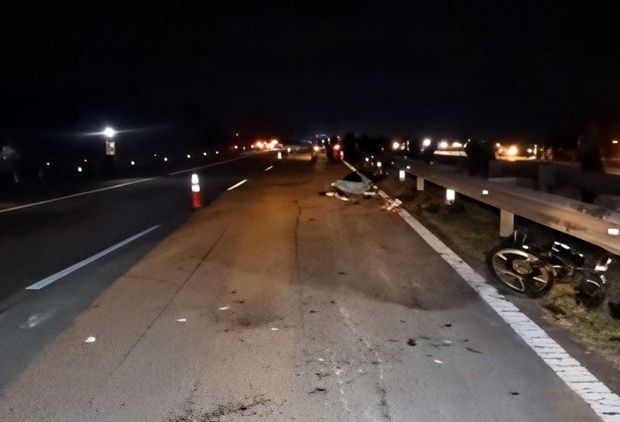
The East Coast Expressway has become synonymous with tragedy once more, as the wreckage of a devastating crash in the early morning hours last Saturday painted a grim picture across its carriageway. Three riders died at the scene, with a fourth succumbing to injuries in hospital, while thirteen others sustained varying degrees of harm. The incident, which unfolded around 1am, immediately triggered the predictable cycle of social media speculation and recrimination, with armchair judges rushing to apportion blame and pontificate about negligent driving practices. Yet beneath this chorus of public condemnation lies a quieter, far more sobering reality that demands equal attention: eight young children, ranging in age from mere infants to early teenagers, lost their fathers in a single moment.
The immediate aftermath of such tragedies typically focuses on questions of liability and culpability. There is legitimate reason to discuss dangerous riding practices and the enforcement of traffic laws—these conversations matter for road safety policy and accident prevention. However, this necessary scrutiny can overshadow an equally critical dimension: the material and emotional devastation that befalls the dependents of those who perish. The families left behind face not abstract moral questions but concrete, relentless demands. There are children whose growth cannot pause for grief, whose educational needs will not diminish, whose nutritional requirements remain constant regardless of circumstances. Single mothers, thrust into breadwinning roles they neither anticipated nor chose, now shoulder the burden of maintaining household stability whilst processing profound loss.
The Social Security Organisation (PERKESO) has never positioned itself as a moral arbiter of whether accident victims deserve protection. Instead, it operates within a carefully constructed framework designed to fulfil a single, essential purpose: ensuring that families do not collapse into destitution when misfortune strikes. This distinction between judgment and protection forms the philosophical bedrock of social security systems across the developed world, yet it remains surprisingly poorly understood in Malaysia. Many Malaysians view social security contributions as temporary inconveniences—small, barely-noticed payroll deductions during stable employment. The true value of these contributions becomes apparent only when the unthinkable occurs, when steady income vanishes overnight and dependents face an uncertain future.
The principle underlying social security extends far deeper than simple risk pooling or actuarial mathematics. It embodies a fundamental social contract, a collective commitment that transcends individual circumstances. The healthy support the sick; those spared by accident stand alongside those devastated by loss; working adults shoulder responsibility for those whose capacity to labour has been diminished or extinguished entirely. This is not charity, nor is it a reward system for the virtuous. Rather, it represents society's acknowledgment that misfortune respects neither character nor prudence, and that civilised communities protect their most vulnerable members from destitution. When disaster threatens to collapse a family's financial world, this safety net aims to prevent children from slipping into poverty and to preserve dignity during humanity's darkest passages.
In the specific instance of this East Coast Expressway tragedy, PERKESO's protection mechanisms have materialised in concrete form. Three of the four deceased workers possessed contribution records that qualified their families for Survivors' Pensions. The family of the late Che Mohd Suffian Che Gani stands eligible to receive RM2,207.63 monthly; the family of the late Muhammad Hafiz Al Hakim Mazlan receives RM1,258.33; and the family of the late Mohd Aizat Husni receives RM708.33. These sums, whilst modest by many standards, represent lifelines for households suddenly deprived of primary income sources. The prescribed apportionment ensures that widows receive lifetime pensions—RM1,325, RM755, and RM425 monthly respectively—whilst the eight orphaned children collectively receive RM1,670 each month until they reach working age. Calculated across the typical benefit periods, these provisions total approximately RM1.2 million in long-term support.
The arithmetic deserves careful attention. When aggregated across a thirty-year period, the widow's pensions alone total RM477,000, RM271,800, and RM153,000 respectively. The child allowances, distributed over fifteen years, amount to RM300,600. For families accustomed to managing household budgets on modest wages, these figures represent substantial contributions to the costs of childhood—from milk powder for infants to school fees for teenagers, from clothing replacements as young bodies grow to nourishing meals that support healthy development. The payments flow continuously, not as occasional charity but as a systematic, predictable income stream that allows mothers to plan and provide with some measure of confidence amidst overwhelming grief. This steady support does not erase loss, cannot restore the fathers these children will never know, and offers no compensation for absent guidance during critical developmental years. Yet it does prevent a secondary catastrophe: the descent of surviving family members into absolute poverty.
The tragedy also highlights the expanded reach of PERKESO's Lindung 24 Jam scheme, a relatively recent addition to Malaysia's social security architecture. Five of the thirteen injured victims from this crash qualified for benefits under this expanded framework. Prior to June 1, when the scheme underwent significant enhancement, many of these individuals might have fallen into the administrative cracks that plague social security systems worldwide. They would have suffered injuries severe enough to trigger temporary or permanent incapacity, yet lacked the precise employment or contribution history that qualified them for traditional benefit categories. Their applications would have languished in legal limbo, with PERKESO unable to provide assistance despite the manifest need. The Lindung 24 Jam expansion addressed this gap, ensuring that injured workers receive protection regardless of whether their accidents occurred during officially recorded work hours or whilst commuting to employment.
The broader significance of this accident extends beyond the immediate families affected. It underscores a persistent gap in Malaysian social security literacy—the widespread public misunderstanding of how these systems function and why they matter. Many Malaysians view PERKESO contributions with mild resentment, treating them as minor inconveniences that reduce take-home pay without apparent benefit. This perception reflects a fundamental misalignment between individual experience during healthy, employed years and the system's true purpose, which reveals itself only during crisis. When working citizens remain unharmed, when employment continues uninterrupted and wages flow steadily, the protective function of social security remains invisible. Only when accident, illness, or death strikes does the system's value become undeniable. Yet by then, many have already experienced decades of the modest reduction to monthly income that these schemes represent.
The challenge facing Malaysian policymakers and social security administrators involves transforming this narrative. Rather than viewing social security contributions as implicit taxes on employment, societies must cultivate deeper understanding of the solidarity principle underpinning these systems. Public education campaigns should help working Malaysians understand that their contributions fund benefits for others today, whilst simultaneously purchasing their own insurance against future catastrophe. The eight children left fatherless by the East Coast Expressway crash will eventually discover this truth through bitter experience. But they need not suffer the additional tragedy of growing up in poverty. Their mothers need not collapse under economic pressures in addition to grieving their losses. PERKESO's framework, though imperfect and requiring ongoing refinement, has prevented the worst-case scenario. That outcome deserves recognition and appreciation, not dismissal as merely financial transaction.
The question of negligence and dangerous riding remains worthy of serious discussion. Road safety advocates should continue pressing for enforcement improvements, infrastructure enhancements, and driver education initiatives. But this conversation need not eclipse the equally important reality that families have become vulnerable, that children now require protection society can provide through existing mechanisms, and that the difference between destitution and survival often rests on whether these safety nets remain robust and accessible. The East Coast Expressway tragedy ultimately represents a moment when social security systems function precisely as designed: catching families before they fall completely, providing steady support during the long reconstruction that follows catastrophic loss, and honouring the principle that no child should suffer poverty simply because their parent's employment ended in tragedy.

