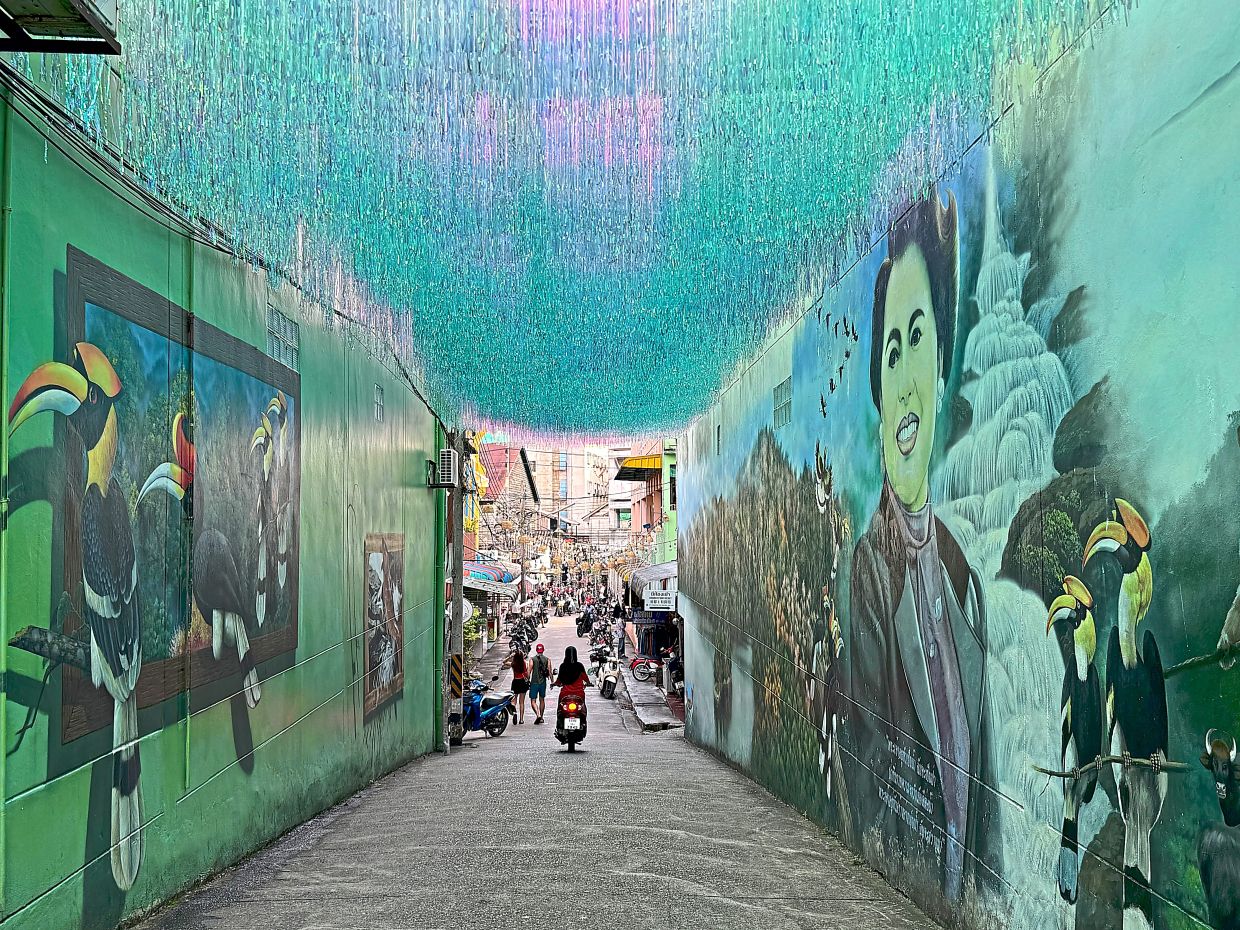
Betong, a modest municipality in southern Thailand perched near the Malaysian frontier, initially presents itself as an unremarkable waypoint. Yet this border town harbours a collection of attractions that reward curious visitors willing to venture beyond the main road. What begins as a casual exploration—perhaps drawn by oversized poultry sculptures decorating lamp posts—unfolds into discoveries spanning local pride, wartime history, and architectural eccentricity that collectively define the destination's character.
The town's obsession with chickens stems from the Betong chicken, an indigenous breed that represents both cultural heritage and economic identity. Enormous statues erected as focal points celebrate this avian significance, signalling that fowl-based cuisine permeates the local food landscape. Restaurants throughout Betong showcase variations on chicken themes, whether transformed into rice dishes, porridge, or other preparations, ensuring that dining becomes an extension of the town's singular agricultural legacy. This culinary consistency, though narrow in scope, demonstrates how small communities construct identity through specialisation.
Located approximately 380 kilometres from Kuala Lumpur—a manageable five-hour drive—Betong functions as an accessible escape for Malaysian weekend travellers seeking alternatives to conventional tourist destinations. The journey itself traverses Highway 410, officially designated the Pattani-Betong route, a 160-kilometre stretch celebrated among motorcycle enthusiasts for challenging topography. Steep gradients and serpentine curves through mountainous jungle create conditions that attract organised cycling communities, transforming the approach into an adventure component rather than mere transit.
Two engineering marvels punctuate the landscape between Kuala Lumpur and Betong town proper. The Mongkollit Tunnel, constructed in 2001 and recognised as Thailand's inaugural mountain bore, initially appears utilitarian and uninspiring during daylight hours. However, evening transformation renders it spectacular, as brilliant azure illumination floods the passage, prompting visitors to populate pedestrian walkways for photography and contemplation. This theatrical reinvention of infrastructure demonstrates how simple technological enhancement can convert functional necessity into experiential attraction.
The Piyamit Tunnel presents considerably deeper historical resonance. Excavated during the late 1970s, this one-kilometre subterranean complex originally served as headquarters for the Communist Party of Malaya during their final operational years. Beyond merely providing shelter, the facility functioned as barracks, meeting chambers, communication centre, and emergency escape passage—sophisticated infrastructure that enabled sustained resistance operations deep within the jungle. Multiple entrances and exits permitted coordinated dispersal during military assaults, though contemporary safety protocols have sealed several access points. The sophistication and scale of these works reveal the organisational capacity and determination of the insurgent movement.
Visitors traverse a covered pathway for approximately fifteen minutes before entering the tunnel proper, building anticipation before encountering the actual space. Upon arrival, a dedicated museum housed within the visitor centre contextualises the site through historical photographs and recovered artefacts documenting daily life among communist combatants. The exhibition humanises what might otherwise remain abstract history, portraying these individuals as operational soldiers sustaining complex logistics across years of conflict. Within the tunnel itself, demarcated areas reveal sleeping quarters, deliberation spaces, and communication posts, allowing spatial understanding of how personnel occupied the restricted environment.
Archaeological detail extends beyond the tunnel's main chamber. An exterior cooking installation demonstrates ingenious engineering wherein specially constructed stoves channelled smoke underground, preventing aerial detection by opposing forces. This innovation—seemingly minor—exemplifies the operational thinking required to sustain clandestine occupation. Such practical adaptations reveal how survival depended upon continuous problem-solving rather than abstract ideology alone. For Malaysian visitors particularly, this site offers context regarding the Cross-Border Insurgency and its lingering regional implications, a historical chapter often overshadowed in contemporary discourse.
Chulabhorn Phatthana Village 9, positioned 120 kilometres distant in Mae Wat, extends the historical narrative into post-conflict rehabilitation. Originally housing former communist fighters following the insurgency's conclusion, this settlement transformed into a cultural tourism site where visitors examine alternative historical perspectives and reconciliation processes. This evolution from military facility to commemorative space demonstrates Thailand's approach to managing ideological conflict through gradual integration rather than obliteration.
Beyond historical layers, Betong's pedestrian-friendly urban design facilitates exploration without vehicular dependency. The central districts concentrate notable sites within reasonable walking distance, though parking complexities make vehicle-free navigation preferable. Local custom, apparently, encodes parking regulations through kerb coloration—black-and-white markings permit parking, while red-and-white equivalents prohibit it. This system, though potentially confusing for uninitiated visitors, reflects practical municipal pragmatism adapted to local traffic patterns.
Wat Phutiwhat temple establishes another focal point within the town geography. An imposing bronze Buddha sculpture dominates the temple entrance, overlooking Betong's sprawling landscape, while interior chambers house respected religious relics. Morning visits provide optimal conditions for contemplation and photography, avoiding congestion that accumulates through afternoon hours. This spiritual dimension, interwoven with secular attractions, reflects Thailand's cultural character whereby religious expression permeates community life.
Mailbox architecture constitutes perhaps Betong's most unexpected landmark category. Standard Thai mailboxes approximate adult human height; Betong, however, features two outsized versions that function as unofficial civic symbols. The original structure, erected in 1924 and standing 3.2 metres tall, occupies a position near the Betong Clock Tower. This venerable installation formerly incorporated built-in loudspeaker systems broadcasting governmental announcements throughout the town—a communication technology now superseded but physically preserved. The box continues serving postal functions, representing unbroken civic continuity across centuries. A nine-metre replica constructed later as explicit tourist attraction now stands at the City Convention Hall along Sukyang Road, institutionalising quirk as marketable commodity.
Betong's appeal ultimately derives from accumulated specificity rather than singular landmark dominance. The Betong chicken celebrates agricultural heritage; tunnels document ideological conflict; temples express spiritual traditions; oversized mailboxes embody administrative history; highway topography attracts sporting enthusiasm. This layering invites visitors to construct personalised experiences rather than consume predetermined tourist scripts. For Malaysian travellers accustomed to more commercialised destinations, Betong offers genuine interaction with a functioning Thai community whose identity remains unconventional yet grounded in authentic local pride.

