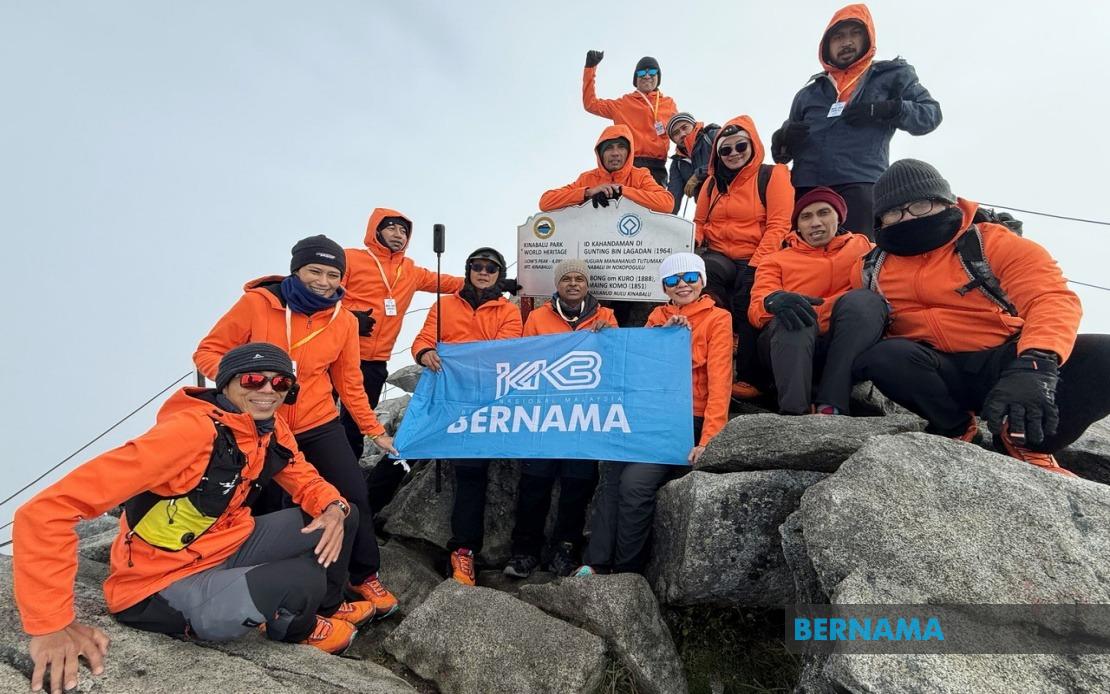
In a demonstration of institutional pride and physical endurance, twenty-three employees of Bernama, Malaysia's national news agency, reached the summit of Mount Kinabalu on July 1 as part of festivities marking the 2026 National Journalists' Day (HAWANA) celebration. The expedition, the first organised by the Bernama Staff Club, brought together a cross-section of the organisation—from reporters and photographers to television crew members and administrative personnel—unified in their determination to conquer Southeast Asia's highest peak at 4,095.2 metres above sea level.
The climb presented a formidable challenge to participants, who navigated the ascent under deteriorating meteorological conditions that included heavy rainfall, dense fog, and powerful gusts of wind. The team departed from Timpohon Gate at 10 am on June 30, made their way to the overnight rest point at Panalaban, and then resumed the final push toward the summit at 2.30 am on July 1. The group successfully broke through the difficult final kilometres and planted themselves atop the mountain by approximately 7.20 am, a testament to their collective preparation and determination.
Bernama Editor-in-Chief Arul Rajoo Durar Raj, who personally led the expedition, articulated two significant objectives beyond the summit itself. The agency is pursuing recognition from the Malaysia Book of Records in two categories: achieving the distinction of being the largest contingent of media professionals from a single organisation to climb Mount Kinabalu, and establishing the first media institution to produce news reports simultaneously in four languages from the mountain's summit. These twin ambitions underscore how the expedition transcended a simple team-building exercise, instead positioning it as a statement of institutional achievement and professional capability.
For Arul Rajoo himself, the summit represented a personal watershed moment. He became the first Editor-in-Chief of Bernama to successfully reach the peak of Mount Kinabalu, a milestone that carries symbolic weight beyond the physical accomplishment. This achievement reinforces the leadership principle of leading from the front—a quality particularly valued in Malaysian organisational culture, where senior figures often set the standard for their teams through personal example rather than directive alone.
The expedition's broader significance extends beyond sport or record-setting. The Bernama Staff Club deliberately fashioned the climb to advance multiple institutional objectives: strengthening bonds between departments and hierarchical levels, testing and developing both physical and mental resilience among personnel, and promoting wellness awareness across the organisation. In an era when media institutions globally face resource constraints and staff fatigue, such initiatives that combine professional celebration with genuine team cohesion carry practical value beyond the ceremonial.
Mount Kinabalu's location within the 754-square-kilometre Kinabalu Park, combined with its designation as a UNESCO World Heritage Site and component of the Kinabalu UNESCO Global Geopark, lends additional prestige to the achievement. The mountain's geological and ecological significance means that summiting it carries resonance beyond Malaysia's borders—it represents an engagement with one of Asia's most recognised natural heritage sites. For a national news agency, scaling such an iconic landmark becomes inherently newsworthy and memorable.
The expedition benefited from substantial corporate support, with strategic partners including international sportswear manufacturer BMAI, regional airline Batik Air, and beverage brand 100PLUS providing resources and expertise. Additional backing came from EHH Food Industry, catering establishments, Malaysia Airports, tourism and infrastructure partners, and Sabah Parks administration. This coalition of sponsors reflects how Malaysian institutions increasingly mobilise diverse stakeholder networks for major endeavours, distributing both the practical burden and the credit for success.
The timing of the expedition during HAWANA 2026 proves particularly meaningful. National Journalists' Day represents an annual occasion for the Malaysian media industry to reflect upon its role, responsibilities, and shared identity. By conducting this expedition during that observance, Bernama signalled that journalism in Malaysia extends beyond the confines of newsrooms—it encompasses the human dimension, institutional pride, and the personal resilience of practitioners who gather, verify, and disseminate information that shapes public understanding.
For Bernama specifically, the expedition offered an opportunity to demonstrate institutional vitality and forward momentum at a time when global media organisations confront significant structural challenges. The agency's willingness to mobilise resources for an ambitious, record-seeking initiative sends signals both internally—boosting staff morale and demonstrating leadership investment in employee welfare—and externally, projecting an image of an organisation confident enough to think beyond daily operations toward longer-term institutional legacy and capability building.
The meteorological adversity encountered during the climb—rather than diminishing the achievement—enhanced its symbolic value. Malaysian audiences recognise that conquering Mount Kinabalu requires not merely physical fitness but psychological fortitude and teamwork under pressure. The drenching rainfall, obscuring mist, and powerful winds that the Bernama team encountered and overcome mirror, metaphorically, the challenging operating environment that contemporary news organisations navigate daily. The summit success thus becomes a metaphor for institutional resilience in an increasingly complex media landscape.

