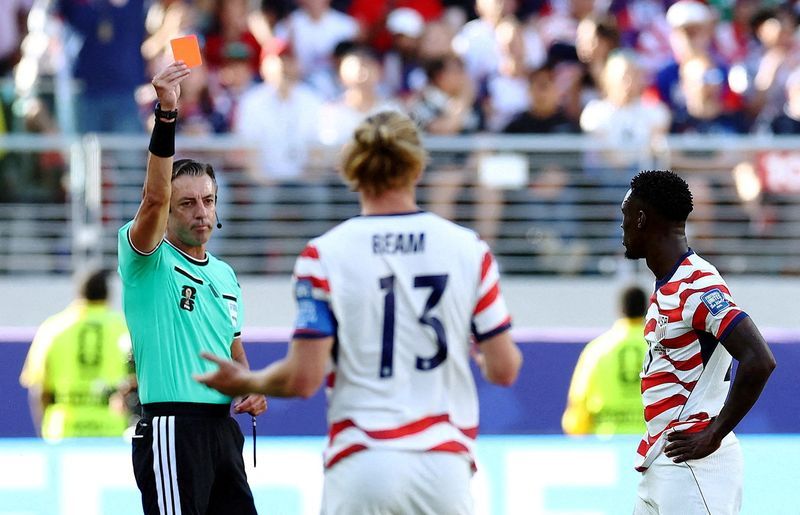
The Belgian football establishment and public have reacted with profound dismay to FIFA's sudden reversal of a red-card suspension for a United States player ahead of Monday's World Cup last-16 encounter in Seattle. The controversial decision, which freed the American striker to participate in the knockout fixture, has exposed deep fractures in perceptions of impartiality within international football's governing body and sparked accusations of political interference at the highest levels.
At the centre of the controversy lies FIFA President Gianni Infantino's decision to overturn a suspension following a personal appeal from US President Donald Trump. The intervention represents an extraordinary departure from standard disciplinary protocol in world football, where match officials' decisions and subsequent penalties have traditionally remained insulated from political pressure. By suspending the red-card ban—a sanction typically imposed to maintain competitive integrity following serious on-field violations—FIFA has fundamentally questioned whether its disciplinary mechanisms can withstand external political pressure.
Belgian citizens expressed their frustration in candid exchanges across Brussels. Therese Kpooubie, a resident of the capital, questioned the logic behind erasing a red-card punishment that had been issued for legitimate reasons. Her questioning cut to the heart of the matter: if a referee had deemed conduct serious enough to warrant ejection, on what basis could a political phone call override that professional judgment? For many Belgians, the reversal suggested that FIFA's disciplinary framework, once considered binding and immutable, had become subject to negotiation through channels outside the sport itself.
Bastien Noel, another Brussels resident, adopted a more pragmatic stance, acknowledging that Belgium must accept the decision while channelling their frustration into on-pitch determination. His perspective reflected a common sentiment among supporters who felt the injustice should serve as motivation rather than distraction. The narrative shifted from institutional grievance to sporting resolve—an attempt to transform administrative controversy into psychological fuel for Belgium's campaign.
Belgium's Deputy Prime Minister Maxime Prevot entered the political arena by issuing a formal statement expressing incredulity at the sequence of events. Prevot's intervention elevated the dispute beyond sporting circles into the realm of international relations and governance standards. By describing the decision as potentially flouting fundamental rules of football and sport, Prevot underscored the broader implications: if political figures could successfully lobby international sporting bodies to overturn disciplinary decisions, the entire framework governing competitive fairness would be compromised. The statement represented an official government position that transcended normal sporting discourse.
Washington's response came through Bill White, the US Ambassador to Belgium, who strenuously denied any improper interference by Trump. White's statement, distributed via Instagram, attempted damage control by repositioning Trump's actions as a courtesy gesture after the fact rather than an attempt to influence FIFA's deliberations. However, this characterisation struggled against widespread perceptions that the timing and nature of Trump's personal intervention had directly precipitated FIFA's decision. The ambassador's defensive posture only reinforced questions about what precisely had transpired behind diplomatic channels.
The incident illuminates the vulnerability of international sporting institutions to political pressure when high-stakes competitions intersect with geopolitical interests. FIFA, already facing perennial questions about its governance and decision-making processes, has now demonstrated that even core disciplinary functions remain susceptible to intervention from powerful national leaders. For Southeast Asian observers and other regional football federations, the episode raises unsettling questions about whether their own players and national teams can expect consistent, politically insulated treatment from international football authorities.
The controversy also exposes the tension between FIFA's aspirations as a neutral governing body and the persistent reality that it operates within a world of competing national interests and political influence. When world leaders personally engage with FIFA officials regarding player eligibility, the distinction between sport and politics collapses entirely. The precedent established by this intervention could fundamentally alter how national governments interact with international sporting bodies, setting expectations that political advocacy might successfully override disciplinary determinations.
For Belgium, the situation crystallised into a test of resilience and character. The Red Devils faced not merely a sporting challenge but a psychological obstacle created by what many perceived as institutional injustice. Supporters like Kpooubie channelled their anger into calls for team unity and determination, insisting that excellence on the pitch represented the only appropriate response to administrative failings off it. This collective rallying became a mechanism for transforming disappointment into competitive energy.
The broader implications extend across international football governance. If FIFA's disciplinary decisions can be reversed through presidential intervention, confidence in the organisation's independence and credibility suffers irreparable damage. For smaller football nations without comparable political leverage, the message is particularly troubling: access to FIFA's decision-making processes appears to correlate with geopolitical power rather than sporting merit or procedural legitimacy. This asymmetry threatens the fundamental principle that competitive football should operate according to uniform, transparent rules applied equally to all participants regardless of national political influence.

