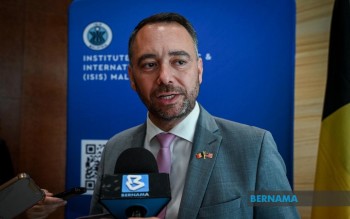
Belgium has identified Malaysia as a promising partner for advancing offshore wind energy development, with the European nation's deputy prime minister highlighting the sector as a cornerstone for bilateral cooperation during his inaugural visit to the country. Maxime Prévot, who holds the portfolios of Deputy Prime Minister and Minister of Foreign Affairs, European Affairs and Development Cooperation, outlined the collaboration opportunity while attending the 39th Asia-Pacific Roundtable in Kuala Lumpur on July 2. His visit marks the first official trip to Malaysia since taking office in February 2025, underscoring the importance Belgium places on deepening ties with the Southeast Asian region.
What makes Belgium's overture particularly significant is the nation's track record in transforming limited natural resources into a renewable energy powerhouse. Operating within just 60 kilometres of coastline, Belgium has nevertheless constructed offshore wind installations capable of generating two gigawatts of electricity for its domestic population. This achievement demonstrates that even geographically constrained countries can pioneer large-scale offshore renewable projects, a lesson potentially applicable to Malaysia's energy infrastructure planning. Prévot indicated that Belgium intends to substantially expand this capacity to between six and seven gigawatts within the coming years, an equivalent output to five or seven nuclear power plants, illustrating the scalability of offshore wind technology when properly implemented and resourced.
The emphasis on offshore energy reflects a broader strategic alignment between the two nations during a pivotal moment in the global energy transition. For Malaysia, the proposition carries particular weight given the country's substantial maritime resources and growing imperative to decarbonise its energy sector while maintaining economic competitiveness. Belgium's experience in developing, financing, and operating advanced offshore installations could provide valuable technical knowledge and best practices that Malaysian policymakers and energy sector stakeholders could adapt to local conditions. Beyond the wind sector itself, Prévot identified complementary areas of potential cooperation, including semiconductors, logistics, clinical trials, biotechnology research and development, and pharmaceuticals, suggesting a multifaceted economic engagement strategy rather than a single-sector focus.
The European Union's commitment to supporting regional energy infrastructure adds substantial financial and political weight to Belgium's bilateral overture. During his address at the roundtable forum, Prévot announced that the EU and its member states plan to mobilise €10 billion—equivalent to approximately RM46.5 billion at current exchange rates—under the Global Gateway Strategy specifically to support the ASEAN Power Grid and accelerate the region's transition away from fossil fuels. This funding mechanism represents more than symbolic support; it constitutes a concrete financial framework through which Malaysia and other Southeast Asian nations can access capital for renewable energy projects, grid modernisation, and related infrastructure development. The investment reflects the EU's strategic interest in supporting stable, sustainable growth throughout ASEAN while simultaneously addressing global climate imperatives.
The ASEAN Power Grid initiative itself represents a crucial piece of regional energy architecture, designed to enhance interconnectivity between Southeast Asian electricity networks and facilitate the sharing of renewable energy resources across borders. By channelling capital toward this objective, the EU positions itself as a long-term partner in the region's structural energy transformation rather than merely offering short-term technical assistance. For Malaysia, participation in such initiatives could yield dual benefits: access to clean energy sources from neighbouring countries with abundant hydroelectric or solar capacity, and opportunities to export surplus renewable generation as domestic capacity expands. The European approach emphasises sustainability not purely from an environmental perspective but as an integrated framework encompassing energy security, economic resilience, and local development benefits.
Belgium and Malaysia's existing economic relationship, while modest by global standards, provides a foundation for expanded cooperation. Total bilateral trade between the nations reached RM9.74 billion during 2025, with Malaysian exports comprising RM6.85 billion and Belgian imports accounting for RM2.89 billion. This trade balance reflects Malaysia's strong position in supplying commodities and manufactured goods to the Belgian market, though the relatively low figures suggest untapped potential for deepening commercial engagement. More significantly, Belgian-backed investments in Malaysia totalled RM5.1 billion across 67 approved projects as of 2025, generating approximately 4,605 jobs. These figures indicate that Belgian enterprises view Malaysia as a viable investment destination, though expansion into energy sector collaboration could substantially increase both project volumes and employment creation.
The timing of Prévot's visit coincides with Malaysia's own strategic review of its energy pathway and climate commitments. The country has set targets for renewable energy deployment and carbon emissions reduction, creating receptive conditions for partnership discussions with technologically advanced nations and multilateral institutions. Belgium's willingness to share offshore wind expertise and the EU's financial commitment signal that Europe regards Southeast Asia, and Malaysia specifically, as regions deserving serious investment in the clean energy transition. This contrasts with earlier periods when many developed economies treated clean energy investment in the Global South as peripheral to their core concerns.
The offshore wind sector carries particular relevance for Malaysia given the nation's extensive coastline and maritime exclusive economic zone. Unlike solar or terrestrial wind installations, which face constraints related to land availability and agricultural competition, offshore wind farms can be positioned to minimise environmental and social disruption while capturing consistent wind resources. Malaysia's monsoon patterns and ocean currents present both challenges and opportunities for offshore wind development, and Belgian expertise in operating wind farms in variable marine conditions could prove invaluable. Furthermore, the technical, regulatory, and supply chain capabilities required to develop and maintain offshore installations offer pathways for local workforce development and technological capability building within Malaysia's energy and engineering sectors.
From a geopolitical perspective, Belgium's initiative reflects broader European efforts to strengthen economic and strategic ties throughout Indo-Pacific region, partly in response to shifting global power dynamics. By positioning itself as a knowledge and capital provider for Southeast Asian energy transitions, Europe can maintain influence in critical infrastructure development and demonstrate commitment to rules-based cooperation on climate matters. For Malaysia, engaging with European partners on energy infrastructure provides strategic diversification beyond reliance on any single external actor while tapping into established European technologies and financing mechanisms. The multilateral framework of the ASEAN Power Grid ensures that no single bilateral relationship dominates the region's energy future.
The success of any Belgium-Malaysia offshore energy partnership will likely depend on several factors beyond initial diplomatic enthusiasm. These include clarity around regulatory frameworks, technology transfer arrangements, workforce training programmes, and financing terms acceptable to both Malaysian stakeholders and Belgian investors. Malaysia's government will need to assess how offshore wind capacity fits within broader energy planning objectives, including targets for renewable deployment, baseload power reliability, and grid stability. Questions regarding environmental impact assessments, maritime jurisdiction coordination, and supply chain localisation will require detailed negotiation. Nevertheless, Prévot's visit and the concrete EU financial commitment through the Global Gateway Strategy suggest that Belgium intends to move beyond preliminary discussions toward substantive project development.
Looking forward, successful collaboration between Belgium and Malaysia on offshore energy could establish a template for broader Southeast Asian engagement with European clean energy expertise. Should initial partnerships prove viable and generate demonstrable benefits—in terms of energy capacity, employment, and technical capability development—other ASEAN members might seek similar partnerships. This could accelerate regional progress toward climate targets while ensuring that the energy transition occurs through partnerships respecting local sovereignty and development priorities. For Malaysia specifically, the opportunity to leverage Belgian expertise and EU capital represents a pragmatic approach to bridging the technology and finance gaps that often constrain renewable energy deployment in developing economies.

