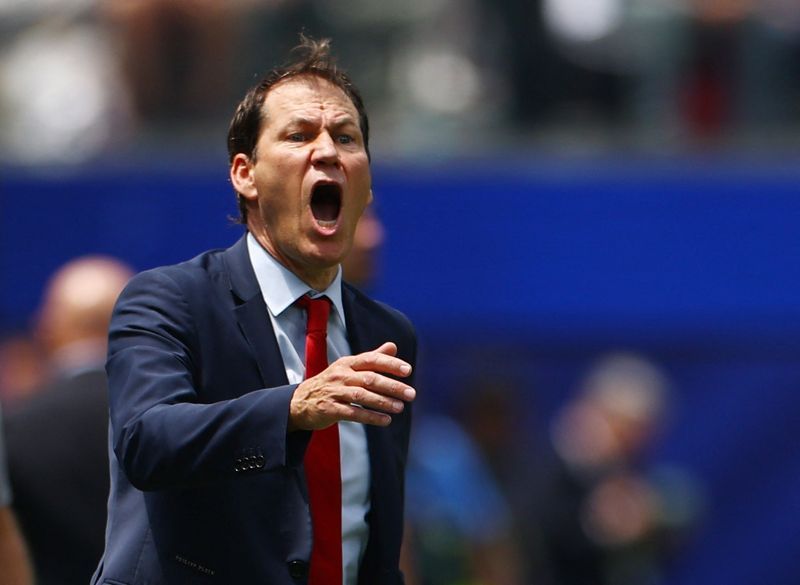
Belgium coach Rudi Garcia finds himself at a crossroads following his controversial substitution of first-choice goalkeeper Thibaut Courtois during Friday's World Cup quarter-final loss to Spain. The incident has crystallized growing doubts about his suitability to lead the national team beyond the tournament, with federation officials set to conduct a comprehensive review of his tenure before his contract expires later this month.
The decision unfolded in the 71st minute when Garcia withdrew Courtois despite the goalkeeper's insistence that he could remain on the pitch despite experiencing minor discomfort in his leg. Garcia's rigid interpretation of his team's fitness protocols dictated that only fully fit players could participate. When Courtois expressed confidence in his ability to continue, the coach overruled him, introducing Senne Lammens as a replacement. That decision proved catastrophic—Lammens failed to secure a low shot from Pau Cubarsi in the 86th minute, allowing Spain substitute Mikel Merino to capitalize and secure a 2-1 victory.
The substitution immediately drew withering criticism from Belgian media analysts and former professionals. Peter Vandenbempt, a prominent radio commentator, articulated the frustration felt across Belgium in scathing terms, questioning how a coach could remove arguably the world's finest goalkeeper from such a high-stakes encounter purely because his distribution range might be compromised. Vandenbempt's incredulous tone reflected a broader sentiment that Garcia's decision prioritized abstract principles over the realities of competitive football at its highest level. The consensus among observers was that a player of Courtois' calibre and experience should retain agency over his own physical readiness, particularly during knockout tournament football.
Garcia, however, remained unmoved by the backlash, articulating a coherent philosophical framework to justify his actions. He emphasized that from the World Cup's outset, he had established a non-negotiable principle: only players operating at full physical capacity would take the field. This standard, he contended, applied uniformly regardless of a player's reputation or importance to the team. Courtois had functioned as a crucial component of Belgium's attacking strategy, delivering long distribution to forwards Charles De Ketelaere and Romelu Lukaku. Garcia acknowledged this tactical necessity but insisted that preserving Courtois' long-term health superseded short-term competitive advantage. The coach expressed no regret about the substitution, framing it as a calculated medical decision rather than a tactical misstep.
The goalkeeper controversy has become emblematic of deeper concerns about Garcia's management approach that will inevitably surface during his imminent contract review. The 62-year-old Frenchman, appointed in early 2025, was recruited specifically to restore stability and morale following Domenico Tedesco's tenure, which critics characterized as emotionally draining and tactically uninspiring. Garcia's mandate was ambitious: revitalize a squad in transition while delivering tangible World Cup results. By several metrics, he has succeeded—Belgium secured Nations League top-division status, qualified for the World Cup, and reached the knockout stage.
Yet his record of 12 wins, six draws, and two defeats across 20 internationals masks significant inconsistency during the tournament proper. Belgium's path to the quarter-finals was markedly uneven, with the team requiring late-stage dramatics to progress. They drew with both Egypt and Iran before defeating New Zealand atop their group, hardly the commanding performance expected from a traditional football powerhouse. Their last-32 encounter against Senegal proved equally unconvincing—Garcia withdrew his leading players while trailing 2-0, only for his substitutes to engineer an improbable comeback. Whether this reversal reflected Garcia's tactical acumen or Senegal's defensive collapse remains genuinely unclear.
Conversely, Garcia can point to notable achievements that demonstrated his team's capabilities. Belgium's 4-1 demolition of co-hosts the United States showcased devastating attacking prowess, while his integration of emerging talents—notably Nathan Ngoy and Nicolas Raskin—injected fresh energy into the squad. These younger players delivered impressive performances throughout the tournament, suggesting Garcia has begun a meaningful reconstruction process. This generational transition was always intended to culminate in genuine competitiveness at the 2028 European Championship, positioning him as a long-term architect rather than a short-term custodian.
The federation's decision regarding Garcia's future will ultimately reflect broader questions about Belgian football's strategic direction. The nation possesses undeniable talent and infrastructure but has endured a curious decline in recent international cycles. Whether Garcia represents a genuine solution or merely a transitional figure remains contested. His tactical inflexibility and sometimes questionable in-game management decisions have attracted mounting criticism, though these same decisions occasionally produced positive results. The Courtois substitution crystallized these contradictions—a decision internally consistent with his stated principles yet externally perceived as rigid and counterproductive.
Belgian federation officials face a consequential choice. They could renew Garcia's contract and commit to his longer-term vision, betting that tournament football's inherent unpredictability masked genuine progress. Alternatively, they could pursue alternative management, though identifying a sufficiently qualified replacement operating at elite level represents a significant challenge. The World Cup's closing week will prove decisive, not merely for Belgium's remaining matches but for establishing the fundamental direction Belgian football will pursue across the remainder of this decade.

