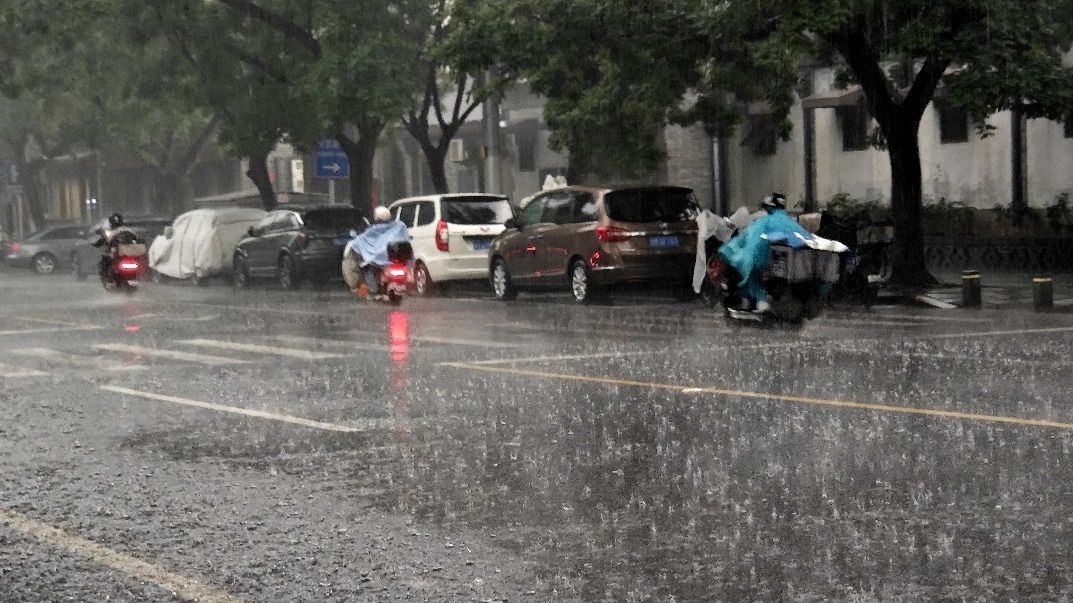
China's capital Beijing has activated heightened weather alert protocols following the issuance of an Orange-level rainstorm warning on Thursday afternoon, marking the first such alert since the commencement of this year's flood season. The Beijing meteorological observatory released the alert at 1.30 pm, triggering a coordinated emergency response across multiple city departments. Simultaneously, the Beijing flood control office elevated its readiness to Level-II status, indicating preparations for potentially severe weather impacts across the municipality.
The meteorological alert forecasts an extended period of heavy precipitation beginning at 2.00 pm Friday and continuing through 8.00 am Sunday. Particular concern centres on several vulnerable districts including Huairou, Miyun, Pinggu, Shunyi and Fangshan, where authorities anticipate torrential downpours. The intensity projections are sobering: some localised areas may experience hourly rainfall rates exceeding 70 millimetres, whilst cumulative totals over a full 24-hour cycle could surpass 150 millimetres. These figures represent substantial precipitation events capable of overwhelming drainage infrastructure and triggering secondary hazards.
The geographical distribution of expected rainfall carries specific implications for Beijing's diverse terrain. Mountainous and hilly regions face elevated meteorological risks, with steep slopes and saturated ground potentially creating conditions for landslides and debris flows. Simultaneously, low-lying urban and peri-urban areas confront elevated waterlogging threats as surface water drainage systems become overwhelmed. This dual hazard profile necessitates differentiated preparedness strategies across the city's varied topography, from vulnerable rural highlands to densely populated metropolitan flatlands.
In response to the forecast, authorities have implemented a comprehensive set of precautionary measures designed to minimise public exposure to dangerous weather conditions. Residents are instructed to curtail outdoor activities and maintain constant awareness of updated official weather communications. Transport authorities recommend shifting from private vehicle usage toward public transportation networks, both to reduce traffic congestion that could hinder emergency vehicle movements and to concentrate commuters in safer environments. This guidance reflects lessons learned from previous flooding events where congested roadways hindered rescue operations.
The labour and education sectors have been explicitly directed to implement flexible arrangements. Enterprises and public institutions are encouraged to adopt staggered work schedules or temporary remote working protocols where feasible, reducing unnecessary pedestrian and vehicular traffic during peak rainfall hours. Schools have been instructed to suspend in-person instruction, practical training programmes and outdoor educational activities, with administrators empowered to make decisions based on real-time conditions in their specific localities. Such measures recognise that educational disruption, while disruptive, represents a necessary trade-off against student and staff safety.
Public space management has become particularly stringent under the alert conditions. Citizens face strong warnings against visiting recreational areas featuring mountainous terrain or water bodies, where flash flooding and terrain collapse create life-threatening scenarios. Underground commercial complexes present additional hazard categories, as basement-level retail spaces, parking facilities and subway stations face inundation risks during heavy rainfall. Geological hazard zones—areas identified as prone to landslides, rockfalls or subsidence—remain strictly off-limits. The prohibition extends to proximity with rivers and drainage channels, which transform into raging torrents during peak precipitation events.
Economic and construction activities across the capital have been effectively halted by the alert conditions. All outdoor operations and construction work face mandatory suspension, preventing workplace injuries whilst simultaneously removing obstacles to emergency vehicle access on city streets. This economic pause, whilst costly in the short term, represents prudent risk management given that construction sites present multiple hazards during severe weather, including unsecured materials, exposed excavations and equipment failures.
Beijing's four-tiered weather warning hierarchy positions this Orange alert as the second-most severe classification, exceeded only by the Red alert designation. This ranking system reflects China's meteorological assessment framework, with Orange warnings typically issued for severe weather events with significant population impact. Yellow and Blue alerts, occupying lower tiers, apply to less severe conditions. The activation of an Orange alert therefore signifies official recognition of genuinely dangerous atmospheric conditions requiring immediate, widespread public response rather than routine precautions.
For Malaysian and Southeast Asian observers, Beijing's meteorological governance and emergency response coordination offer pertinent lessons regarding urban flood management in densely populated regions. Beijing's pre-event mobilisation across multiple agencies—from weather services to flood control authorities, transport departments, labour ministries and education authorities—demonstrates institutional integration increasingly relevant as climate change intensifies extreme rainfall events across Asia. The capital's emphasis on public communication, early alert systems and mandatory activity suspension reflects best-practice approaches that Asian cities are progressively adopting as precipitation intensification becomes more frequent.
The specific precipitation thresholds cited in Beijing's alert—70mm hourly and 150mm daily—establish meteorological benchmarks recognising that modern urban infrastructure faces escalating challenges from intensifying rainfall patterns. Southeast Asian cities, particularly in Malaysia where monsoon seasons regularly generate heavy precipitation, confront comparable drainage capacity constraints. Beijing's visible mobilisation of resources and public cooperation mechanisms offers instructive precedent for regional metropolitan centres developing climate resilience strategies.
As the alert unfolds through the weekend, Beijing's emergency management response will likely generate practical data regarding contemporary urban flood preparedness, evacuation protocols and infrastructure performance under stress. The coordination between meteorological forecasting, flood control authorities and sectoral emergency procedures provides real-world testing of integrated risk management systems. Such practical experience, when documented and analysed, contributes valuable knowledge to Asia's expanding community of cities confronting intensifying precipitation events.

